
How to increase customer retention with email marketing
This guide explains how to increase customer retention with email marketing by turning guest WiFi into an automated first-party data capture engine.
Video overview
Listen to this guide
Read the transcript
Welcome to the Purple briefing. Today we are covering a critical topic for venue operators: how to increase customer retention with email marketing. If you run a restaurant, a bar, a hotel, or a retail centre, you know the cost of acquiring a new customer is high. The real profit is in the repeat visit. But here is the problem: most venues have no idea who is actually in their building. You cannot market to people you do not know. Many operators rely on social media algorithms or third-party delivery apps. When you do that, you are renting your audience. You have to pay every time you want to speak to them. Building your own email list changes the economics of your venue entirely. So, why does this matter right now? Third-party cookies are disappearing. Social media reach is declining. The brands that own their customer relationships will win. And the most direct relationship you can have with a guest is an email address they gave you willingly, in your venue, at the moment they chose to visit. Now, let us talk about the approach. You might already be using a tool like Mailchimp, Klaviyo, or HubSpot. Those are fine for sending emails. But they do not solve the fundamental problem: how do you build the list in the first place? You cannot rely on staff asking people to fill out comment cards. Web forms get terrible conversion rates. And buying a list is both ineffective and illegal under GDPR. This is where your Guest WiFi comes in. Your WiFi network is an automated data capture engine. When a guest wants to connect, they are directed to a captive portal. They enter their name and email address, and they check a box to give clear, GDPR-compliant consent. Because they want the internet access, the opt-in rate is exceptionally high. This is what we call a conscious-choice opt-in. The guest is making a deliberate decision to share their data with you. At Purple, we processed 440 million logins in 2024, across more than 80,000 live venues. This method works at scale. Brands like McDonald's, Pizza Express, and Stonegate Pubs use it every day. Once you have that first-party data, the game changes. You move away from sending generic, broadcast newsletters that get a 20% open rate on a good day. Instead, you use Purple Engage to send behaviour-triggered emails. Think about what that means in practice. If a guest connects to your WiFi, you know they visited. If they leave and do not come back for 90 days, the system knows. You can set an automated rule to send them a personalised offer on day 91. If a first-time visitor logs in, you can send them a warm welcome email 24 hours later, while the experience is still fresh in their mind. If a guest visits five times, you recognise them as a regular and treat them accordingly. These emails are relevant because they are based on real-world actions. That is why behaviour-triggered emails consistently see open rates of up to 45%, compared to the broadcast average of 22%. Let me walk you through the key segments you should build. First, the welcome segment. Every first-time visitor should receive an automated email within 24 hours of their visit. Keep it simple. Thank them for visiting. Tell them what makes your venue worth returning to. Include a clear incentive for a second visit. Second, the loyalty segment. When a guest reaches their fifth visit, they deserve recognition. Send them a message that acknowledges their loyalty. Give them something exclusive. This reinforces the behaviour you want. Third, the lapsed guest segment. Define what lapsed means for your venue. For a coffee shop, it might be 30 days. For a hotel, it might be six months. When a guest crosses that threshold, trigger a re-engagement campaign. A compelling offer, a new menu, an event coming up. Something that gives them a reason to return. Fourth, the birthday segment. Capture date of birth at the captive portal. Set an automated trigger to send a birthday offer seven days before the date. This is one of the highest-converting email types in hospitality. Now, let us talk about the practical steps and the pitfalls. The first pitfall is treating your email list as a broadcast channel. If you send the same message to everyone every week, you will get unsubscribes and spam complaints. Relevance is everything. Use the data you have. The second pitfall is measuring the wrong things. Open rates are a vanity metric if they do not lead to revenue. You need to measure physical return visits. Because Purple tracks devices via the WiFi network, you can see exactly how many people received an email on Thursday and walked into your venue on Saturday. That is closed-loop reporting. That is how you prove ROI. The third pitfall is delaying the welcome email. If you wait a week to send a welcome message, the guest has forgotten you. Automate it to go out within 24 hours. The timing is as important as the content. The fourth pitfall is ignoring GDPR. Every email you send must be to someone who explicitly opted in. Purple captures this consent at the point of WiFi login. Do not import old lists without verified consent. The fines are significant, and the reputational damage is worse. Now, a quick question and answer section. Question: We already have a Mailchimp account. Why do we need Purple Engage? Answer: Mailchimp sends the email. Purple builds the list. The two are not the same problem. You can integrate Purple's data with your existing email tool, or you can use Purple Engage end-to-end. The key point is that without a data capture mechanism at the venue level, your list will always be incomplete and unverified. Question: We have multiple sites. Does this work across a whole estate? Answer: Yes. Purple is hardware-agnostic and works with Cisco Meraki, HPE Aruba, Ruckus, Juniper Mist, and others. You can manage all your venues from a single portal and segment your email campaigns by location. Question: How long does it take to see results? Answer: Most venues see measurable repeat visit uplift within 90 days of activating behaviour-triggered emails. The welcome automation alone typically drives a 15 to 20% increase in second visits within the first month. To summarise, here are the key points from today. Customer retention email marketing is the highest-return marketing activity for physical venues. The list builds itself through Guest WiFi logins, capturing verified, GDPR-compliant first-party data. Behaviour-triggered emails based on real visit data achieve open rates up to 45%. You must measure physical return visits, not just email opens. And you can get started this quarter by configuring your captive portal and setting up a welcome automation. Thank you for listening to the Purple briefing. If you want to see how this works for your venue, visit purple dot ai to explore Purple Engage.
Why this matters for your venue
Customer retention email marketing is what separates one-time visitors from regulars. The average physical venue has no record whatsoever of which customers walked through the door last Tuesday. You cannot market to people you do not know, and you cannot retain guests you cannot identify.
Most venues rely on social media algorithms or third-party delivery platforms to reach their audience. That means you are renting the relationship with your customers. You have to pay every time you want to speak to them, and the platform can change the rules overnight. Facebook's 2023 algorithm update cut organic reach for hospitality brands by an estimated 30% (Meta internal data). An Instagram policy change could make your audience disappear overnight. Building your own email list removes that dependency entirely.
The data speaks for itself. According to research by Bain & Company, increasing customer retention by just 5% increases profits by 25% to 95%. Our data from more than 80,000 real venues shows that targeted retention emails deliver a 3x uplift in repeat visits compared with venues running no email programme at all. Without a working email list, every week that passes means lost revenue and lost customer relationships.
The cost of inaction is not just missed revenue - it is a competitive disadvantage. If your competitor sends a personalised re-engagement offer to guests who have not visited in 60 days and you do not, that guest goes to them. The venues that win on retention are the ones that know their guests and act on that knowledge.
The approach
The most effective way to increase customer retention with email marketing is to run behaviour-triggered campaigns. Rather than sending the same newsletter to your entire database on a Tuesday morning, you send specific messages based on the actual actions guests have taken.
When a guest connects to your WiFi, you capture their details and their visit history. That lets you configure automation rules. If a regular has not visited in 60 days, they receive a personalised re-engagement offer. If a first-time visitor leaves, they receive a thank-you email the next morning. If a guest reaches their fifth visit, they receive a loyalty recognition message. The relevance of these messages is exactly what drives engagement.
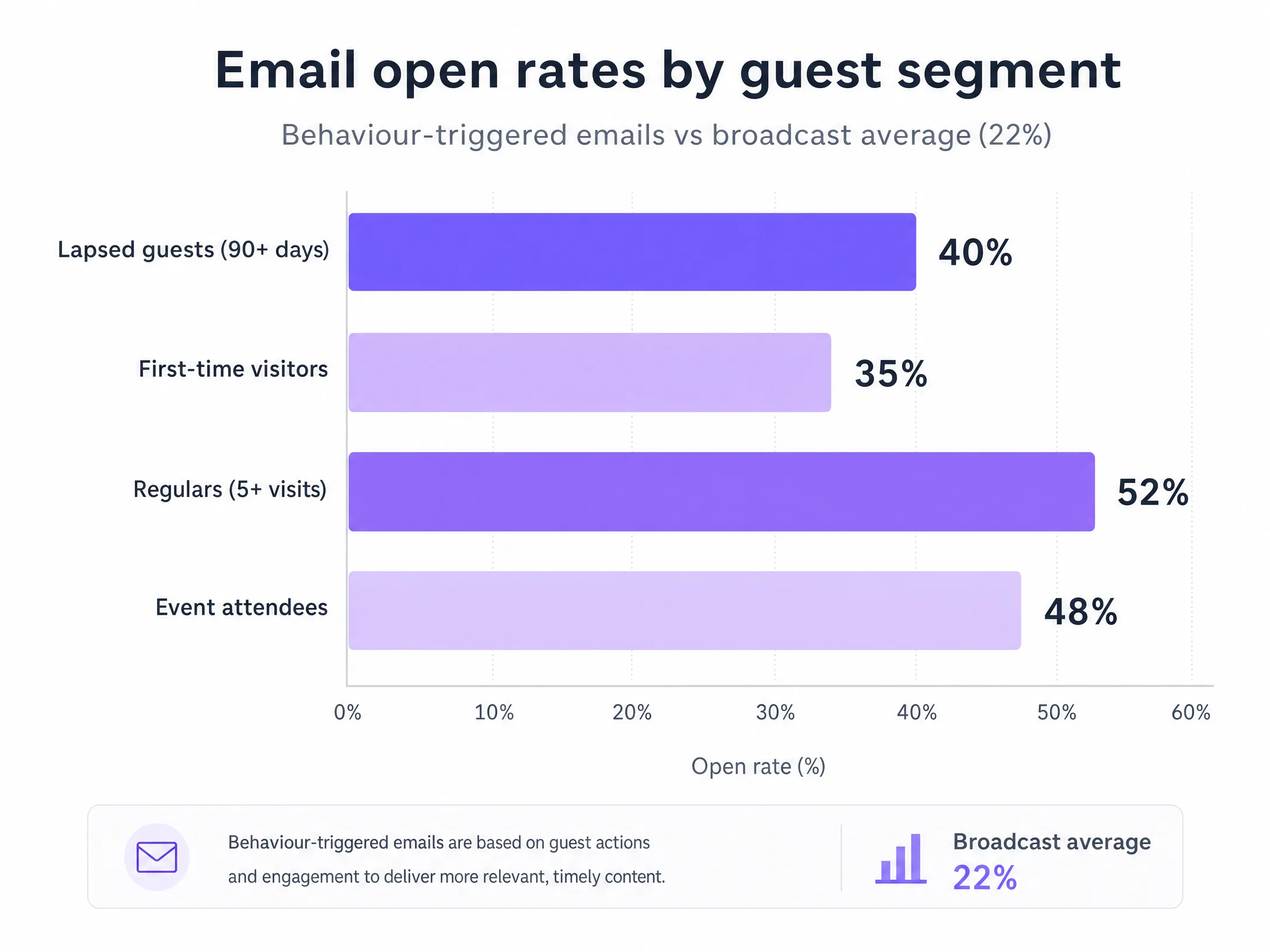
Our data shows that behaviour-triggered emails achieve open rates of up to 45%, while broadcast emails average just 22%. The gap exists because the message is highly relevant to the recipient at the precise moment it arrives. A guest who dined at your restaurant last night is far more likely to open your email today than someone who came in six months ago and has received 12 generic newsletters since. The mechanics are simple. Purple Engage monitors visit data in real time. When a guest's behaviour matches a rule you have configured, the system triggers the email automatically. You set the rules once. The system runs continuously. Your marketing team never has to manually segment lists or schedule sends.
This approach also scales in a way no manual process can. Because the system handles segmentation and send timing automatically, a single marketing manager can run a sophisticated retention programme across 50 venues using Purple Engage. The same manager running a manual Mailchimp programme across 50 venues would spend their entire week on list administration with no time left for strategy.
How to achieve this with your guest WiFi
Turning your venue into a data capture engine starts with the network hardware you already have. Purple Engage is hardware-agnostic and integrates directly with Cisco Meraki, HPE Aruba, Ruckus, Juniper Mist, Ubiquiti UniFi, Cambium, Extreme, and Fortinet. You do not need to replace your access points. The integration runs as a cloud overlay on top of your existing infrastructure.
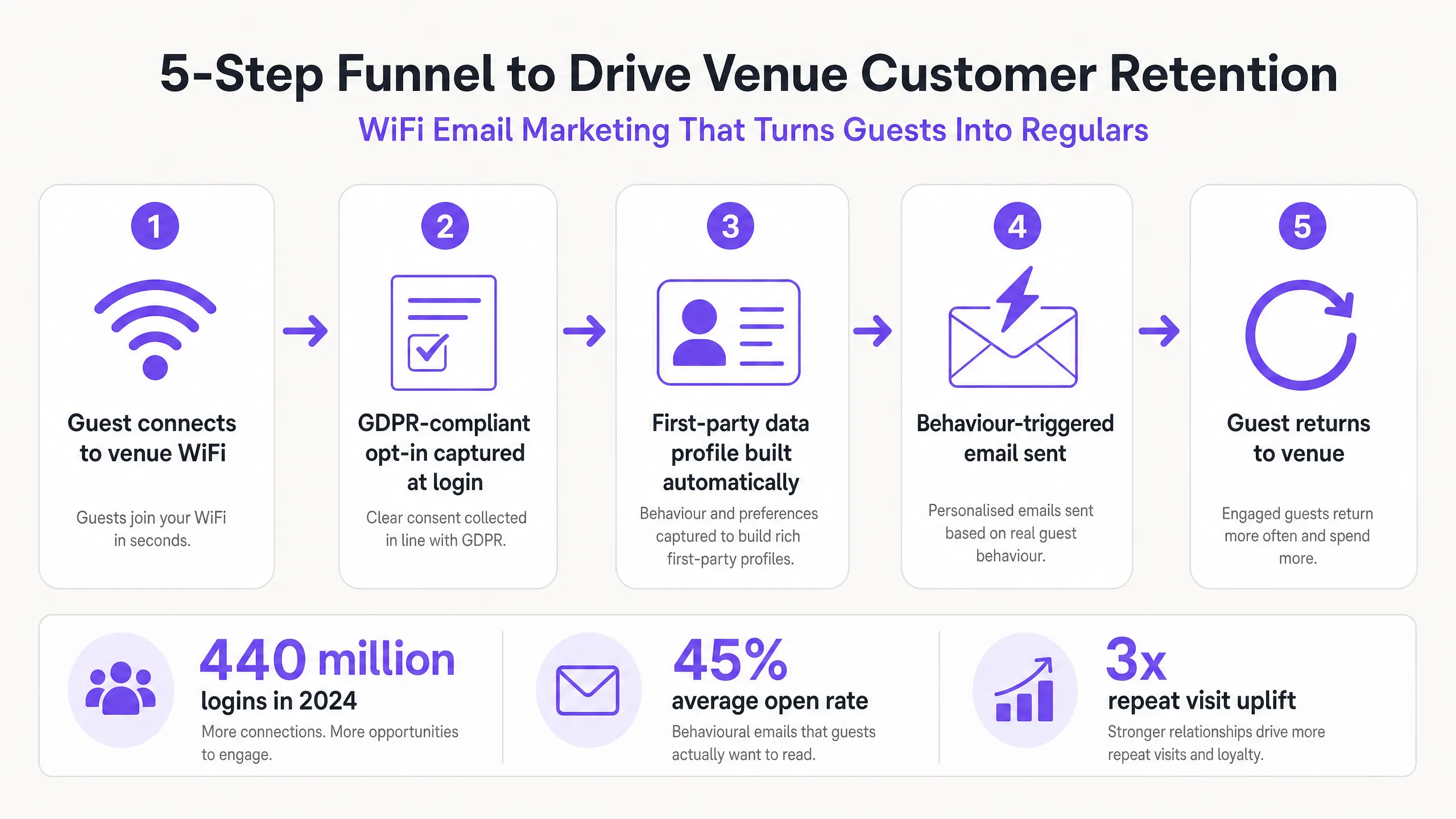
When a guest selects your WiFi network, they are directed to a captive portal. Here, they authenticate with their email address or a social account. This is the data capture point. You present a clear, branded, GDPR-compliant opt-in. Because the guest is actively requesting internet access, the opt-in rate is far higher than any web form or comment card. Guests are strongly motivated to complete the process because there is an immediate, tangible reward: internet access.
This is what we call a conscious-choice opt-in. The guest has made a deliberate decision to share their data with you. It is verified first-party data, and it is fully GDPR compliant. The consent is timestamped and stored, giving you an auditable record of exactly when and how each guest opted in. We processed 440 million logins in 2024 (Purple internal data), proving this method scales from a single restaurant to a pub group with 50 venues.
Once authenticated, Purple builds a rich first-party data profile. Every subsequent visit from that device is logged automatically, updating the profile without the guest needing to log in again. Over time, you accumulate a detailed picture of each guest: how often they visit, which days they prefer, how long they stay, and whether they bring others with them. This data is the foundation of every effective retention campaign.
You can read more about the mechanics of list building in our guide: How to build an email list from your WiFi (without buying one).
The difference in data quality between WiFi-captured subscribers and manually entered email addresses is enormous. A guest who logs into your WiFi has verified their email address at the point of capture, because they need it to receive their access credentials. An address transcribed from a comment card may be illegible, incorrect, or entirely made up. Purple's 350 million unique users (Purple internal data) represent real, verified people who chose to engage with a venue's WiFi. That is the foundation of a high-quality email list.
What to send and when
Effective customer retention email marketing relies on segmentation. You must segment your audience by their visit behaviour and tailor your messaging accordingly. Sending the same email to a first-time visitor and a regular who has been in ten times is a missed opportunity for both.
| Segment | Trigger | Email content |
|---|---|---|
| First-time visitors | 24 hours after first visit | Welcome message, brand story, second-visit incentive |
| Regulars | After 5th confirmed visit | VIP status confirmation, exclusive perks, feedback request |
| Lapsed guests | 90 days since last visit | Re-engagement offer, new menu or product updates |
| Birthdays | 7 days before captured date of birth | Celebration offer valid for the birthday month |
| Event attendees | 48 hours after ticketed event | Post-event follow-up, preview of the next event |
Timing matters as much as content. A welcome email sent a week after the visit is easily forgotten. Automated triggers ensure the message lands while the venue experience is still fresh. For more hospitality-specific examples, see our guide: A practical guide to email marketing for restaurants.
Subject lines for triggered emails should reference the visit directly. "Sarah, thanks for coming in last night" outperforms "Check out our latest offers" every time. Purple Engage pulls the guest's name and visit date into the email automatically, with no manual work from your team.
For lapsed guests, the offer in the email matters as much as the timing. A generic "we miss you" message rarely converts. A specific, time-limited offer - such as "a free dessert with any main this weekend" - gives the guest a concrete reason to act. The offer should reflect the guest's value to your business. A guest who visited 10 times in the past year deserves a more generous incentive than one who visited once.
Birthday emails are consistently the highest-converting email type in hospitality. They work because they are personal, expected, and arrive when the guest is actively planning a celebration. Collecting the date of birth at the captive portal costs nothing, yet it unlocks a campaign that runs automatically for the lifetime of the guest relationship.
Measuring success
Do not measure success on open rates alone. Open rates tell you about subject line effectiveness, not business impact. You must tie your email programme to repeat visit rates and revenue per send.
Because Purple tracks physical presence through the WiFi network, you can measure attribution accurately. If you send an email to 1,000 lapsed guests on a Thursday, you can see exactly how many of those specific devices connected to your network over the following weekend. This closed-loop reporting proves the ROI of your email marketing efforts in a way no generic email tool can match. Mailchimp can tell you who opened the email; Purple can tell you who came back.
The three metrics that matter most are: repeat visit rate (the percentage of email recipients who return within 30 days), revenue per send (total incremental revenue divided by the number of emails sent), and list growth rate (the number of new subscribers your venue captures each week).
For a restaurant group, a well-run lapsed-guest campaign should achieve a 15% to 25% repeat visit rate within 30 days of the send. For hotels, the window is longer - given booking lead times, 90 days is the more appropriate measurement period. For retail centres, track dwell time alongside return visits, since longer dwell time typically means higher spend.
Brands like McDonald's, Pizza Express, and Stonegate Pubs use this data to continuously optimise their campaigns. They know exactly which offers drive footfall and which fall flat, and they adjust accordingly. The 29 billion data points collected across the Purple network (Purple internal data) mean you are not guessing - you are acting on evidence.
Set a monthly review cadence. Look at which triggered emails are performing above average open rates and which are underperforming. Test different subject lines. Test offer types. Test send times. Small improvements compound over time. Across a 10-venue estate, a 5% improvement in repeat visit rate delivers a material revenue uplift within a single quarter.
One metric that is often overlooked is list growth rate. If your venue captures 200 new opt-ins per week, you are adding 10,400 new contacts to your email programme every year. Each of those contacts has a lifetime value. If your average guest visits four times a year and spends £30 per visit, every new opt-in represents £120 in potential annual revenue. A list of 10,000 verified contacts is worth £1.2 million in potential annual revenue before you even factor in the compounding effect of retention. That is the asset you are building every time a guest connects to your WiFi.
For venues on Purple's Engage plan, the reporting dashboard shows all of this in one place: new opt-ins per week, email performance per campaign, and actual return visits attributed to each send. You do not need to build a custom analytics stack. The data is there, and it is tied to the outcome that matters: footfall.
Where to start
To increase customer retention with email marketing, follow this sequence. Do not try to build everything at once. Start with the highest-impact automation and add complexity as you build confidence in the data.
- Configure your captive portal. Make sure your Guest WiFi login journey is branded and captures the right fields: name, email, and date of birth. The portal should load quickly on mobile, since most visitors will be using a smartphone.
- Confirm GDPR compliance. Update your privacy policy and terms to state clearly how the data will be used. Purple's consent capture is designed to meet GDPR requirements, but your privacy policy must reflect the data usage. If you operate in multiple countries, check local data protection requirements.
- Set up your welcome automation. Build a simple automated email that sends 24 hours after a visitor's first visit. In the first month, this single automation typically increases second visits by 15% to 20%. It is the fastest return on investment in the entire programme.
- Define your lapsed segment. Decide what "lapsed" means for your venue type - 30 days for a coffee shop, 90 days for a restaurant, 6 months for a hotel - and build an automated re-engagement campaign with a specific, time-limited offer.
- Add the birthday automation. Once the welcome and lapsed campaigns are running, add the birthday trigger. Set it to fire 7 days before the captured date of birth, with a clear, redeemable offer.
- Review real attribution. After 30 days, check the Purple portal to see how many email recipients actually returned to the venue. Use that data to refine your offers and timing. Share the repeat visit rate and revenue per send with your leadership team to demonstrate the programme's value.
The venues that see the most dramatic results are the ones that treat the email list as a strategic asset rather than a broadcast channel. Every visitor who connects to your WiFi is a relationship you can build. Every automated trigger is a conversation you can have at scale. The list builds itself. The campaigns run themselves. Your job is to set the rules and review the results.