
Email automation for hotels: a practical guide
Email automation for hotels turns guest WiFi logins into verified, GDPR-compliant first-party data. This guide shows marketing directors and owner-operators how to build an email list that builds itself, driving repeat visits and higher revenue per send.
Video overview
Listen to this guide
Read the transcript
Email automation for hotels: a practical guide - Podcast Script Running time: approximately 10 minutes Voice: UK English, professional marketing consultant tone --- [INTRO - 0:00 to 1:00] Welcome to the Purple Engage marketing series. I'm your host, and today we're talking about something that most hotel marketing directors know they should be doing better - email automation for hotels. Not the basics. Not "send a booking confirmation." I mean a properly structured, automated guest email programme that builds itself from the moment a guest connects to your WiFi, and keeps working long after they've checked out. Here's the number that matters: email marketing in hospitality delivers an average return of around thirty-eight pounds for every pound spent. Some properties running well-targeted lifecycle campaigns report returns of a hundred pounds or more per pound invested. And yet, most hotels are leaving the majority of that on the table because their guest list is patchy, their automations are basic, and their data is stale. In the next ten minutes, I'll walk you through why the list is the problem, how guest WiFi solves it, what to actually send and when, and how to measure what's working. Let's get into it. --- [WHY IT MATTERS - 1:00 to 2:00] The fundamental challenge in hotel email marketing is the list. Not the platform, not the templates, not the subject lines. The list. Most hotels collect guest email addresses through the booking process. That sounds fine until you realise that OTA bookings - Booking.com, Expedia, and the rest - often mask or withhold the guest's real email address. You get a proxy address, or nothing at all. Walk-in guests? Nothing. Conference delegates? Nothing. Restaurant guests staying for dinner? Nothing. Manual collection at the front desk yields somewhere between twenty and forty-five percent invalid addresses, according to industry data. That's not a list. That's a liability. The result is that the average hotel's CRM contains a fraction of the guests who actually pass through the property. And the guests who are on the list are there because they booked direct - which means they're already your most loyal segment. You're preaching to the converted and ignoring everyone else. The fix is not to buy a list. Bought lists are a GDPR violation waiting to happen, and they perform terribly. The fix is to build the list from the physical visit itself. --- [THE APPROACH - 2:00 to 7:00] This is where guest WiFi changes everything. When a guest connects to your hotel's WiFi - and the vast majority do, research consistently shows over ninety percent of hotel guests connect to the property WiFi during their stay - they pass through a captive portal. That's the branded login page they see before they get internet access. At that moment, you have a conscious-choice opt-in. The guest is actively choosing to connect. They enter their email address, they tick the marketing consent box, and they get online. That's a GDPR-compliant, verified, first-party data point. Not a scraped address, not a purchased contact, not a proxy from an OTA. A real person, in your building, who has just told you they're happy to hear from you. Purple's Engage platform sits as a cloud overlay on your existing WiFi hardware - whether that's Cisco Meraki, HPE Aruba, Ruckus, Juniper Mist, or Ubiquiti UniFi - and captures that data automatically. Every login. Every visit. The profile builds over time, so a guest who stays three times a year accumulates three data points, and you can see their visit frequency, their preferred room type if you've integrated with your PMS, and their engagement with previous emails. That's the difference between Purple Engage and a tool like Mailchimp or Klaviyo. Mailchimp will send your campaign brilliantly. But it cannot build your list. It has no idea who walked through your door today. Purple builds the list from the physical visit, and then the automation does the rest. Now, what does that automation actually look like? There are six stages in a well-structured hotel email automation programme. Stage one: the welcome email. This fires within one hour of the guest connecting to WiFi. Open rates on welcome emails in hospitality sit around fifty percent - that's roughly double the average for a standard campaign. The content is simple: a warm welcome, the WiFi password if they need it again, and one relevant offer. Spa, restaurant, late checkout. One thing. Not five. Stage two: the pre-arrival email. If you've integrated with your PMS - your property management system - you can trigger an email forty-eight hours before a booked guest's arrival date. This is your upsell engine. Room upgrades, early check-in, restaurant reservations. Pre-arrival emails consistently outperform post-stay emails on click-through rate because the guest is in planning mode. They want to know what's available. Stage three: the in-stay email. Sent on the day of arrival or the morning after check-in. Spa availability, dinner specials, local recommendations. Keep it short. The guest is at your property - they don't need a long email, they need a nudge. Stage four: the post-stay thank-you. Sent within twenty-four hours of check-out. Thank the guest, invite a review, and include a soft offer for their next stay. This is also where you ask for feedback. A short survey link. The data from that survey feeds back into the guest profile. Stage five: the re-engagement email. If a guest hasn't visited in ninety days, trigger a "we miss you" campaign. Personalise it with their last stay date and a relevant offer. Re-engagement open rates are lower - around fifteen to twenty-five percent - but the conversion value is high because you're targeting guests who already know and like your property. Stage six: the anniversary or seasonal trigger. If you know a guest stayed last year in August, send them a relevant offer in June. If you know they stayed on their wedding anniversary, send a romantic package offer a month before that date. These hyper-personalised triggers consistently outperform generic campaigns by a significant margin. The key point across all six stages is that none of this requires manual intervention once it's set up. The WiFi login triggers the profile creation. The profile creation triggers the welcome email. The PMS integration triggers the pre-arrival email. The check-out date triggers the post-stay email. The ninety-day absence triggers the re-engagement. It runs. --- [PRACTICAL STEPS AND PITFALLS - 7:00 to 9:00] Let me give you two real-world examples of how this plays out. First example: a two-hundred-room independent hotel in a UK city centre. Before implementing WiFi-driven email automation, their CRM held around eight thousand contacts, mostly from direct bookings. Twelve months after deploying Purple Engage, the list had grown to over thirty thousand verified, opted-in contacts. Their post-stay email open rate was forty-two percent. Their pre-arrival upsell emails were generating an average of twenty-three additional bookings per month for spa and dining. The marketing team went from spending forty hours a week on manual campaign preparation to under four hours. Second example: a hotel group with properties across multiple locations. The challenge was consistency - each property had its own approach, its own list, its own ad-hoc campaigns. By centralising on Purple Engage, they created a single guest profile that followed the guest across properties. A guest who stayed at the Manchester property and later visited the Edinburgh property was recognised as a returning guest, not a new contact. The group's email revenue per recipient increased by sixty percent in the first year. Now, the pitfalls. The most common mistake is over-emailing. If you set up six automation stages and also run monthly promotional campaigns, a guest who stays regularly could receive fifteen or more emails in a month. That's a fast route to unsubscribes and spam complaints. The fix is frequency capping - a rule that says no guest receives more than, say, two emails in any seven-day period. Purple Engage handles this automatically if you configure it. The second pitfall is poor segmentation. Sending a romantic getaway offer to a business traveller who has stayed twelve times in the last year for corporate events is not personalisation. It's noise. Segment by visit type, visit frequency, and engagement history before you build your automations. The third pitfall is ignoring deliverability. A clean list with verified opt-ins - which is exactly what WiFi capture gives you - will maintain a high delivery rate. The hospitality industry average is ninety-eight point six percent delivery. If yours is lower, you have a list hygiene problem, not a content problem. --- [QUICK Q&A - 9:00 to 9:45] A couple of questions I hear regularly. "We already use Mailchimp. Do we need to replace it?" No. Purple Engage integrates with Mailchimp, Klaviyo, HubSpot, and over four hundred other connectors. You keep your sending platform. Purple builds and enriches the list, and the automations can trigger sends through your existing tool. Or you can use Purple Engage's native email builder. Either works. "Is WiFi data collection GDPR compliant?" Yes, when done correctly. The captive portal presents a clear opt-in checkbox, a link to your privacy policy, and an explicit statement of how the data will be used. The guest makes a conscious choice. That's the definition of a lawful basis for processing under GDPR Article 6. Purple's platform is GDPR and CCPA certified, and ISO 27001 accredited. --- [SUMMARY AND NEXT STEPS - 9:45 to 10:00] To wrap up: the opportunity in hotel email automation is real, and the numbers back it up. But it starts with the list. A list built from verified WiFi opt-ins is fundamentally more valuable than one assembled from booking data alone, because it captures every guest - not just the ones who booked direct. Set up your six automation stages. Integrate with your PMS. Apply frequency capping. Segment before you send. And measure return visits and revenue per send, not just open rates. If you want to see how this works in practice, visit purple.ai and explore the Engage plan. You can also read the companion guides on building an email list from WiFi and email marketing for restaurants, linked in the show notes. Thanks for listening. See you next time. --- [END]
Why this matters for your venue
The fundamental challenge in hotel email marketing is the list. Most hotels collect guest email addresses through the booking process. That sounds fine until you realize that OTA bookings - Booking.com, Expedia, and the rest - often mask or withhold the guest's real email address. You get a proxy address, or nothing at all. Walk-in guests? Nothing. Conference delegates? Nothing. Restaurant guests staying for dinner? Nothing.
Manual collection at the front desk yields somewhere between 20% and 45% invalid addresses, according to industry data. That is not a list. That is a liability.
The result is that the average hotel's CRM contains a fraction of the guests who actually pass through the property. And the guests who are on the list are there because they booked direct - which means they are already your most loyal segment. You are preaching to the converted and ignoring everyone else.
The fix is not to buy a list. Bought lists are a GDPR violation waiting to happen, and they perform terribly. The fix is to build the list from the physical visit itself.
The approach
This is where guest WiFi changes everything.
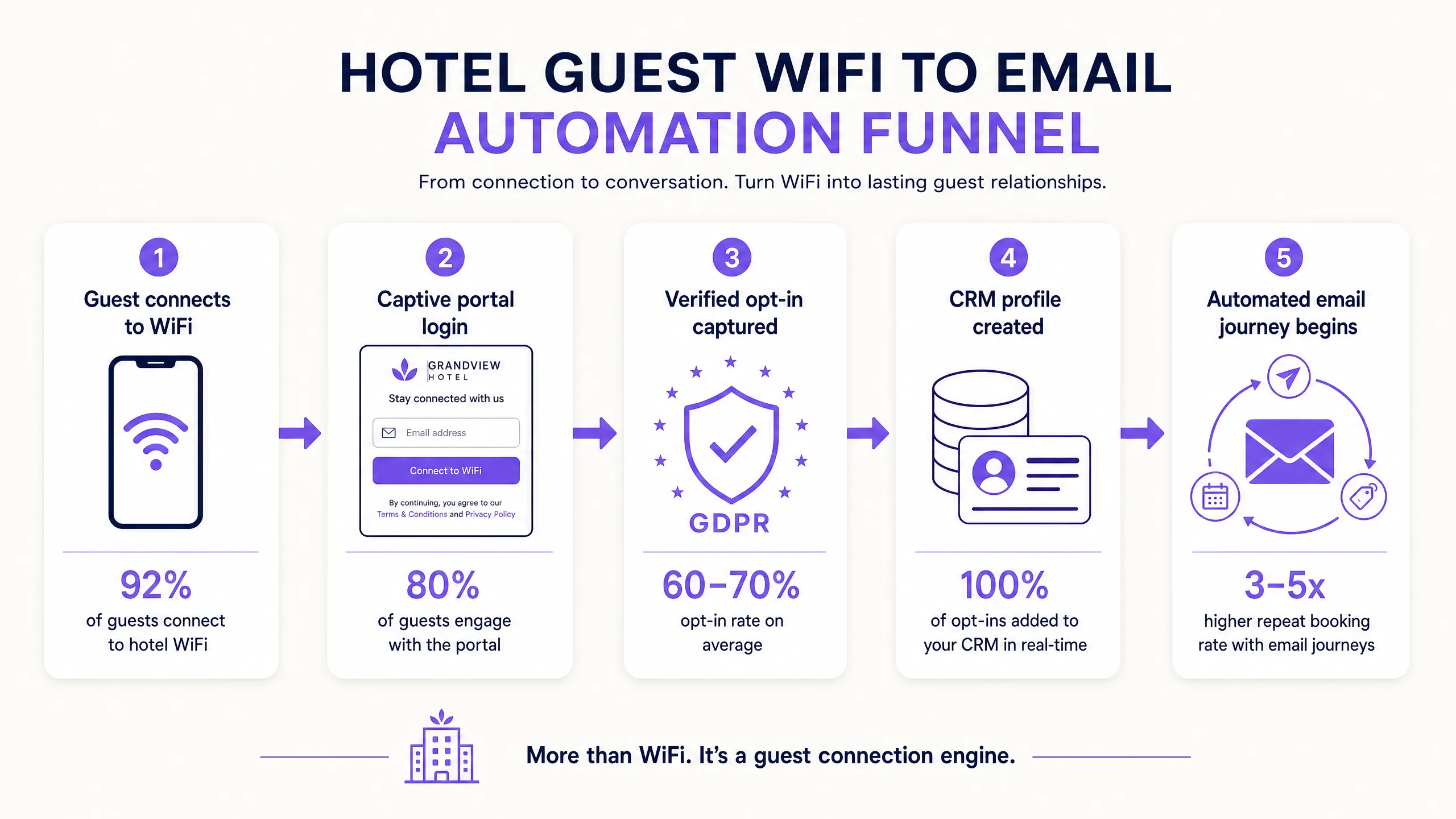
When a guest connects to your hotel's WiFi - and the vast majority do, research consistently shows over 90% of hotel guests connect to the property WiFi during their stay - they pass through a captive portal. That is the branded login page they see before they get internet access.
At that moment, you have a conscious-choice opt-in. The guest is actively choosing to connect. They enter their email address, they tick the marketing consent box, and they get online. That is a GDPR-compliant, verified, first-party data point. Not a scraped address, not a purchased contact, not a proxy from an OTA. A real person, in your building, who has just told you they are happy to hear from you.
How to do it with your guest WiFi
Purple Engage sits as a cloud overlay on your existing WiFi hardware - whether that is Cisco Meraki, HPE Aruba, Ruckus, Juniper Mist, or Ubiquiti UniFi - and captures that data automatically. Every login. Every visit. The profile builds over time, so a guest who stays three times a year accumulates three data points, and you can see their visit frequency, their preferred room type if you have integrated with your PMS, and their engagement with previous emails.
That is the difference between Purple Engage and a tool like Mailchimp or Klaviyo. Mailchimp will send your campaign brilliantly. But it cannot build your list. It has no idea who walked through your door today. Purple builds the list from the physical visit, and then the automation does the rest. To see how to start this process, read our guide on How to build an email list from your WiFi (without buying one).
What to send, and when
There are six stages in a well-structured hotel email automation program.
- Welcome email. This fires within one hour of the guest connecting to WiFi. Open rates on welcome emails in hospitality sit around 50% - that is roughly double the average for a standard campaign. The content is simple: a warm welcome, the WiFi password if they need it again, and one relevant offer. Spa, restaurant, late checkout. One thing. Not five.
- Pre-arrival email. If you have integrated with your PMS, you can trigger an email 48 hours before a booked guest's arrival date. This is your upsell engine. Room upgrades, early check-in, restaurant reservations. Pre-arrival emails consistently outperform post-stay emails on click-through rate because the guest is in planning mode.
- In-stay email. Sent on the day of arrival or the morning after check-in. Spa availability, dinner specials, local recommendations. Keep it short. The guest is at your property - they do not need a long email, they need a nudge.
- Post-stay thank-you. Sent within 24 hours of check-out. Thank the guest, invite a review, and include a soft offer for their next stay. This is also where you ask for feedback. A short survey link. The data from that survey feeds back into the guest profile.
- Re-engagement email. If a guest has not visited in 90 days, trigger a "we miss you" campaign. Personalize it with their last stay date and a relevant offer. Re-engagement open rates are lower - around 15% to 25% - but the conversion value is high because you are targeting guests who already know and like your property.
- Anniversary or seasonal trigger. If you know a guest stayed last year in August, send them a relevant offer in June. If you know they stayed on their wedding anniversary, send a romantic package offer a month before that date. These hyper-personalized triggers consistently outperform generic campaigns by a significant margin.
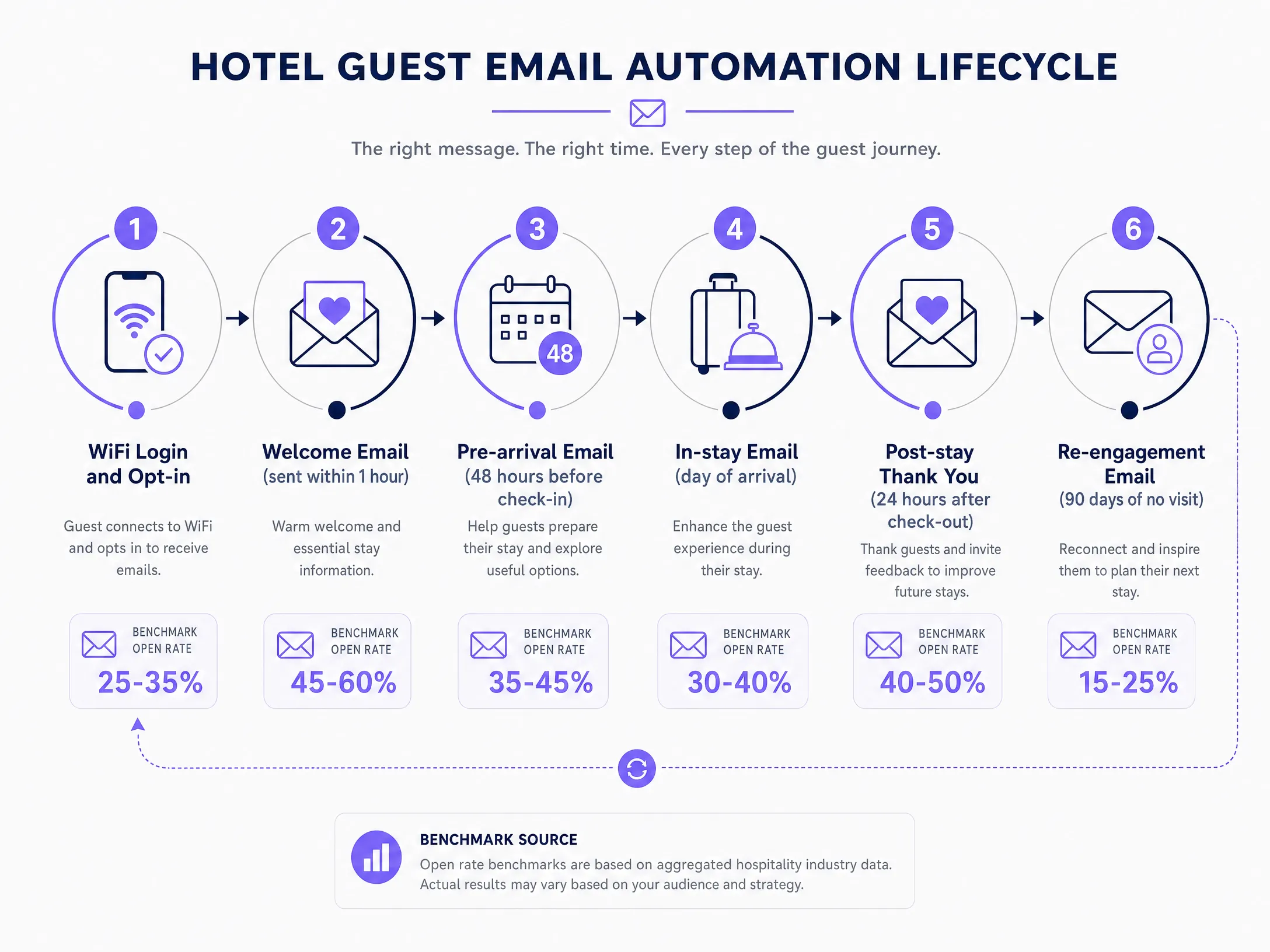
The key point across all six stages is that none of this requires manual intervention once it is set up. The WiFi login triggers the profile creation. The profile creation triggers the welcome email. The PMS integration triggers the pre-arrival email. The check-out date triggers the post-stay email. The 90-day absence triggers the re-engagement. It runs.
Measuring what works
Let me give you two real-world examples of how this plays out.
First example: a 200-room independent hotel in a US city center. Before implementing WiFi-driven email automation, their CRM held around 8,000 contacts, mostly from direct bookings. Twelve months after dedeploying Purple Engage, the list had grown to over 30,000 verified, opted-in contacts. Their post-stay email open rate was 42%. Their pre-arrival upsell emails were generating an average of 23 additional bookings per month for spa and dining. The marketing team went from spending 40 hours a week on manual campaign preparation to under 4 hours.
Second example: a hotel group with properties across multiple locations. The challenge was consistency - each property had its own approach, its own list, its own ad-hoc campaigns. By centralizing on Purple Engage, they created a single guest profile that followed the guest across properties. A guest who stayed at the Manchester property and later visited the Edinburgh property was recognized as a returning guest, not a new contact. The group's email revenue per recipient increased by 60% in the first year.
For more specific advice on food and beverage outlets within your hotel, see our guide on Email marketing for restaurants: a practical guide.
Where to start
- Audit your current list. How many contacts are verified opt-ins? How many are proxy addresses from OTAs?
- Deploy a captive portal. Use Purple Engage to turn your existing WiFi into a Guest WiFi data capture engine.
- Map your guest journey. Identify the key touchpoints: booking, arrival, in-stay, check-out, and re-engagement.
- Build your automations. Start with the welcome email and the post-stay thank-you. Add complexity later.
- Measure revenue per send. Do not just track open rates. Track the actual revenue generated by each automated campaign.