
Email marketing for cafés and coffee shops
Café email marketing is the highest-ROI channel available to independent and multi-site coffee shops, but it fails when operators cannot build a list.
Video overview
Listen to this guide
Read the transcript
Welcome to the Purple Engage strategy briefing. I'm your host, and today we're tackling a persistent challenge in hospitality: email marketing for cafes and coffee shops. Let's start with the reality of the situation. You know email works. The data is clear. Across the industry, email marketing generates an average return of 36 dollars for every 1 dollar spent. It vastly outperforms social media algorithms, where you're constantly fighting for visibility among passive scrollers. For a cafe, where the goal is driving high-frequency, repeat visits, having a direct line to your guests is invaluable. And yet, most independent cafes and even many multi-site operators are either not doing it at all, or doing it badly. So today, we're going to cover why it matters, the right approach for a physical venue, the practical steps to get it running, the pitfalls to avoid, and we'll finish with a quick question and answer, and a clear set of next steps you can action this week. Let's get into it. Why does email marketing matter so much for cafes specifically? A cafe is a high-frequency, low-ticket business. Your average transaction might be three to five pounds. The lifetime value of a loyal daily guest, however, is enormous. If someone comes in five days a week for fifty weeks a year, spending four pounds each time, that's a thousand pounds a year from one person. Retaining that person, or converting a once-a-week visitor into a twice-a-week visitor, has a dramatic impact on your revenue. Email is the most direct tool you have to influence that behaviour. Unlike social media, where you're at the mercy of an algorithm deciding whether your post gets shown, an email lands directly in the inbox of someone who has already chosen to hear from you. Research from McKinsey shows that email is forty times more effective at bringing new guests back than Facebook or Twitter. Forty times. And the economics are compelling. A thirty-six to one return on investment is not a theoretical number. It's an industry average. For a cafe spending fifty pounds a month on an email platform, that's a potential eighteen hundred pounds in attributable revenue. The question is not whether to do it. The question is how to do it properly in a physical venue environment. Now let's talk about the approach. The core challenge for any physical venue is list building. An e-commerce brand captures emails at checkout. A restaurant with an online booking system captures them at reservation. But a cafe? Your guests walk in, order at the counter, and leave. There is no natural digital touchpoint unless you create one. The most common mistake I see is operators trying to solve this manually. A clipboard on the counter. A QR code on a table card that nobody scans. Asking staff to prompt guests during the rush. None of these work at scale. Staff are busy, guests are in a hurry, and the data you do collect is inconsistent and often inaccurate. The solution is to automate the capture using your guest WiFi. Here is the mechanism. When a guest connects to your WiFi network, instead of granting direct access, you present a branded splash page, also called a captive portal. The guest sees your logo, your brand colours, a simple message, and a form asking for their email address. They tick a box to opt-in to marketing communications, and they get online. This is a genuine value exchange. The guest gets fast, reliable internet access. You get a verified, accurate email address from someone who is physically present in your venue and has explicitly chosen to receive marketing from you. That last point is critical. This is not a bought list. This is not a scraped list. These are conscious-choice opt-ins from real people who have visited your venue. From a GDPR perspective, this is exactly how consent should work. The opt-in is clear, the purpose is stated, and the guest makes an active choice. You are building a legally compliant, first-party data asset. Now, the technology that makes this work is Purple Engage. Purple operates as a cloud overlay on your existing WiFi hardware. Whether you're running Cisco Meraki, HPE Aruba, Ubiquiti UniFi, Ruckus, or any of the major enterprise access point brands, Purple integrates directly. You do not need to replace your hardware. The captive portal sits on top of your existing network, captures the data, and feeds it directly into the Purple Engage CRM. The list builds itself. Every day, every new guest who connects to your WiFi and opts in is automatically added to your marketing database. No staff intervention. No manual data entry. No clipboards. Let's talk about what to actually send, and when. Once the list is building, you need a set of automated campaigns that run without you having to think about them every week. These are the evergreen automations that drive repeat visits on autopilot. The first is the Welcome Email. This triggers automatically one to two hours after a guest's first WiFi login. The timing is important. You want to catch them while the experience is still fresh. The email should be warm and personal. Thank them for visiting. Tell them something interesting about your coffee, your roasting process, your team. And include a small incentive for their second visit. A ten percent discount, a free upgrade on their next drink. Something that gives them a reason to come back soon. Welcome emails consistently outperform all other campaign types. Open rates for triggered welcome emails in hospitality regularly exceed fifty percent. This is your single highest-impact automation. The second is the Win-Back Campaign. This is where the integration of WiFi data and email becomes genuinely powerful. Because Purple tracks physical presence via WiFi logins, the system knows when a regular guest stops coming in. If someone who was visiting twice a week suddenly goes thirty days without a login, Purple Engage automatically triggers a win-back email. Something like: we haven't seen you in a while. Here's a free pastry with your next coffee. It's a low-cost gesture that breaks their new routine and brings them back to you. The cost of a pastry is negligible compared to the lifetime value of a returning regular. The third is the Slow-Day Promotion. Use the footfall analytics built into Purple to identify your quietest periods. If Tuesday afternoons are consistently dead, create a segment of guests who have visited on other days but not on Tuesdays. Send them a targeted email on Tuesday morning with a specific afternoon offer. You're not discounting for guests who were already planning to come. You're specifically targeting people who need a reason to change their habits. The fourth is the Seasonal Campaign. New menu items, limited-time specials, a new blend from your roaster. These are genuine reasons to reach out to your full list. Keep these to once or twice a month maximum. You want your guests to look forward to hearing from you, not to feel bombarded. And the fifth is the Birthday Reward. If you collect date-of-birth information on the splash page, automate a birthday email with a free drink offer. These emails have some of the highest redemption rates of any campaign type. People feel genuinely valued when a local business remembers their birthday. Now let's cover the practical steps and the pitfalls. Step one: audit your existing WiFi hardware. Log into your network management console and identify your access point vendor. If you're on Cisco Meraki, HPE Aruba, Ubiquiti UniFi, or Ruckus, you're already compatible with Purple Engage. Step two: configure your branded splash page. This is the first thing your guests will see when they connect to your WiFi. Make it look like your cafe. Use your logo, your colours, a welcoming message. Keep the form simple. Name, email address, and a marketing opt-in checkbox. Do not ask for date of birth, phone number, and preferences all at once. You will reduce your opt-in rate significantly by asking for too much. Step three: set up the welcome automation. Before you do anything else, get this one running. It is the highest-impact campaign you will ever send, and it requires zero ongoing effort once it's live. Step four: connect Purple Engage to your existing tools. If you're already using Mailchimp or another email platform, Purple can feed data into it. If you're starting fresh, Purple Engage handles the full campaign management natively. Step five: monitor your capture rate for the first two weeks. A well-configured captive portal in a busy cafe should be capturing between forty and sixty percent of guests who connect to the WiFi. If your rate is lower than thirty percent, review the splash page design and the clarity of the value exchange. Now, the pitfalls. The first pitfall is over-emailing. If you send more than two or three emails a month to your full list, you will see unsubscribe rates climb. Cafes are not e-commerce brands. Your guests do not want daily promotional emails. Automate the behaviour-triggered campaigns, keep the broadcast emails to genuine news and offers, and respect your guests' inboxes. The second pitfall is generic messaging. Sending the same email to every person on your list is a wasted opportunity. A guest who visits every morning at seven thirty has completely different needs and motivations to someone who comes in for brunch on Sundays. Use the segmentation tools in Purple Engage to send relevant messages to relevant people. The third pitfall is measuring the wrong things. Open rates are a useful signal, but they are not revenue. The metric that matters for a physical venue is the return visit. Purple Engage enables closed-loop attribution, meaning you can track exactly how many guests who received a specific email subsequently walked back into your venue and connected to the WiFi. That is the number you should be reporting to your manager or your business partner. Let's do a quick question and answer. Question one: I already have a Mailchimp account with a few hundred subscribers. Should I switch to Purple Engage? The honest answer is that these are not mutually exclusive. Purple Engage can feed data into Mailchimp if you prefer to stay with a familiar sending platform. The key point is that Purple solves the list-building problem that Mailchimp cannot. Mailchimp sends the campaign; Purple builds the audience. You can use both. Question two: Is this GDPR compliant? Yes, provided the captive portal is configured correctly. The opt-in checkbox must be unticked by default, the purpose of the marketing must be clearly stated, and guests must be able to opt out at any time. Purple's standard splash page templates are built to meet these requirements. Question three: How long does it take to see results? In a busy cafe with fifty or more WiFi connections per day, you should have a meaningful list within four to six weeks. The welcome automation will start driving second visits almost immediately. Win-back campaigns become effective once you have a few months of visit history to work with. Let's wrap up with a summary and your next steps. The key takeaways from today are these. Email marketing delivers a thirty-six to one return on investment, and for a cafe, the primary goal is driving repeat visits, not just opens and clicks. Manual list building fails in a busy service environment. Automate the capture using your guest WiFi and a captive portal. Every email you capture via the WiFi is a verified, GDPR-compliant, first-party data point from someone who has physically visited your venue. Purple Engage works as a cloud overlay on your existing hardware, whether that's Cisco Meraki, Ubiquiti UniFi, or any of the major access point brands. Set up five core automations: the welcome email, the win-back campaign, the slow-day promotion, the seasonal broadcast, and the birthday reward. Measure success by physical return visits, not just open rates. Purple's closed-loop attribution connects the email you sent to the guest who walked back through your door. Your next steps this week: check your WiFi hardware vendor, book a demo with Purple Engage to see the captive portal in action, and commit to getting your welcome automation live within the next fourteen days. Thanks for listening. To explore Purple Engage and see how it works for your venue, visit purple dot ai.
Why this matters for your venue
Email marketing delivers a $36 return for every $1 spent [1], vastly outperforming social media advertising. For cafés and coffee shops, the business outcome is very specific: converting one-time visitors into daily regulars. An increase in customer retention of just 5% can lift profits by 25% to 95% [2], and for a high-frequency, low-ticket business like a café, the lifetime value of a loyal guest is substantial.
The problem is not sending emails. The problem is building the list. Staff cannot ask for email addresses while steaming milk and managing a queue. Generic email tools like Mailchimp or Klaviyo will send your campaigns, but they rely on you to supply the audience. Without a frictionless way to capture first-party data at the point of service, your email list stagnates and you remain entirely dependent on passing footfall with no way to re-engage it.
See also: Why bought email lists fail venues
The approach
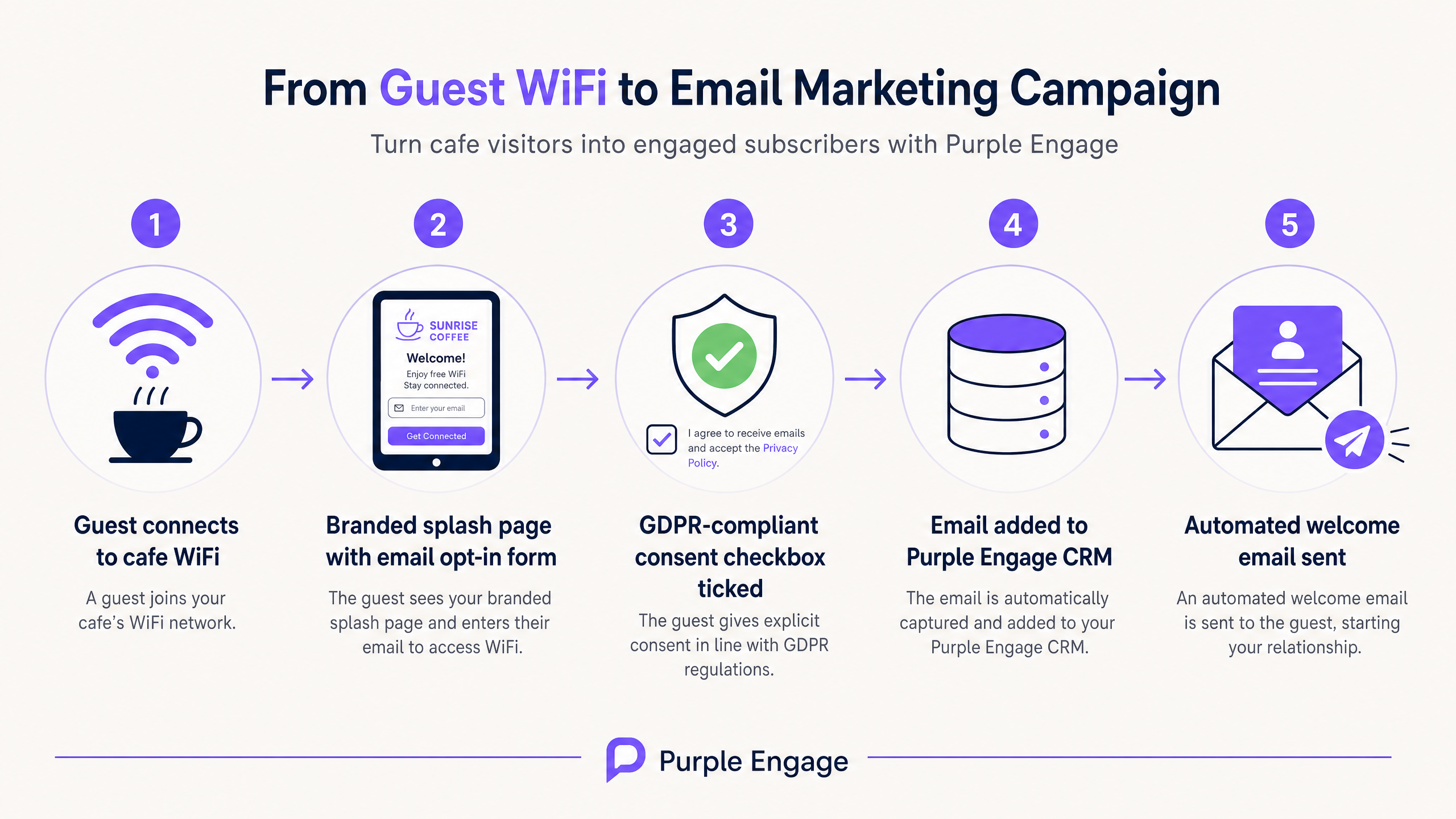
The mechanism is your guest WiFi. When a guest connects to your network, Purple Engage presents a branded captive portal - the splash page. To access the internet, the guest provides their email address and explicitly opts in to marketing. This creates a verified, conscious-choice, first-party data list. Every email is tied to a physical visit, complete with a timestamp, a visit-frequency count and dwell time.
This is the cornerstone of café email marketing: capture data at the point of service, then use that data to drive the next visit. Mailchimp sends campaigns; Purple Engage builds the audience.
How to do it with your guest WiFi
Guest WiFi from Purple integrates directly with your existing hardware. Whether you run Cisco Meraki, HPE Aruba, Ubiquiti UniFi or Ruckus, you do not need to replace your access points. Purple operates as a hardware-agnostic cloud overlay.
The workflow has four steps.
Step one, the splash page. When a guest selects your WiFi network, Purple intercepts the connection and displays a custom splash page. This page must be optimised for mobile, because the majority of café WiFi logins happen on smartphones.
Step two, capture. The guest enters their email address, or signs in socially via Google Workspace or Microsoft Entra ID.
Step three, consent. The guest ticks a clearly labelled box to accept the terms and opt in to marketing. This is a GDPR-compliant, conscious-choice opt-in that makes the data legally usable.
Step four, CRM. The email address flows immediately into Purple Engage along with the visit timestamp and device data. The list builds itself with no staff involvement whatsoever.
Purple operates across more than 80,000 active venues worldwide and recorded 440 million logins in 2024 (Purple internal data). The platform is ISO 27001 and GDPR certified.
What to send and when
Building the list is only the first step. To drive revenue, you need automated campaigns triggered by guest behaviour, not a content calendar you have to maintain by hand.
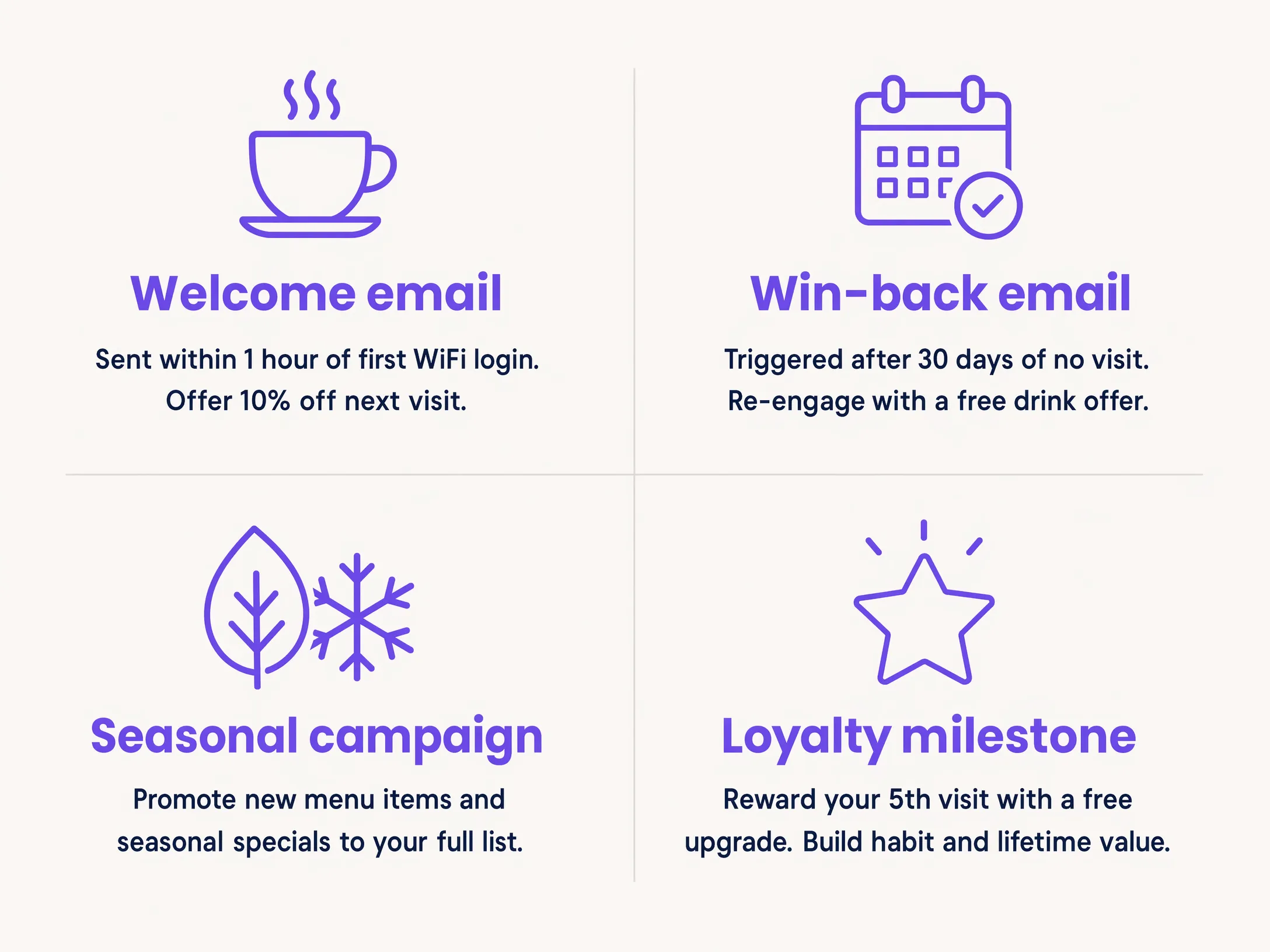
| Campaign | Trigger | Goal | Typical offer |
|---|---|---|---|
| Welcome email | First WiFi login | Drive the second visit | 10% off the next purchase |
| Win-back | No login for 30 days | Re-engage lapsed guests | Free item with next purchase |
| Slow-day promotion | Scheduled broadcast | Fill off-peak hours | Limited-time afternoon offer |
| Birthday reward | Date-of-birth match | Build emotional loyalty | Free drink or upgrade |
| Seasonal launch | Manual broadcast | Promote a new menu | Early access or a tasting event |
The welcome email is the highest-impact automation you will set up. In hospitality, triggered welcome emails routinely achieve open rates above 50% [3]. Set it to fire one to two hours after the first login, while the positive experience is still fresh.
The win-back campaign is where the WiFi-to-email integration becomes genuinely powerful. Because Purple tracks physical presence via network logins, the system knows when a regular stops visiting. Thirty days without a visit triggers the campaign automatically. The cost of a free pastry is trivial compared with the lifetime value of a returning regular.
Measuring success
Do not judge success by open rates alone. The hospitality average open rate is 43.6% [3], which is a useful benchmark, but opens do not generate revenue. Physical return visits do.
Because Purple Engage links the email address to the device's network session, you get closed-loop attribution. You can see that you sent 500 win-back emails, 200 people opened them, and exactly 42 of those guests physically walked back into the café and logged into the WiFi within the following seven days. That is the metric to report: revenue per send, and the number of return visits attributed to each campaign.
Compared with a generic broadcast send, personalised email campaigns can lift recipient spend by 20% within 30 days (Olo, 2025).
Where to start
- Confirm your WiFi hardware vendor (Cisco Meraki, HPE Aruba, Ubiquiti UniFi, Ruckus or other).
- Configure a branded captive portal in Purple Engage with a clear GDPR opt-in checkbox.
- Set up an automated welcome email with a second-visit incentive.
- Monitor list growth and capture rate for 14 days to establish your baseline.
- Add the win-back automation once you have 60 days of visit history.
References
[1] Litmus, "The ROI of Email Marketing", 2025. https://www.litmus.com/blog/infographic-the-roi-of-email-marketing
[2] Bain & Company, "The Value of Online Customer Loyalty", cited in Harvard Business Review, 1990.
[3] MailerLite, "Email Marketing Benchmarks by Industry and Region for 2026", December 2025. https://www.mailerlite.com/blog/compare-your-email-performance-metrics-industry-benchmarks