
Email marketing for shopping centers and malls
Shopping centres capture millions of footfall visits each year but rarely own the relationship with the shopper.

Listen to this guide
Read the transcript
[Intro] Welcome to the Purple marketing briefing. Today we are covering email marketing for shopping centres and malls. If you manage a retail destination, you know the challenge. Thousands of shoppers walk through your doors every day. They visit, they spend money, and they leave. Unless they sign up for a specific loyalty programme, they remain anonymous. You have no way to reach them again. Relying on individual retailers to share their customer data is a losing strategy. You need to build your own asset. You need first-party data. And the best way to get it is already installed in your ceiling. [Why it matters - 1 minute] Let us start with the business outcome. The goal of shopping centre marketing is to drive repeat visits. You want to increase the lifetime value of every shopper. A shopper who visits twice a month is worth significantly more than one who visits twice a year. The difference between those two shoppers is often a well-timed, relevant email. Generic email tools like Mailchimp or Klaviyo are excellent at sending campaigns. But they do not build the list for you. You have to find a way to get the email address in the first place. Most centres rely on competition entries, loyalty card sign-ups, or retailer data shares. All of these are slow, inconsistent, and often not GDPR-compliant. This is where Guest WiFi changes the equation entirely. When a shopper wants to get online, they connect to your network. They see a captive portal. They enter their email address and provide a conscious-choice opt-in for marketing. You are turning an anonymous visitor into a known contact. And you are doing it in a way that is fully compliant with GDPR. The list builds itself. You capture the data once, and you own the relationship. [The approach - 5 minutes] Now let us talk about how this works in practice. Purple operates as a cloud overlay on your existing network hardware. We are hardware-agnostic. This means you do not need to replace your existing access points. Whether you run Cisco Meraki, HPE Aruba, Ruckus, Juniper Mist, Ubiquiti UniFi, Cambium, Extreme, or Fortinet, Purple integrates directly. We process 440 million logins a year across 80,000 live venues. The system is built to scale on the infrastructure you already have. Once a shopper authenticates on the Guest WiFi, the system starts working immediately. Purple tracks their movement across the centre. We collect spatial data. We see if they spend two hours in the food court or 45 minutes in the luxury retail wing. We see if they visit the cinema on Friday evenings or the gym on weekday mornings. This is the context that makes your email marketing effective. You are no longer sending a generic monthly newsletter to your entire database. You are sending targeted, relevant campaigns based on actual physical behaviour. A shopper who visits the food court three times a week should receive a very different email to a shopper who visits the luxury wing once a month. The centre-wide approach is the key differentiator here. Individual retailers capture their own shoppers. But you, as the centre operator, can capture every shopper who connects to the WiFi, regardless of which stores they visit. You build a single, unified database of your entire visitor population. No individual retailer has that view. Only you do. Let us talk about segmentation. Purple Engage allows you to create audience segments based on demographics, visit frequency, recency, and physical location within the centre. These are the same principles used in RFM segmentation - Recency, Frequency, and Monetary value. You identify your most valuable shoppers, your at-risk shoppers, and your lapsed shoppers. You then communicate with each group differently. Your most frequent visitors should receive early access to sales events and exclusive previews. Your at-risk shoppers - those who have not visited in 60 days - should receive a compelling reason to return. Your lapsed shoppers, absent for 90 days or more, need a win-back offer with a clear incentive. [Practical steps and pitfalls - 2 minutes] Now let us move to practical steps and common pitfalls. The biggest mistake centres make is batch-and-blast marketing. They send the same email to every contact in the database. A family of four and a solo professional receive identical messages about a children's play area event. The professional unsubscribes. You lose a contact you worked hard to capture. The solution is automation based on physical behaviour. Set up a welcome email for every first-time visitor. Send it 24 hours after their first visit. Include a centre map, parking information, and a small incentive for their next visit. This single automation, running continuously, builds a positive relationship with every new shopper from day one. Set up a lapsed visitor campaign. Define your threshold - typically 90 days without a WiFi connection. When a shopper crosses that threshold, trigger an email with a strong offer. A free coffee, a parking discount, or early access to an upcoming event. The key is that you are using physical presence data to define lapsed, not just email engagement data. The pitfall to avoid here is using email opens as your proxy for engagement. A shopper might open every email you send but never return to the centre. That is not engagement. That is entertainment. The metric that matters is physical return visits. [Quick Q and A - 1 minute] A question we hear often from marketing teams: what about shoppers who do not use the WiFi? It is a fair point. Not every shopper will connect. But in a modern retail environment, the majority of visitors will connect to a free WiFi network at some point during their visit, particularly during longer dwell times in food courts, cinemas, and leisure areas. Purple data shows that centres using our platform capture a significant proportion of their total footfall as email contacts within the first six months of deployment. Another common question: is this compliant with GDPR? Yes. The captive portal presents a clear, unticked opt-in checkbox. The shopper makes a conscious choice to receive marketing. Purple stores the consent record with a timestamp. You have a full audit trail. This is first-party data captured with explicit consent - the gold standard under UK and EU data protection law. [Summary and next steps - 1 minute] Let us wrap up. First, audit your existing network hardware. Confirm you are running compatible access points. Second, configure your captive portal with clear GDPR-compliant consent language. Third, define your three core segments before you launch: new visitors, frequent shoppers, and lapsed visitors. Build one automation for each. Fourth, set your success metric as physical return rate, not email open rate. Report this to your board and your retailers. Fifth, review your results after 30 days. Look at which segments are returning at the highest rate. Double down on what is working. The shopping centre operators who will win the next decade are the ones who own their shopper relationships. Not the ones who rent access through social media or rely on retailers to share data. The list you build through your Guest WiFi is your most valuable marketing asset. Start building it today. Thank you for listening to the Purple marketing briefing.
Why this matters for your venue
Shopping centre marketing often relies on mass media, paid social media, or the hope that individual retailers will share their data. None of this builds an asset that you own. When you rely on third-party channels, you are essentially renting your audience. But when you collect first-party data through your own infrastructure, you own the relationship.
The cost of not collecting this data is measurable. Shoppers arrive, spend money, and leave. You have no way to measure their visit frequency, no way to understand which zones they visit, and no way to invite them back. You cannot run effective shopping centre marketing without knowing who is inside the building.
Generic email tools like Mailchimp, Klaviyo, or HubSpot send campaigns well enough. But they do not build the list. You need a mechanism that converts anonymous footfall into verified, consciously consented opt-in contacts. That mechanism is already on your ceiling.
Purple processes 440 million logins a year across 80,000+ live venues (Purple internal data, 2024). Centres using our platform see their email databases grow continuously from day one, without staff intervention, without competition entry forms, and without relying on retailers to share data.
The right approach
The core method uses your existing network hardware to collect visitor details during WiFi authentication. When a shopper connects to guest WiFi, they authenticate through a Captive Portal - the web page displayed before accessing the internet. They provide their email address and consent to receive marketing messages through a clear, GDPR-compliant opt-in process. This consent is an active decision: an unticked checkbox with clear, plain-language copy.
This creates a continuous, automated pipeline of first-party data. The list builds itself. Once a shopper authenticates, Purple uses access point association data to track their movement across the entire centre. You can see which major anchor stores they visit, how long they spend in the food court, and whether they return to the same zones on subsequent visits.
You can then use this behavioural data to segment your audience. A shopper who visits the luxury wing twice a month requires a completely different email to a family spending three hours near the cinema on a Saturday afternoon. Relevant shopping mall email marketing relies on exactly this kind of context - and that context is only possible if you have the spatial data behind it.
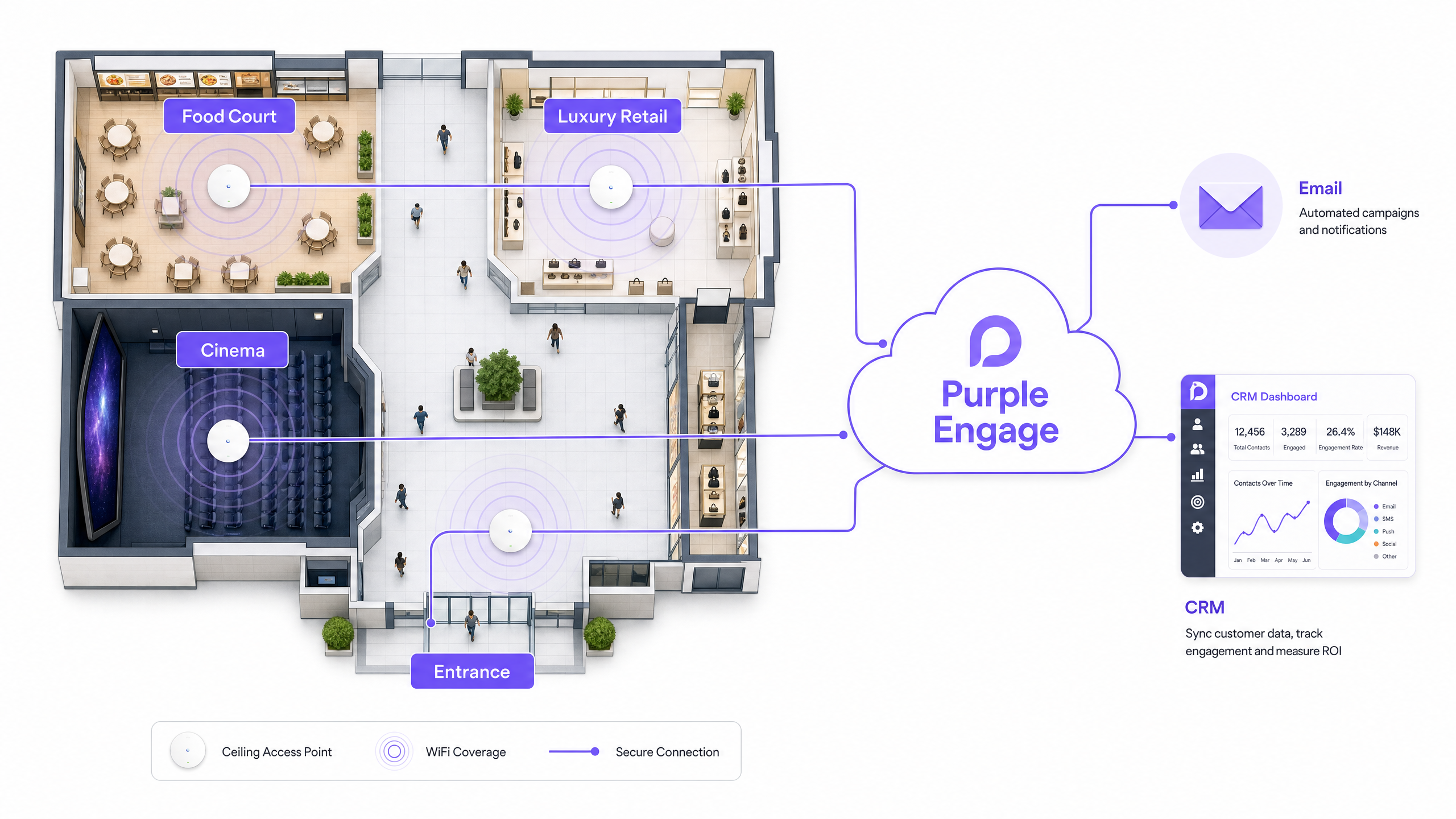
A centre-wide perspective is the key differentiator. Individual retailers can only collect data on their own shoppers. But as a centre operator, you can capture data on every shopper who connects to the WiFi, regardless of which stores they visit. You can build a single, unified database of your entire visitor population. No individual retailer has this overview. Only you do. This database is your most valuable marketing asset.
How to do this with your guest WiFi
Purple Engage transforms your network into a retail centre CRM. We apply a cloud overlay to your existing hardware - there is no need to replace your access points. Purple supports Cisco Meraki, HPE Aruba, Ruckus, Juniper Mist, Ubiquiti UniFi, Cambium, Extreme, and Fortinet. If you already use any of these, you are ready to go.
When a shopper logs in, they see a branded Captive Portal. They authenticate via email or social login. Purple captures and securely stores this data. We are ISO 27001 certified, GDPR and CCPA compliant, and B Corp certified. The data collection process is auditable and defensible.
Guest WiFi data flows directly into Purple Engage, where you can build segments, design automations, and send campaigns. The platform connects physical presence data from the network with the email marketing layer. This is a connection that tools like Mailchimp and Klaviyo cannot make on their own - they have no way of seeing who has walked through your doors.
| Capability | Generic email tools | Purple Engage |
|---|---|---|
| Send email campaigns | Yes | Yes |
| Build lists from WiFi logins | No | Yes |
| Segment by physical zones | No | Yes |
| Measure return visit rates | No | Yes |
| GDPR-compliant opt-in at capture point | No | Yes |
| Hardware-agnostic deployment | N/A | Yes |
What to send, and when
Timing and relevance dictate the success of footfall marketing. Sending a monthly newsletter to your entire database is the least effective approach. Automated, trigger-based campaigns perform far better than batch sends because they are relevant to the moment the recipient receives them.
Welcome automation. Set up a welcome email for every first-time visitor. Send it 24 hours after their first visit. Include a centre map, parking information, and a small incentive for their next visit. This single, always-on automation builds a positive relationship with every new shopper from day one.
Lapsed visitor win-back. Define your lapsed threshold - typically 90 days without a WiFi connection. When a shopper crosses that threshold, trigger an email with an appealing offer. A free coffee, a parking discount, or early access to an upcoming event. The offer does not need to be expensive; the signal that you noticed their absence is often enough.
Zone-based promotions. Shoppers who frequently visit dining areas should receive food and beverage offers. Those who spend time in fashion zones should receive style-related content. You can apply the same RFM segmentation principles used in the hospitality sector here - see RFM segmentation for restaurants and hospitality for a detailed framework. Recency and frequency metrics apply directly to retail.
Event-based campaigns. When you have an event at your centre - such as late-night shopping, pop-up markets, or school holiday activations - segment by visit history. Send event invitations to those who have visited in the last 60 days. Send a stronger offer to those who have not visited in 60 to 90 days. Do not message lapsed contacts unless you have a compelling win-back offer.
The table below shows a recommended automation stack for a typical shopping centre.
| Automation | Trigger | Timing | Audience |
|---|---|---|---|
| Welcome | First WiFi login | 24 hours after visit | All new contacts |
| Second visit nudge | No return after welcome | 14 days after welcome | New contacts who have not returned |
| Zone offer | Repeat visits to a specific zone | 48 hours after third zone visit | Zone-based segment |
| Lapsed win-back | No login for 90 days | Day 90 | Lapsed shoppers |
| Event invitation | Upcoming event on calendar | 7 days before event | Active visitors (last 60 days) |
| Post-event follow-up | Event date passed | 48 hours after event | Visitors who connected during the event |
Measuring what works
Open rates and click-through rates do not pay the rent. You must link your email marketing to return visits and revenue. This is the measurement gap that most centres fail to bridge.
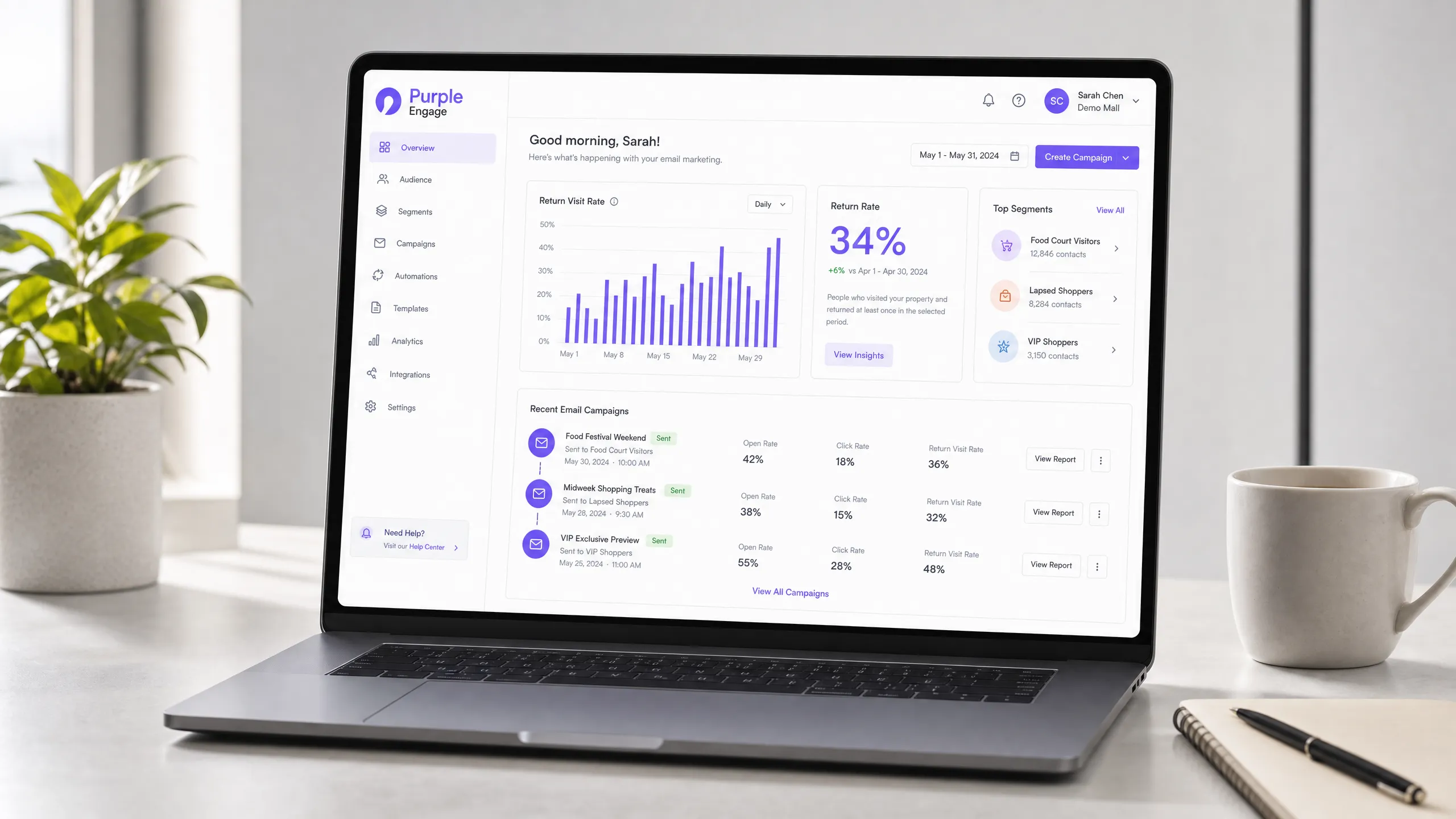
Because Purple tracks physical presence via WiFi authentication, you can measure the exact return rate of your campaigns. You send an email to 10,000 lapsed shoppers. Purple will show you exactly how many of them connected to the guest WiFi within the next 14 days. This is your real campaign conversion rate. It is a physical metric, not a digital one.
Track these four metrics for every campaign you send:
Return visit rate. The percentage of email recipients who authenticate on the guest WiFi within 14 days of receiving the campaign. This is your primary success metric.
Incremental visits. Compare the visit frequency of email subscribers against non-subscribers. Subscribers who receive regular, relevant communication visit more frequently. This frequency gap is the business justification for your marketing programme.
Revenue per send. If your retailers share transaction data, you can calculate the average spend per visit for shoppers driven back by email. This is the metric your board and your retail partners want to see.
Opt-in rate. The percentage of WiFi users who consent to marketing. A well-designed Captive Portal should achieve an opt-in rate of over 60% (Purple internal benchmark, 2024). If your rate is lower, review the portal design and consent copy.
Where to start
- Audit your existing hardware. Ensure you are using Cisco Meraki, HPE Aruba, Ruckus, Juniper Mist, Ubiquiti UniFi, Cambium, Extreme, or Fortinet access points.
- Configure your Captive Portal. Ensure the GDPR consent language is clear, the opt-in checkbox is unticked by default, and the brand design matches your centre's identity.
- Review Purple Engage to understand the automation and segmentation capabilities available.
- Define your three primary segments before launch: new visitors, regular shoppers, and lapsed visitors.
- Activate a welcome automation for all new Guest WiFi registrations.
- Set up your reporting dashboard to show return visit rate as the primary metric.
- Review results after 30 days. Identify which segment has the highest return rate and build from there.