
Email segmentation for venues: a practical guide
Email segmentation for venues explains how physical venue operators - restaurants, hotels, bars, and retailers - can move beyond generic broadcast emails to targeted campaigns built on real visit behaviour.
Video overview
Listen to this guide
Read the transcript
Email segmentation for venues: a practical guide. A Purple Engage marketing briefing. [WHY IT MATTERS - approximately 1 minute] Let's start with a simple question. If you send the same email to every person on your list, what are you actually saying? You're saying: I don't know who you are, and I don't care. That's the reality of most venue email marketing. A monthly newsletter goes out to everyone, open rates hover around 20%, and nobody can tell you whether a single person walked back through the door because of it. Email segmentation changes that. It means sending the right message to the right person at the right time, based on what they've actually done - not what you think they might want. For a physical venue, that means basing your segments on real visit behaviour. Not web clicks. Not survey responses. Actual footfall. The business case is straightforward. Segmented email campaigns generate significantly more revenue than broadcast campaigns. For a restaurant, a hotel, or a retail store, that's the difference between email marketing that pays for itself and email marketing that quietly drains budget. [THE APPROACH - approximately 5 minutes] So how does this actually work for a physical venue? Let's talk about the list first, because the list is everything. Most venues using tools like Mailchimp or Klaviyo build their lists through web forms, loyalty sign-ups, or manual imports from a booking system. The problem is that these lists are incomplete, often out of date, and they capture only the guests who were motivated enough to sign up. You're missing the majority of your footfall. The approach we advocate at Purple is different. Your guest WiFi becomes the list-building engine. When a guest connects to your WiFi, they authenticate through a captive portal. That portal presents a clear, GDPR-compliant opt-in for marketing communications. The guest makes a conscious choice to share their email address. This is first-party data - verified, consented, and tied directly to a physical visit. GDPR is worth pausing on here. The regulation requires that consent for marketing is freely given, specific, informed, and unambiguous. A pre-ticked box doesn't count. A vague 'I agree to terms' doesn't count either. The captive portal approach, done correctly, captures genuine, documented consent at the point of a real physical interaction. That's a much stronger consent record than a web form buried in a footer. Now, here's where segmentation becomes genuinely powerful. Because the WiFi login captures not just the email address, but the behaviour around it. When did this person visit? How long did they stay? How many times have they been back? All of that data flows into the Purple Engage platform and becomes the basis for your segments. Let's walk through the three core segments every venue should build. The first segment is first-time visitors. These are guests who have connected to your WiFi exactly once. They've shown enough interest to visit, but you haven't yet earned their loyalty. The window to convert a first-time visitor into a regular is short - typically 14 days. If you don't reach out in that window, the probability of a second visit drops significantly. The email you send to this segment should be warm, welcoming, and contain a clear reason to return. A small incentive - a complimentary drink, a discount on their next visit, an invitation to an upcoming event - works well here. The key is speed. Automate this email to trigger 24 hours after the first visit. The second segment is your regulars. These are guests who visit frequently - let's say three or more times in the last 30 days. This is your most valuable segment. They already love what you do. The mistake most venues make is sending this group the same promotional emails as everyone else. Discount-driven campaigns train your best customers to wait for offers. Instead, use this segment for exclusive communication. Early access to new menus. Invitations to private events. Recognition that they're valued. These guests have the highest lifetime value, and your email strategy should reflect that. The third segment is lapsed regulars. These are guests who used to visit frequently but haven't been seen in 60 days or more. This is your win-back segment. The email here needs to acknowledge the gap - not in a guilt-trip way, but in a way that shows you noticed. A strong offer helps. So does a reason to come back that's new - a seasonal menu, a refurbishment, a new event series. The goal is to reactivate someone who already knows and liked your venue. Beyond these three core segments, you can build more granular ones as your data matures. Day-of-week visitors - guests who always come on a Thursday, for example - can receive targeted Thursday-specific offers. High dwell-time guests who spend two or more hours at your venue are likely candidates for loyalty programmes or upsell communications. Guests who visit multiple locations of your brand can receive cross-venue campaigns. The segmentation logic in Purple Engage is built around these behavioural triggers. You define the criteria - visit frequency, recency, dwell time, location - and the platform assigns guests to segments automatically. When a guest's behaviour changes, their segment updates. A first-time visitor who returns three times in a month moves into the regulars segment. A regular who goes quiet for 60 days moves into the lapsed segment. This is dynamic segmentation, and it means your campaigns stay relevant without manual intervention. [PRACTICAL STEPS AND PITFALLS - approximately 2 minutes] Let's talk about implementation. The first step is auditing your captive portal. Your WiFi login process needs to include a clear, GDPR-compliant opt-in for marketing. Not buried in the terms and conditions - a visible, explicit checkbox. This is non-negotiable for both legal compliance and list quality. The second step is defining your segments before you start building campaigns. Don't try to build 20 segments on day one. Start with three: first-time visitors, regulars, and lapsed. Get those automations running, measure the results for 30 days, then add complexity. The third step is connecting your attribution loop. This is where most venues fall short. They send the email, they see the open rate, and they call it done. But the metric that matters is return visits. Purple Engage tracks physical presence, so when you send a win-back campaign to lapsed regulars, you can see exactly how many of them walked back through the door within seven days of receiving the email. That's the number you should be optimising for. Now, the pitfalls. The most common one is over-segmenting too early. If you split your list into 15 segments before you have enough data, you end up with segments too small to be statistically meaningful. Start broad, then narrow. The second pitfall is treating email segmentation as a one-time setup. Segments need to be reviewed quarterly. Guest behaviour changes seasonally. A segment that was accurate in January may be stale by July. The third pitfall is ignoring the unsubscribe signal. If a particular segment has a high unsubscribe rate, that's not a deliverability problem - it's a relevance problem. The content or the frequency isn't matching what that group wants. Investigate before you send again. [QUICK Q AND A - approximately 1 minute] A few questions that come up regularly. 'We already use Mailchimp. Do we need to replace it?' Not necessarily. Purple Engage can integrate with Mailchimp and Klaviyo. The difference is that Purple builds and segments the list from WiFi data, then pushes the segments into your existing email tool. You keep the sending infrastructure you're comfortable with, and you add the behavioural data layer on top. 'What if guests don't connect to the WiFi?' That's a fair point. WiFi-based data captures a significant proportion of your footfall - typically 60 to 70 percent at venues where WiFi is actively promoted - but it won't capture everyone. Supplement with other opt-in mechanisms: loyalty sign-ups, booking confirmations, receipt-based prompts. The WiFi list is your largest and most behavioural dataset, but it works best as part of a broader first-party data strategy. 'How long before we see results?' Most venues see measurable improvement in return visit rates within the first 60 days of running automated first-time visitor campaigns. Win-back campaigns for lapsed regulars typically show results within 30 days of launch. [SUMMARY AND NEXT STEPS - approximately 1 minute] To bring this together. Email segmentation for venues is not about sending more emails. It's about sending fewer, better emails to the right people at the right time. The foundation is a verified, first-party data list built from real visit behaviour captured at WiFi login. The three segments to start with are first-time visitors, regulars, and lapsed guests. The metric that matters is return visits, not open rates. If you're running a restaurant, a hotel, a bar, or a retail store, and you're not yet using your guest WiFi as a data-collection engine, you're leaving the most valuable marketing asset in your building switched off. The next step is straightforward. Audit your captive portal. Check your opt-in language. Define your three core segments. And set up one automated email - the 24-hour first-time visitor follow-up. That single automation, running consistently, will generate more measurable return visits than any broadcast newsletter you've ever sent. For more on how Purple Engage works, visit purple dot ai. And if you want to go deeper on building your email list from WiFi, we have a dedicated guide on that topic linked in the show notes. Thanks for listening.
Why this matters for your venue
Most venue email marketing is broadcast marketing wearing a CRM badge. You export a list, write a newsletter, hit send, and hope someone books a table or walks back through the door. Open rates hover around 20% on a good day, and nobody can draw a straight line between the email and the footfall. The cost of this approach is not just wasted budget - it is a burned list. Guests who receive irrelevant emails unsubscribe, and once they are gone, they are gone.
Email segmentation is the practice of dividing your contact list into groups based on shared characteristics or behaviors, then sending each group a message that is relevant to them specifically. For physical venues, the most valuable segmentation criteria are not demographic - they are behavioral. How often does this guest visit? When did they last come in? How long do they typically stay? These signals tell you far more about intent and loyalty than age or zip code ever will.
The business outcome is measurable. Segmented campaigns drive higher open rates, lower unsubscribe rates, and - most importantly for venues - higher rates of physical return visits. Purple Engage connects the email send directly to the footfall outcome, so you can see the revenue per send rather than just the click-through rate.
The cost of not segmenting compounds over time. A guest who receives a discount offer they did not need becomes trained to wait for discounts. A lapsed regular who receives a generic newsletter instead of a personalized win-back message does not return. A first-time visitor who hears nothing for two weeks after their visit simply forgets you exist.
The approach
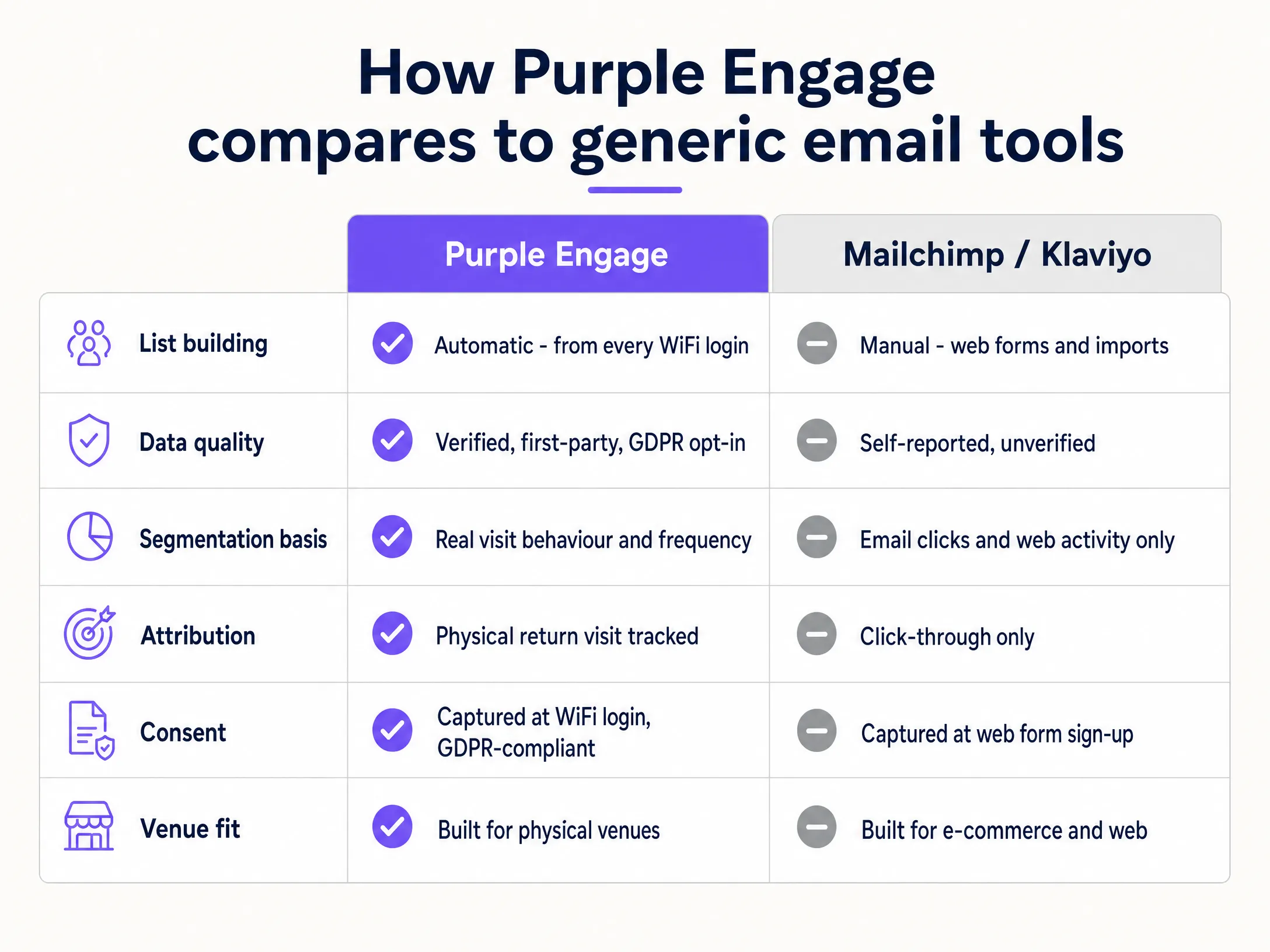
The differentiator for physical venues is not the email tool - it is the list. Generic email platforms like Mailchimp, Klaviyo, and HubSpot are excellent at sending campaigns, but they do not build the list for you. They rely on web forms, manual imports, booking system exports, and loyalty program sign-ups. These methods capture only the guests motivated enough to actively opt in through a digital channel. You are missing the majority of your footfall.
Guest WiFi changes this. When a guest connects to your WiFi, they authenticate through a Captive Portal - a branded login page that presents clear terms and a GDPR-compliant opt-in for marketing communications. The guest makes a conscious choice to share their email address. This is first-party data: verified, consented, and tied directly to a physical visit at a specific date and time.
GDPR requires that consent for marketing is freely given, specific, informed, and unambiguous. A pre-checked checkbox does not satisfy this standard. A vague reference to terms and conditions does not either. The captive portal approach, configured correctly, captures documented consent at the point of a real physical interaction - a stronger consent record than most web form sign-ups produce. Purple has operated across 80,000+ live venues and 440 million logins in 2024 (Purple internal data), and GDPR-compliant consent capture is built into the platform by default.
The second advantage of the WiFi-based approach is the behavioral data that accompanies the email address. Every login records the date, time, dwell time, and visit frequency for that guest. This data does not require the guest to fill in a survey or update a profile. It builds itself from the act of visiting. That behavioral record is the raw material for email list segmentation that actually reflects how guests interact with your venue.
How to do it with your guest WiFi
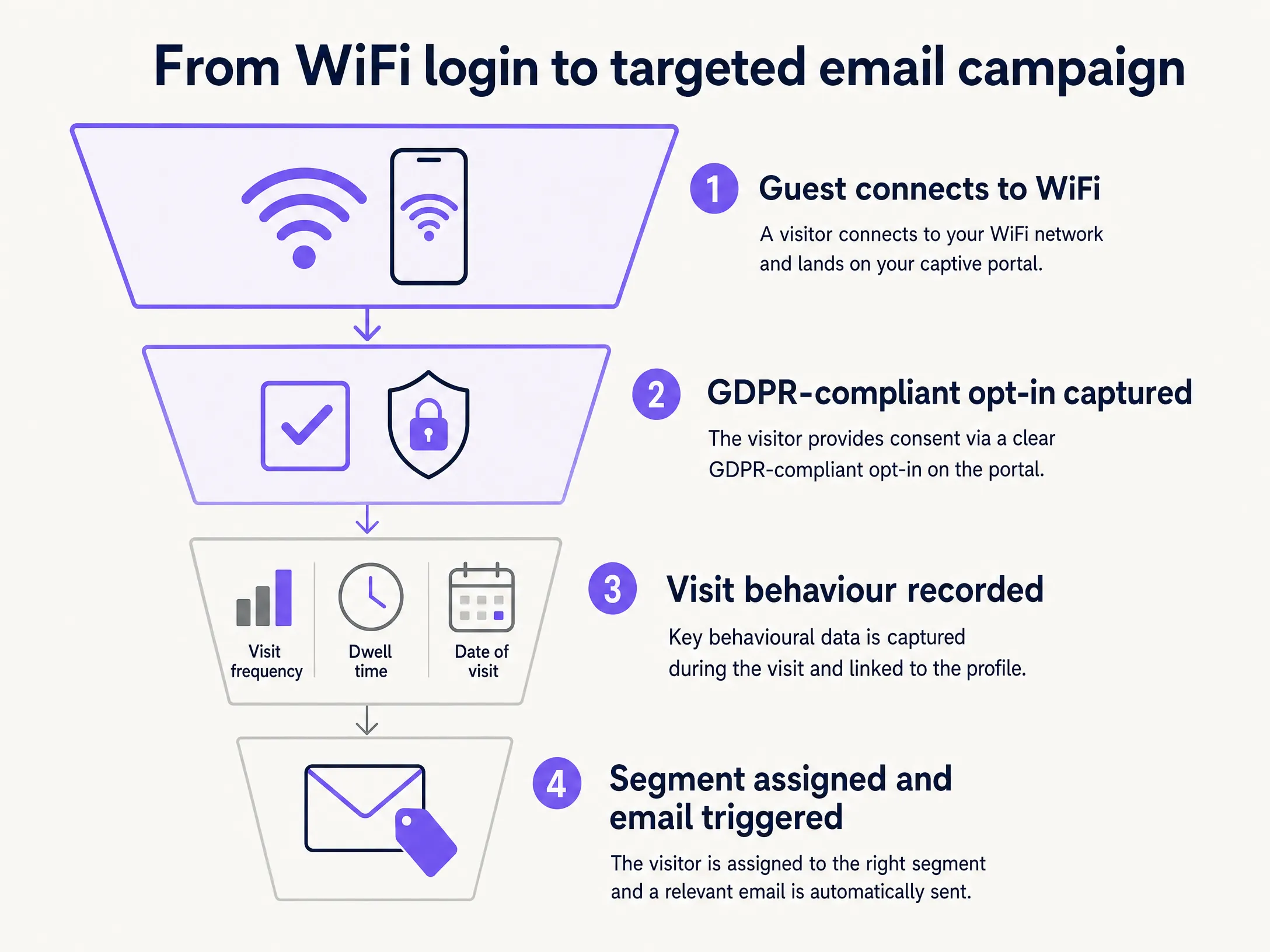
Purple Engage captures the data and runs the campaign natively. The workflow has four stages.
Stage 1: Capture. The guest connects to your WiFi. The captive portal collects their email address and a GDPR-compliant marketing opt-in. Purple creates a guest profile and records the visit timestamp, dwell time, and location.
Stage 2: Enrich. Each subsequent visit updates the profile. Visit frequency, recency, and average dwell time accumulate automatically. No manual data entry. No integration required to get started, though Purple Engage does connect to Salesforce, HubSpot, Klaviyo, and Mailchimp via native integrations if you want to push segments into an existing tool.
Stage 3: Segment. You define segment criteria in Purple Engage using a visual rule builder. A segment might be: "visited once in the last 30 days" or "visited 3 or more times in the last 30 days" or "last visit was more than 60 days ago and previously visited at least 3 times." The platform assigns guests to segments dynamically. When a guest's behavior changes, their segment updates automatically.
Stage 4: Deploy. Automated campaigns trigger when a guest enters a segment. The first-time visitor email fires 24 hours after the first login. The win-back email fires when a regular crosses the 60-day lapsed threshold. You set the rules once, and the platform runs the campaigns continuously.
For venues already using Mailchimp or Klaviyo, Purple Engage can push segment membership into those tools. You keep your existing email templates and sending infrastructure, and you add the behavioral segmentation layer on top. The list builds itself from WiFi logins; the campaign sends from your existing tool.
What to send, and when
Three segments cover the majority of the value for most venues. Build these first, measure for 30 days, then add complexity.
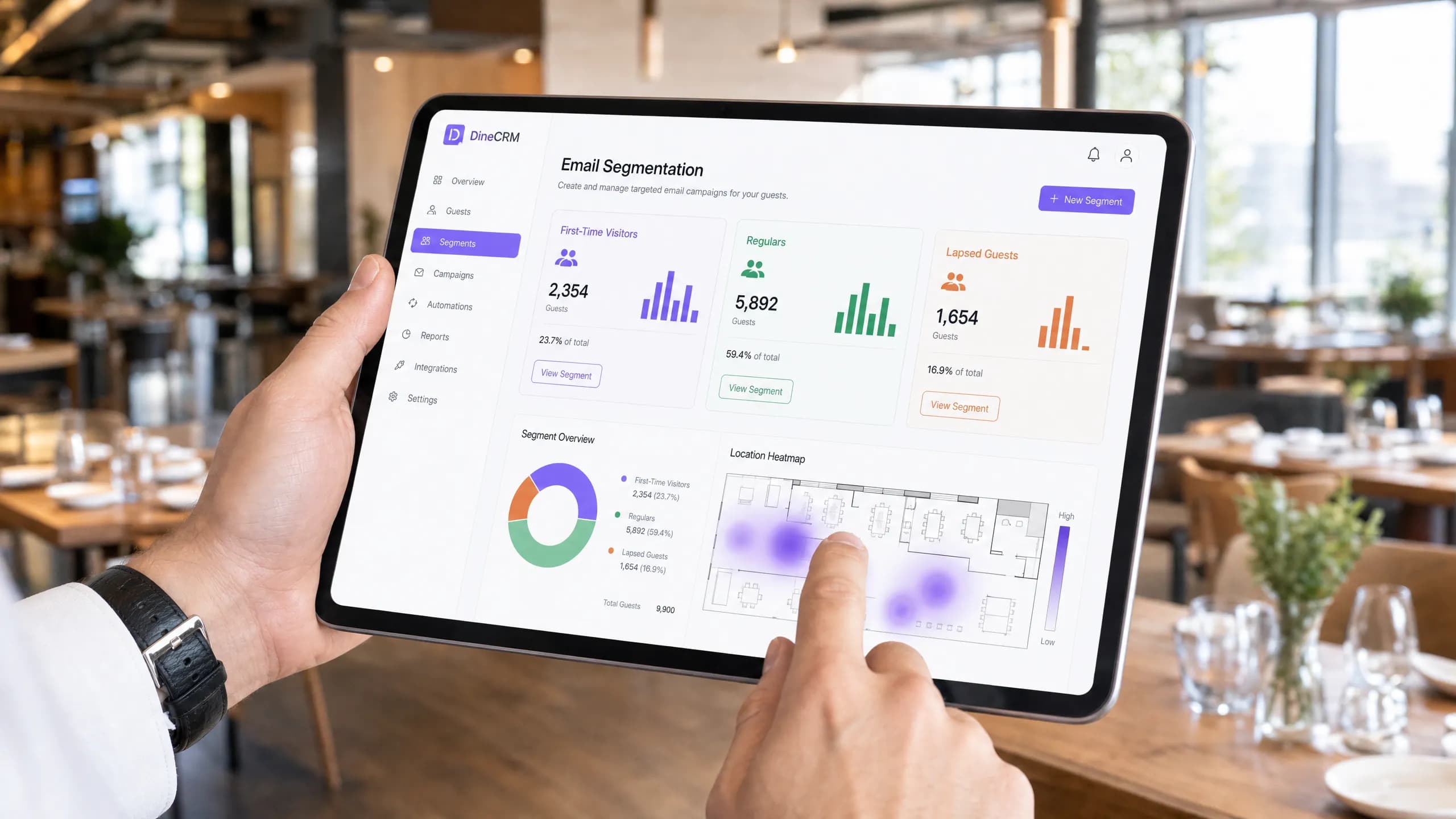
Segment 1: First-time visitors. Criteria: one WiFi login, no prior visits. Timing: email triggers 24 hours after the first visit. Content: a warm welcome, a brief reminder of what makes your venue worth returning to, and a single clear incentive to come back within 14 days - a complimentary item, a percentage discount, or an invitation to an upcoming event. The 14-day window matters. Research on hospitality loyalty consistently shows that the probability of a second visit drops sharply after two weeks without re-engagement. This automation is the single highest-return campaign most venues can run.
Segment 2: Regulars. Criteria: three or more visits in the last 30 days. Timing: monthly, or triggered by a specific event such as a new menu launch or a private event invitation. Content: exclusive access, early information, recognition. Do not send this group discount campaigns. Discount-driven emails train your most loyal guests to wait for offers before visiting. Instead, treat them as insiders. Premier Inn and Whitbread use loyalty-adjacent communications to maintain engagement with their highest-frequency guests without conditioning them to expect price reductions.
Segment 3: Lapsed regulars. Criteria: previously visited three or more times, no visit in the last 60 days. Timing: email triggers when the 60-day threshold is crossed. Content: acknowledge the gap without guilt. Lead with something new - a seasonal menu, a refurbishment, a new event series. Include a strong incentive. The goal is to give a lapsed regular a specific, timely reason to return rather than a generic "we miss you" message.
Beyond these three, consider these additional segments as your data matures:
| Segment | Criteria | Campaign type |
|---|---|---|
| Day-of-week loyalists | Visits consistently on the same day | Day-specific offers or event invitations |
| High dwell time | Average dwell time above 90 minutes | Loyalty program enrollment, upsell |
| Multi-location visitors | Logins at two or more of your venues | Cross-venue campaigns, brand loyalty |
| New to area | First visit, device location suggests non-local | "Worth the trip" content, seasonal events |
| Event-driven visitors | Visit spikes around specific dates | Post-event follow-up, next event preview |
For hospitality venues like restaurants and bars, the first-time visitor and lapsed regular automations alone can increase return visit rates by 15-25% within 90 days of launch, based on Purple Engage customer data across the platform.
Measuring what works
Open rate is a vanity metric for venue marketing. A 30% open rate means nothing if none of those openers walked back through the door. The metric that matters is return visit rate - the percentage of email recipients who physically return to the venue within a defined window after receiving the campaign.
Purple Engage measures this directly. Because the platform tracks WiFi logins, it can identify whether a guest who received an email authenticated at the venue within seven, 14, or 30 days of the send. This closed-loop attribution ties your email marketing spend to footfall and revenue rather than to inbox engagement.
The metrics to track, in order of importance:
- Return visit rate per segment. Which segments generate the highest rate of physical return? This tells you where your email marketing is actually working.
- Revenue per send. If your POS system integrates with Purple Engage, you can calculate average spend per returning guest and attribute it to the campaign. Even without POS integration, you can estimate this from average transaction values.
- Segment growth rate. Is your first-time visitor segment growing? If not, your footfall acquisition may be the problem, not your email marketing.
- Lapsed rate. What percentage of your regulars segment is moving into the lapsed segment each month? A rising lapsed rate signals a retention problem that email alone cannot fix.
- Unsubscribe rate by segment. A high unsubscribe rate in a specific segment is a relevance signal. The content or frequency is wrong for that group.
Open rate and click-through rate are secondary. They are useful for diagnosing email content quality, but they are not the outcome you are optimizing for.
Where to start
This is the ordered checklist for getting your first segmented campaign live within two weeks.
- Audit your captive portal. Confirm that your WiFi login process includes a visible, explicit GDPR-compliant marketing opt-in checkbox. If it does not, this is the first fix.
- Check your existing list. How many opted-in contacts do you have? What data do you hold on each one? Identify gaps - specifically whether you have visit frequency and recency data.
- Define your three core segments. First-time visitors, regulars, lapsed regulars. Write the criteria in plain language before you build them in the platform.
- Build the first-time visitor automation. Set the trigger to 24 hours after the first WiFi login. Write the email. Keep it short - three sentences, one offer, one call to action.
- Set your attribution window. Decide whether you will measure return visits at seven days or 14 days. Be consistent so you can compare results over time.
- Run for 30 days before adding complexity. Resist the urge to build 10 segments immediately. Let the first automation run, measure the return visit rate, and use that baseline before expanding.
For more on building your email list from WiFi, see our guide: How to build an email list from your WiFi (without buying one). For the hospitality-specific application, see Email marketing for restaurants: a practical guide.