
First-party data for venues: why your WiFi is your best marketing channel
Third-party cookies are disappearing, leaving venue marketers without a reliable way to reach past guests.
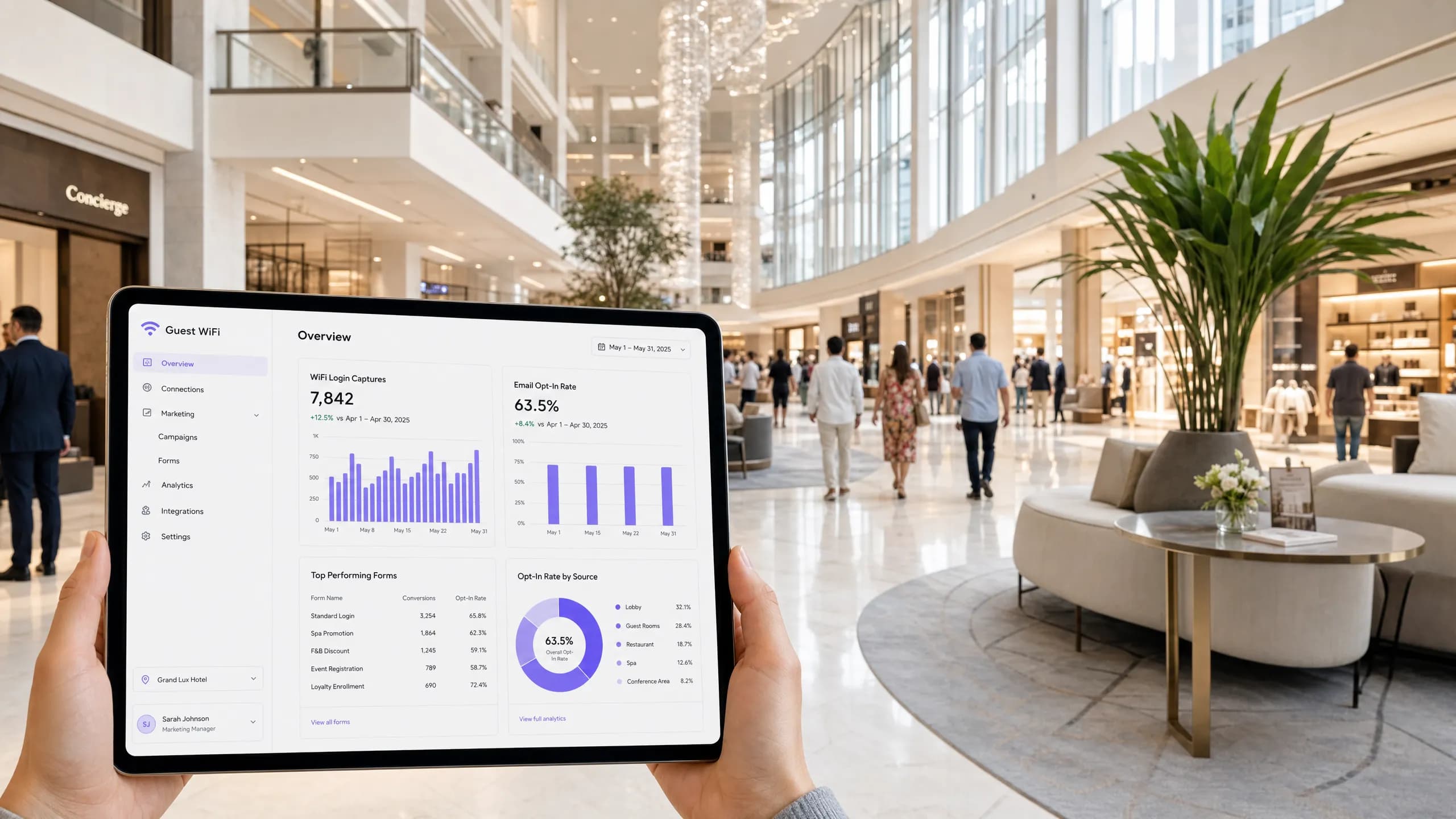
Video overview
Listen to this guide
Read the transcript
Welcome back. Today we're looking at physical venues - restaurants, retail, hotels - and a specific problem they face. You have foot traffic, but how do you turn that into contactable customers? Third-party cookies are disappearing. Buying email lists is a GDPR nightmare. And paper forms are, frankly, a mess. So, what's the alternative? We're discussing why your existing guest WiFi is actually your best marketing channel. Let's get into it. Let's start with the core issue. If you run a venue, you might see a thousand people walk through the door today. But unless they book a table, buy something online, or join a loyalty scheme, they leave as anonymously as they arrived. You're spending money to acquire them, but you have no way to bring them back. You need first-party data. Data they explicitly choose to share with you. Now, first-party data means information your guests give directly to you, with their consent. It's not data you've bought from a broker. It's not inferred from browsing behaviour across third-party websites. It's a direct relationship. And that distinction matters enormously right now, because the entire digital advertising ecosystem is shifting away from third-party data. Google has been deprecating third-party cookies for years. Regulators across Europe are tightening enforcement of GDPR. Apple's App Tracking Transparency has already cut off a huge chunk of mobile data. The message is clear: if you don't own your audience data, you don't own your marketing channel. So what does that mean for a venue operator? It means the traditional playbook - retargeting ads based on cookies, buying audience segments from data brokers, relying on social media platforms to reach your past customers - is becoming less effective and more expensive. You need a direct line to your guests. And the most practical way to build that line is already sitting in your venue, probably being used right now. The traditional methods of data capture in physical spaces just don't scale. Asking staff to collect emails slows down service and creates inconsistency. QR codes add friction. Paper forms are illegible and hard to digitise. And purchasing email lists carries significant GDPR risk, because you do not have the explicit consent required to market to those people. This is where guest WiFi changes the game. It's an infrastructure you already pay for. By adding a cloud overlay like Purple Engage, you turn a sunk cost into an automated data capture engine. It works on a simple value exchange: you provide fast, secure internet access, and in return, the guest provides their contact details and their consent to receive marketing. This isn't just about grabbing an email address. It's about quality and compliance. When a guest logs in via a captive portal - that's the branded web page they see before they get online - they make a conscious choice to opt in. That covers your GDPR requirements. And because you can verify the login via email confirmation or social login through providers like Google Workspace or Microsoft Entra ID, the data is accurate. No more deciphering handwriting or dealing with fake addresses. Let's talk about scale. Purple operates across more than 80,000 live venues worldwide. In 2024 alone, the platform processed 440 million logins. That's 440 million moments where a real person, in a real venue, chose to share their data. That's the scale of the opportunity. But capturing the data is only step one. The real power is in the behavioural context. Your WiFi network sees the device. It knows when the guest arrives, how long they stay, and how often they return. This allows you to move away from generic email blasts - which we all know yield diminishing returns - and move towards automated, segmented campaigns based on physical behaviour. Imagine setting up an automation that triggers an email 30 minutes after a first-time guest logs in, offering a small incentive for their next visit. Or a campaign targeting lapsed guests - people who visited three times last month but haven't been back in 30 days. Because the message is tied to their actual presence in your venue, the relevance is high, and the engagement rate follows. Or consider a birthday campaign. You capture the date of birth at login. You set up an automated email that goes out a week before their birthday with a personalised offer. That's a campaign that feels personal, costs almost nothing to run, and drives a visit at exactly the right moment. This is the difference between Purple Engage and a generic email tool like Mailchimp or Klaviyo. Those tools are excellent at sending campaigns. But they don't build the list. They don't know that a guest visited your venue on a Tuesday afternoon and stayed for two hours. They don't know that the same person hasn't been back in six weeks. Purple does, because the data comes from the physical network. Let's walk through a real-world example. A large pub group - think dozens of sites across the UK - was struggling with data capture. Staff were inconsistently asking for emails at the bar. Their database was small, patchy, and full of duplicates. They deployed Purple Engage across their estate, integrating with their existing Cisco Meraki hardware. No new hardware required. Within three months, they were capturing thousands of new, verified profiles every week. They set up a simple welcome email and a lapsed guest campaign. Return visit rates among the emailed segment increased significantly compared to the control group. Another example: a retail mall. The marketing team wanted to understand shopper behaviour and target frequent visitors with loyalty offers. But they had no way to track physical presence. Third-party cookies told them nothing about who was in the building. By deploying Purple across their HPE Aruba network, they could see dwell times, visit frequency, and which zones of the mall were most popular. They created a segment of high-frequency shoppers and ran a targeted campaign inviting them to a premium loyalty tier. The conversion rate was far higher than any previous campaign, because the audience was defined by real behaviour, not guesswork. Now let's talk about measurement, because this is where venue marketing often falls short. Open rates and click-through rates are standard email metrics, but they don't tell you if the campaign actually drove footfall. And footfall is what pays the bills. Because Purple Engage tracks physical presence via the WiFi network, it provides closed-loop attribution. You send an offer to 5,000 lapsed guests. You can see exactly how many of those devices walked back into your venue within 14 days. You can tie revenue directly to the send. That's a level of accountability that generic email tools cannot provide. So, where do you start? Here's a practical checklist. First, audit your current setup. Identify your existing WiFi hardware. Purple works with Cisco Meraki, HPE Aruba, Ruckus, Juniper Mist, Ubiquiti UniFi, Cambium, Extreme, and Fortinet. You almost certainly don't need to replace anything. Second, define your data requirements. Decide what information is most valuable to you - email address, phone number, date of birth, postcode. Keep the login form short. The more you ask for upfront, the lower your conversion rate will be. Third, establish the value exchange. Make sure your WiFi is fast and reliable. If the connection is poor, guests won't bother completing the login, and you lose the data. Fourth, set up your core automations. Start with a welcome email and a lapsed guest sequence. These two automations alone will drive measurable return visits. Fifth, review and refine. Look at your opt-in rates and your return visit attribution monthly. Adjust your forms and campaigns based on what the data tells you. A common pitfall to avoid: don't ask for too much information upfront. If you ask for their life history just to get online, they will abandon the process. Ask for the essentials - email and consent - and build the profile over time as they return. Let me answer a question I hear a lot: we already have a loyalty programme, why do we need this? The answer is that loyalty programmes capture a small percentage of your most engaged guests. Guest WiFi captures everyone who walks through the door. These two things complement each other. Use WiFi data to identify guests who visit frequently but haven't joined the loyalty programme, and target them with a specific campaign to enrol them. Another common question: is this really GDPR compliant? Yes, when implemented correctly. The key is the conscious-choice opt-in. The guest must actively tick a box to receive marketing. The consent must be recorded with a timestamp. And you must provide a clear and easy way to unsubscribe. Purple handles all of this within the platform. To summarise: the marketing landscape has shifted. Third-party cookies are disappearing, and venues need to own their audience data. Your guest WiFi is the most scalable, compliant, and context-rich way to build that first-party database. It automates capture, enables behavioural segmentation, and proves return on investment through physical attribution. If you're not using it, you're leaving your most valuable marketing asset sitting idle. The next step is straightforward. Audit your existing hardware, talk to your marketing team about what data they actually need, and look at how Purple Engage can sit on top of what you already have. You don't need a big infrastructure project. You need a cloud overlay and a clear strategy. Thanks for listening. We'll be back next time with more practical strategies for venue operators.
Why this matters for your venue
If you run a physical venue, you face a specific challenge that online businesses do not. Footfall does not equal contactable customers. A busy restaurant might serve 800 guests in a week, but if your CRM only holds 60 customers who booked online, you are marketing to just 7.5% of your actual audience. The other 92.5% leave as quietly as they arrived, without leaving any personal information behind.
The tools that once bridged this gap are disappearing. Third-party cookies, which allowed you to retarget past visitors with display ads, are being deprecated by every major browser. Purchased email lists carry serious GDPR risk and consistently underperform, because you do not have the explicit consent of the people on the list. Paper sign-up sheets are not only inefficient and illegible, they also depend on staff remembering to ask.
The cost of inaction is concrete. You spend budget attracting new customers but lack a way to bring them back. You pay for social media advertising to reach people who have already been inside your building. You run promotions but cannot measure whether they actually drive repeat visits.
First-party data - information your customers explicitly choose to share with you - is the solution. It is accurate, legally compliant, and owned by you. The most scalable way to collect it is already installed in your venue: your Guest WiFi.
How it works in practice
Guest WiFi inverts the data acquisition model. Instead of chasing customers after they leave, you capture their data the moment they arrive and choose to connect. The mechanism is the captive portal - the branded login page guests see before they get online. They provide their details, tick the marketing opt-in box, and receive internet access in exchange.
This is a conscious opt-in. Guests actively decide to share their data. That satisfies GDPR's requirement for explicit consent, and the consent is automatically timestamped and recorded. There is no paper trail and no ambiguity.
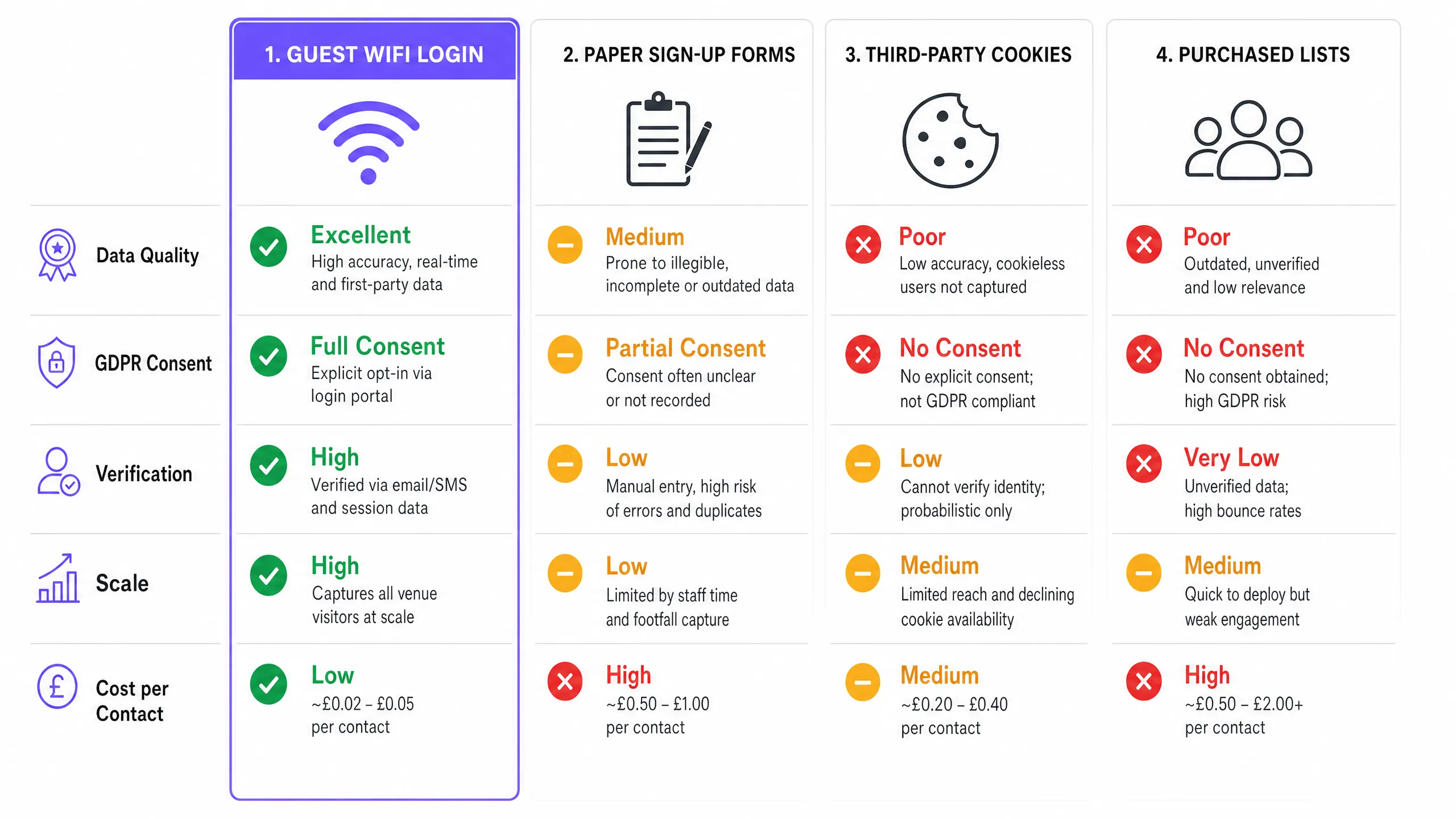
Data quality is high because it is verified. A guest who confirms their login via email has proven the address is real and accessible. A guest who signs in with a social account through Google Workspace or Microsoft Entra ID provides identity data that has already been verified by that provider. Contrast that with purchased lists, where bounce rates commonly run at 20-40% because the data is unverified and often stale.
Because the WiFi network recognises every connected device, data capture is automatic and continuous. A multi-site hospitality brand using Purple Engage adds thousands of verified new profiles to its CRM every week without any manual intervention. Purple runs across more than 80,000 active venues worldwide and processed 440 million logins in 2024 (Purple internal data, 2024). That is the scale of the opportunity.
How to achieve this with your guest WiFi
Turning your network into a marketing channel requires the right overlay. Your existing hardware - whether Cisco Meraki, HPE Aruba, Ruckus, Juniper Mist, Ubiquiti UniFi, Cambium, Extreme or Fortinet - provides the connectivity. Purple Engage runs on top as a cloud overlay, providing the data capture, CRM and campaign engine without requiring you to replace any infrastructure.
When guests connect, they are redirected to your branded captive portal. You configure the authentication methods: a simple form, social login, or an identity provider. You also configure which data fields to collect. Keep it lean. Asking for more than three to four fields (typically email address, first name, date of birth and marketing consent) significantly reduces completion rates.
Once authenticated, the guest's profile is created in Purple Engage. The network then tracks their behaviour: when they visit, how long they stay, and which of your venues they frequent. Over time this builds a rich behavioural profile rather than just a static email address. A guest who comes in every Tuesday lunchtime and stays for 45 minutes is a completely different marketing target from one who visited once six months ago.
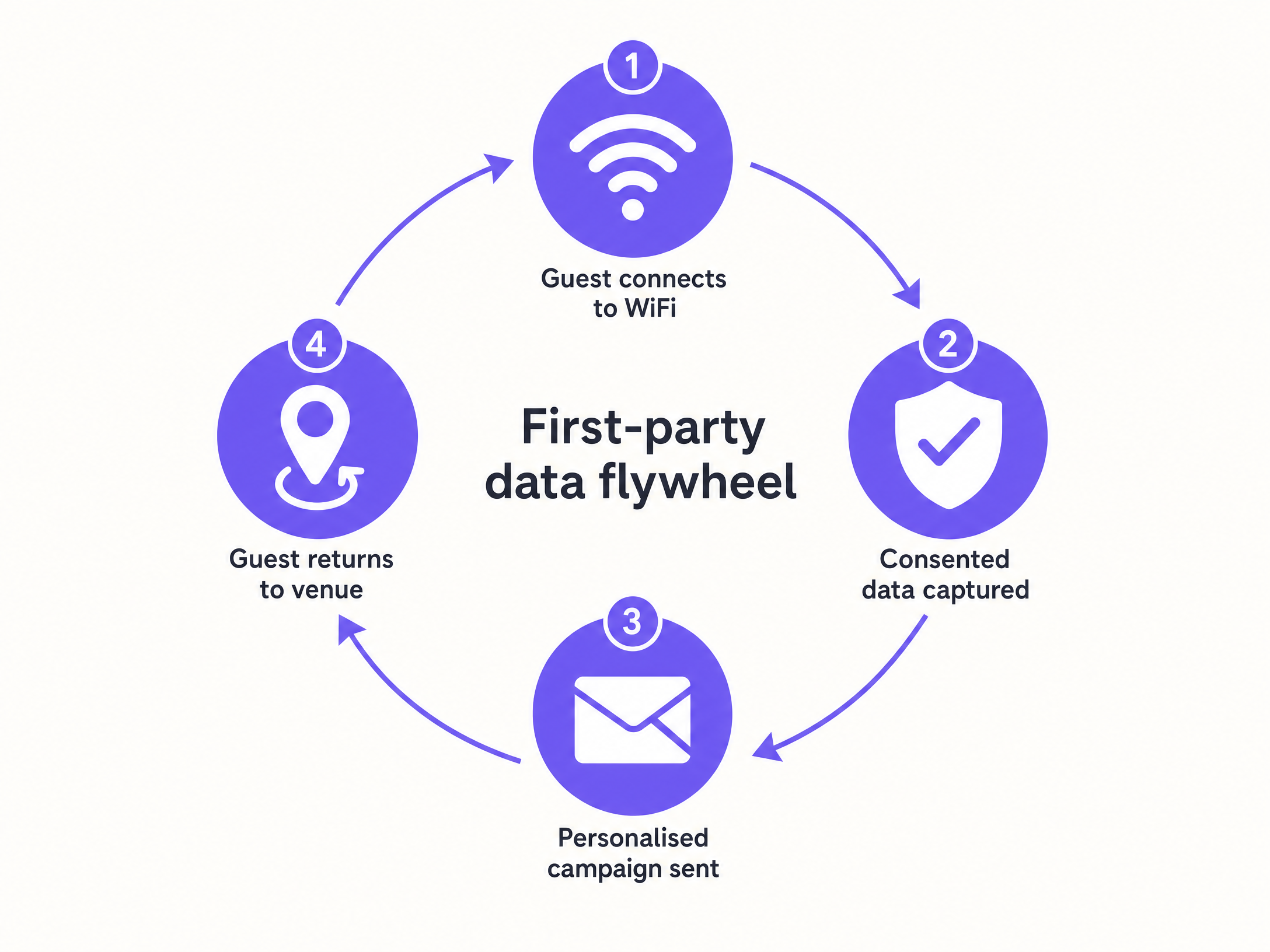
For a deeper look at building your list from scratch, see How to build an email list from WiFi (without buying one).
What to send, and when
Capturing data is only the first step. The value lies in using it to drive repeat visits. Unlike generic tools such as Mailchimp or Klaviyo, Purple Engage understands venue context. It knows whether someone is a first-time guest or a regular. It knows when they last visited. It knows their dwell time. These signals let you send the right message at the right moment.
Four automations deliver most of the return:
Welcome sequence. Trigger an email 30 minutes after a first-time guest logs in. Thank them for coming, offer a small incentive for their next visit, and invite them to leave a review. This automation alone converts one-off visits into second visits.
Lapsed guest win-back. Segment guests who visited three or more times within 30 days but have not returned in the past 45 days. Send a targeted offer to win them back. This is your highest-value segment, because their intent is already proven.
Birthday trigger. Collect date of birth at login. Automatically send an email with an exclusive offer seven days before their birthday. Customers who receive birthday wishes from a venue they like tend to come back for the occasion.
High-value segment. Identify guests with long dwell times or high visit frequency and invite them to join your loyalty programme. These are your most engaged customers, and conversion from WiFi data into loyalty sign-ups is significantly higher than from generic acquisition campaigns.
Measuring what actually works
Open rates and click rates are the standard email metrics, but they do not directly generate revenue. For venue marketers, the true measures of success are footfall and revenue.
Because Purple Engage tracks actual physical presence through the WiFi network, it provides closed-loop attribution. You can see exactly how many people received a campaign email, and how many of their devices subsequently appeared in your venue within a defined window. If you send a "20% off your next visit" email to 5,000 lapsed customers and 420 of those devices reconnect within 14 days, you have a clear, attributable return on that campaign.
This changes the conversation with your finance team. You are no longer reporting vanity metrics. You are reporting incremental footfall and the revenue it generated. That is a number your CFO will recognise.
Track these four metrics for every campaign: captive portal consent opt-in rate (target above 50%), email open rate (the hospitality average is around 25-30%), return-visit rate among the emailed segment, and revenue per send. The last two are the metrics that matter most.
Where to start
- Audit your hardware. Confirm your existing WiFi infrastructure. Purple Engage integrates with Cisco Meraki, HPE Aruba, Ruckus, Juniper Mist, Ubiquiti UniFi, Cambium, Extreme and Fortinet. You will almost certainly not need to replace anything.
- Define your data fields. Agree a minimum viable dataset with your marketing team. Email address and marketing consent are non-negotiable. Date of birth and postcode are high-value additions. Cap the form at four fields maximum.
- Make the WiFi worth connecting to. The value exchange only works if the connection is fast and reliable. If guests connect and the experience is poor, you lose the data and damage the brand.
- Set up your core automations. Start with the welcome email and the lapsed guest sequence. These two automations deliver measurable return visits within the first month.
- Fix your attribution window. Decide how many days after a campaign send a return visit counts as attributed. For most hospitality venues, 14 days is a practical standard.
- Review monthly. Monitor consent opt-in rate, return-visit rate and revenue per send. Adjust your portal design and campaign content based on what the data tells you.
For more on campaign strategy once your list is built, see A practical guide to email marketing for restaurants.