
Mailchimp for hotels: where it falls short for venues
This guide explains why generic email tools like Mailchimp fall short for hotels, as they track inbox metrics rather than physical return visits.
Video overview
Listen to this guide
Read the transcript
Mailchimp for hotels: where it falls short for venues A Purple Engage marketing brief. Approximately 10 minutes. --- SECTION ONE: WHY THIS MATTERS - approximately 1 minute Let's start with a question you've probably already asked yourself. You've got Mailchimp set up, you're sending campaigns, the open rates look reasonable - so why aren't more guests coming back? Here's the honest answer: Mailchimp was built for e-commerce. It was designed to sell products online, track clicks to a checkout page, and measure orders. It does that very well. But a hotel is not an online store. Your guests don't buy a room the way someone buys a pair of trainers. They arrive in person, they sleep in your property, they eat in your restaurant, they use your spa. The value you want to measure is whether they come back - and whether they spend more when they do. Mailchimp cannot tell you that. It measures opens and clicks. It has no idea whether the guest who opened your spring offer email actually booked a return stay, or walked through your door again six weeks later. That gap - between what Mailchimp measures and what hotels actually need to know - is exactly what this guide is about. --- SECTION TWO: THE APPROACH - approximately 5 minutes Let's break down what Mailchimp actually does for a hotel, and where the gaps appear. Mailchimp is, at its core, an email sending platform. You upload a list, design a template, schedule a send, and review the results. The results it gives you are: how many people opened the email, how many clicked a link, how many unsubscribed. If you've connected it to an e-commerce store, it can track online orders. That's the product. For a hotel, the first problem appears before you even send anything: the list. Mailchimp does not build your guest list. You have to bring the list to it. That means exporting contacts from your property management system, cleaning the data, formatting it correctly, and uploading it manually. If your PMS data is patchy - and in most hotels it is, because guests book through OTAs and never hand over a direct email address - your list is thin. You're marketing to a fraction of the guests who actually stayed with you. The second problem is consent. Under GDPR, you cannot simply email every guest who ever stayed at your property. You need a lawful basis - and for marketing, that almost always means explicit opt-in consent. If your guests booked through Booking.com or Expedia, the OTA holds the relationship, not you. You don't have consent to market to them. Mailchimp has no mechanism to solve this. It will happily send to whoever is on your list, but it cannot tell you whether those contacts actually consented to receive marketing from your hotel specifically. The third problem is segmentation. Mailchimp segments are built from email behaviour: who opened, who clicked, who bought something online. For a hotel, the segments that matter are completely different. You want to know: which guests stayed more than twice in the last year? Which guests visited in the summer but not the winter? Which guests used the spa? Which guests haven't returned in 18 months and are worth a win-back offer? None of those segments exist in Mailchimp, because Mailchimp has no connection to your property data. It only knows what happened in the inbox. The fourth problem is measurement. When you send a campaign in Mailchimp, you see opens and clicks. You do not see whether the guest who clicked your "book again" button actually completed a reservation. You do not see whether the guest who ignored the email walked in anyway because they were passing. You cannot connect a campaign send to a return visit, because Mailchimp has no visibility of what happens in your physical venue. Now, here's where Purple Engage works differently - and the difference starts before the campaign is even built. When a guest connects to your Guest WiFi, they land on a branded splash page. That page asks for their email address and presents a clear, GDPR-compliant opt-in checkbox. The guest makes a conscious choice to receive marketing from you. That's a conscious-choice opt-in - not a pre-ticked box, not buried in terms and conditions, but a deliberate action by a real person who is physically present in your venue. That contact goes straight into Purple Engage. No CSV export, no manual upload, no data cleaning exercise. Purple operates across more than 80,000 venues worldwide and recorded 440 million logins in 2024. That scale means the platform has been tested and refined across every type of physical venue - hotels, restaurants, retail, airports. Premier Inn and Whitbread both use Purple. The platform carries ISO 27001 certification, GDPR compliance, CCPA compliance, and Cyber Essentials certification. The consent mechanism is built to the standard, not bolted on afterwards. Once the guest is in the system, Purple Engage tracks their return visits. Every time they reconnect to your WiFi, the system logs it. You can see first visit, most recent visit, visit frequency, and dwell time. Those data points become the basis for your segments. You can target guests who visited once and haven't returned. You can target guests who visit regularly and reward them. You can target guests who visited last summer and send them a relevant offer as the season approaches again. The campaigns themselves are triggered by real venue behaviour, not email behaviour. A guest who hasn't logged into your WiFi in 60 days gets a win-back email. A guest who logs in for the third time gets a loyalty reward. A guest who connects on a Friday evening gets a weekend dining offer. The trigger is a physical action in your venue, not a click on a previous email. --- SECTION THREE: PRACTICAL STEPS AND PITFALLS - approximately 2 minutes Let's talk about what to do and what to watch out for. The first practical step is to audit your current list quality. Before you switch tools or add a new layer, understand what you actually have. How many of your current Mailchimp contacts have explicit consent for hotel marketing? How many came from OTA bookings where you don't hold the direct relationship? If the answer is "I'm not sure," that's a GDPR risk you need to address regardless of which platform you use. The second step is to connect Purple Engage to your existing WiFi infrastructure. Purple is hardware-agnostic - it works with Cisco Meraki, HPE Aruba, Ruckus, Juniper Mist, Ubiquiti UniFi, Cambium, Extreme, and Fortinet. You don't need to replace your access points. The platform sits as a cloud overlay on top of your existing network. The third step is to design your splash page. This is the guest's first interaction with your marketing system, so it matters. Keep it on-brand, keep the form short - email address and the opt-in checkbox is enough - and be clear about what the guest is signing up for. "Receive exclusive offers from The Grand Hotel" is better than "Subscribe to our mailing list." Specificity increases opt-in rates. The main pitfall to avoid is treating Purple Engage as a replacement for Mailchimp and then using it in exactly the same way. The platform's value is in the venue data - the visit frequency, the dwell time, the return patterns. If you ignore those signals and just send the same generic monthly newsletter you were sending before, you'll get similar results. The segments are what make the difference. Use them. The second pitfall is neglecting the post-stay window. Research from Revinate shows that post-stay emails sent within 48 hours of checkout achieve open rates of 52%, compared to 18% for generic hotel newsletters. The guest is still in the mindset of their stay. That's the moment to ask for a review, offer a return booking incentive, or introduce your loyalty programme. Don't wait two weeks. --- SECTION FOUR: QUICK Q AND A - approximately 1 minute A couple of questions that come up regularly. "We already have a PMS - do we still need this?" Yes. Your PMS manages reservations and operations. Purple Engage manages the marketing relationship with guests who are physically present. The two systems serve different purposes. Purple Engage builds the opted-in marketing list that your PMS cannot build, because most PMS contacts come from OTA bookings without direct marketing consent. "What about guests who don't use WiFi?" They won't be captured through the WiFi login flow. For those guests, your PMS data and direct booking forms remain the source. Purple Engage complements your existing data collection - it doesn't replace it. But in practice, the majority of hotel guests connect to the property WiFi during their stay, which makes it the highest-volume opt-in touchpoint available to you. "Is this GDPR compliant?" Yes. Every contact in Purple Engage has actively opted in at the WiFi login stage. The platform is ISO 27001 certified and GDPR compliant. The consent record is stored against each contact. --- SECTION FIVE: SUMMARY AND NEXT STEPS - approximately 1 minute Let's bring this together. Mailchimp is a good email tool for e-commerce. For hotels, it has three structural gaps: it cannot build your guest list from venue activity, it cannot segment by physical visit behaviour, and it cannot tie a campaign to a return visit. Those gaps mean you're measuring the wrong things and missing the guests who matter most. Purple Engage closes those gaps by starting at the WiFi login. The list builds itself from guests who are physically present and actively consenting. Segments are based on visit frequency and behaviour, not inbox behaviour. And the metric that matters - repeat visits - is the one the platform is designed to improve. The platform has delivered a 24% increase in repeat visits across venues using it. The next step is straightforward. Audit your current consent position, check your WiFi hardware against the compatible list - Cisco Meraki, HPE Aruba, Ruckus, and the others - and book a demo with the Purple team. You can find the product overview at purple.ai/guest-wifi/engage. That's it for this episode. Thanks for listening.
Why this matters for your venue
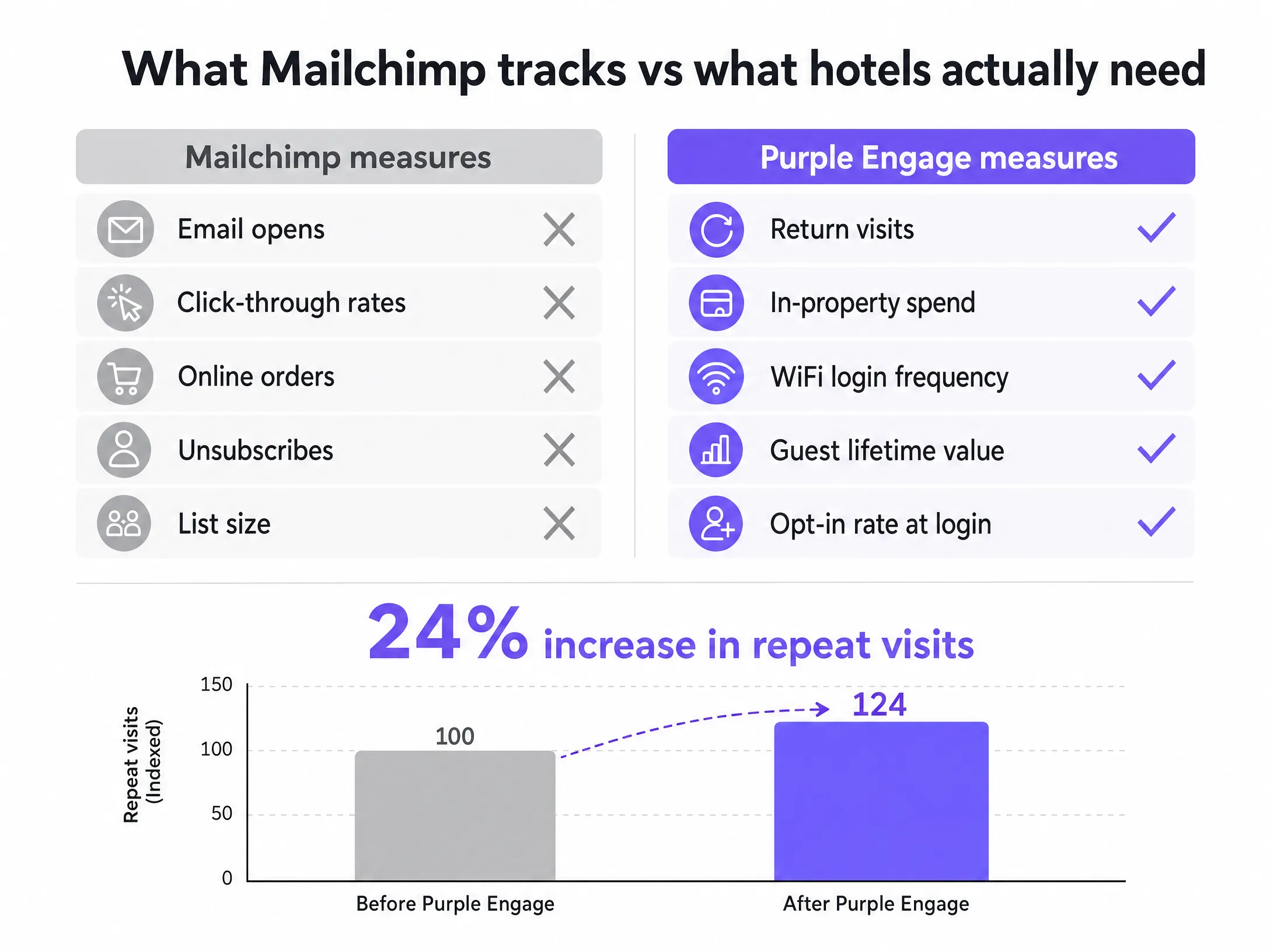
If you manage marketing for a hotel, you already know the core problem with generic email tools. You send a campaign, you look at the open rates, and you try to guess if anyone actually booked a return stay. Mailchimp was built for e-commerce. It measures email opens, link clicks, and online shopping cart orders. It does not measure foot traffic, return stays, or in-property spend.
For a hotel, the cost of this disconnect is high. You rely on property management system data that is often incomplete, because guests who book through online travel agencies do not share their direct email addresses. You spend time formatting CSV files to upload into Mailchimp, only to send generic newsletters to a list that is missing half your actual guests. You measure success by whether an email was opened, not by whether the guest walked through your door again. This approach leaves revenue on the table. Purple Engage solves this by capturing the guest at the WiFi login and tying campaigns to actual return visits.
The approach
The fundamental difference between Mailchimp and a venue-native platform is how the list is built. Mailchimp expects you to bring the list to the platform. Purple Engage builds the list for you, using the physical infrastructure you already have.
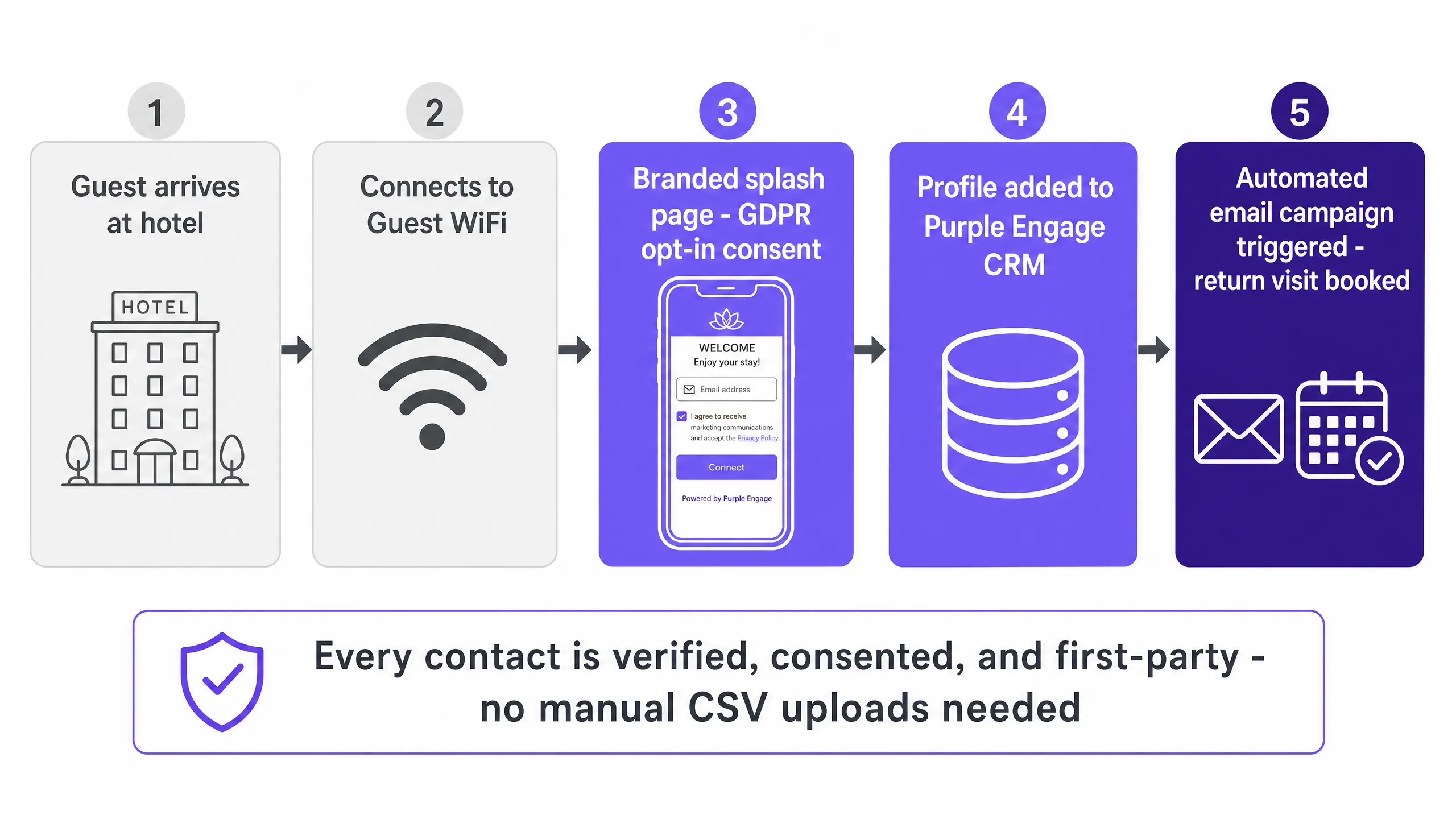
When a guest arrives at your property, they connect to the Guest WiFi. They land on a branded splash page, enter their email address, and check a box to opt in to marketing communications. This is a conscious-choice opt-in. The guest is physically present, making a deliberate decision. The data flows directly into the Purple Engage CRM. There is no manual upload. Every contact is verified, consented, and first-party.
This mechanism solves the GDPR compliance problem that plagues hotels relying on OTA bookings. You hold the direct relationship, and you have the consent record to prove it. From that moment, the platform tracks the guest's physical behavior. It logs their visit frequency, their dwell time, and their return patterns.
How to do it with your guest WiFi
Implementing this approach requires connecting your marketing strategy to your physical network. Purple Engage operates as a cloud overlay. It integrates with Cisco Meraki, HPE Aruba, Ruckus, Juniper Mist, Ubiquiti UniFi, Cambium, Extreme, and Fortinet. You do not replace your hardware.
The process begins with the splash page. The design must be clean and the form short. Ask for the email address and provide the opt-in checkbox. Once the guest authenticates, their profile is created or updated in the CRM. The platform then tracks their device MAC address, anonymizing it for privacy but using it to log subsequent visits.
When you build a segment in Purple Engage, you build it based on venue data. You isolate guests who visited three times in the last six months. You segment guests who stayed during the summer season. You identify guests who have not returned in a year. Mailchimp cannot do this because it only knows who opened an email. Purple Engage knows who actually came back.
What to send, and when
Timing is the difference between a conversion and an unsubscribe. Because Purple Engage tracks physical presence, you can trigger campaigns based on real venue behavior.
The post-stay window is critical. Research shows that post-stay emails sent within 48 hours of checkout achieve 52% open rates, compared to 18% for generic hotel newsletters. This is the moment to ask for a review, offer an incentive for a direct return booking, or introduce your loyalty program.
Automate your win-back campaigns. Set a trigger for guests who have not logged into the WiFi for 180 days. Send them a targeted offer. Automate your loyalty rewards. When a guest logs in for their fifth visit, trigger an email offering a complimentary drink at the bar or a spa discount. These are campaigns that run quietly in the background, driving revenue without manual intervention.
Measuring what works
The metric that matters is the return visit. Mailchimp measures campaign success by open rates and click-through rates. Purple Engage measures success by whether the guest returned to the venue.
The platform tracks the correlation between the email send and the subsequent WiFi login. You can see exactly how many guests received the win-back campaign and subsequently walked through your doors. This is the proof point you need for your venue owners. You are no longer reporting on inbox metrics; you are reporting on foot traffic and direct revenue. Purple data shows a 24% increase in repeat visits across venues using this approach.
Where to start
- Audit your current Mailchimp list to identify how many contacts have explicit, GDPR-compliant consent for hotel marketing.
- Review your existing WiFi hardware against the compatible list (Cisco Meraki, HPE Aruba, Ruckus, etc.).
- Design a branded splash page that prioritizes a simple email capture and a clear opt-in checkbox.
- Set up your first automated post-stay campaign to trigger 48 hours after the guest's final WiFi login.
- Define your win-back segment based on guests who have not visited in the last six months.
For more information on capturing first-party data, read our guide on Guest WiFi. To see the full product capabilities, visit the Product overview. For guidance on presenting these metrics, review Proving marketing ROI to venue owners with WiFi data.