
Managing consent and unsubscribes for venue email
Managing email consent correctly is the difference between a high-converting guest database and a GDPR liability.

Video overview
Listen to this guide
Read the transcript
Welcome to the Purple Engage briefing. I'm your host, and today we're covering something that sits right at the intersection of compliance and commercial performance: managing email consent and unsubscribes for venue email marketing. If you run a restaurant, a hotel, a bar, or a retail space, this affects you directly. Get it wrong and you face GDPR fines and a damaged sender reputation. Get it right and you build a high-quality, high-converting list that drives real repeat visits. Let's start with why this matters. Here is the core problem. Most venues have a leaky consent process. Someone fills in a paper form at the bar, a member of staff types it into a spreadsheet on Friday afternoon, and by the time it reaches your email platform, the data is three days old and possibly wrong. A guest who unsubscribed on Tuesday might still receive your Thursday newsletter, because the manual sync hasn't run yet. That is not just a compliance risk under GDPR. It is a list quality problem. Every email you send to someone who doesn't want it damages your sender reputation with inbox providers like Google and Microsoft. A damaged sender reputation means your emails land in spam, even for the guests who do want to hear from you. The financial case is straightforward. Venues that maintain clean, verified lists see higher open rates, higher click-through rates, and - crucially - higher return visit rates. The list is the asset. Protecting it is protecting revenue. The right approach is to use your guest WiFi login as the single point of truth for consent. Here is how it works. When a guest connects to your WiFi, they see a captive portal - the login page before they get online. That portal presents a clear, conscious-choice opt-in for marketing communications. Not a pre-ticked box. Not buried in terms and conditions. A deliberate, visible choice. This is the key distinction that separates Purple Engage from generic email tools. Mailchimp, Klaviyo, HubSpot - these are excellent platforms for sending campaigns. But they do not build the list. Purple builds the list, automatically, from verified guests who are physically present in your venue at the moment they opt in. GDPR requires that consent be freely given, specific, informed, and unambiguous. A conscious-choice opt-in at the WiFi portal meets all four criteria. And because Purple timestamps every consent event - recording the date, time, venue, and method of opt-in - you have a defensible record you can produce in the event of a regulatory query. That timestamp is not a minor technical detail. It is your legal evidence. If a guest ever disputes whether they opted in, you have the exact record. Let me walk you through the implementation in practical terms. Step one: configure your captive portal. Your portal needs a clear, separate checkbox for marketing opt-ins. The language should be straightforward - something like 'I'd like to receive exclusive offers and updates from this venue.' Do not bundle this with the terms of service acceptance. GDPR requires them to be separate. Step two: let Purple capture the data. As guests log in, Purple records their email address, consent status, and the timestamp. It also captures their device identifier, which allows Purple to recognise returning guests even before they log in again. This builds a visit history that feeds directly into your segmentation. Step three: automate the sync. Purple integrates directly with your email marketing platform. Every new opt-in flows into your list automatically. Every unsubscribe flows back out automatically. There is no manual CSV export. There is no Friday afternoon data entry. The list is always current. Step four: handle unsubscribes correctly. Every marketing email you send must include an unsubscribe link. When a guest clicks it, Purple receives the opt-out signal and immediately updates their profile. They are removed from all future sends. This happens in real time, not in the next weekly batch. This is the structural difference between a compliant process and a risky one. The risk is not in the intent - most venue operators have no desire to spam their guests. The risk is in the gap between the unsubscribe action and the list update. Purple closes that gap to zero. Once you have a verified, opted-in list, the question becomes what to send and when. The welcome email is the highest-performing automation in venue marketing. Send it within 24 hours of a guest's first visit. Thank them for coming. Offer a reason to return - a discount, a loyalty point, an exclusive event. Guests who receive a well-timed welcome email return at a significantly higher rate than those who don't. The win-back campaign targets guests who haven't visited in 90 days. Purple tracks visit frequency, so you can identify exactly who has gone quiet. A targeted offer - 'We haven't seen you in a while, here's something to bring you back' - reactivates a meaningful proportion of lapsed guests. The VIP segment rewards your most frequent visitors. These are the guests who visit at least once a month, who spend above average, who are genuinely loyal. Treating them differently - with early access to events, personalised offers, a handwritten note from the manager - builds the kind of loyalty that is very hard for competitors to replicate. For more on how to build these segments using recency, frequency, and monetary value, we have a full guide on RFM segmentation for restaurants and hospitality. The link is in the show notes. Let me cover the three most common pitfalls I see venue operators make. Pitfall one: conflating WiFi access with marketing consent. You cannot make marketing opt-in a condition of accessing the WiFi. GDPR is explicit on this. Consent must be freely given. If a guest has to tick the marketing box to get online, that consent is not valid. Keep the two separate. Pitfall two: relying on a single unsubscribe mechanism. Your email footer link is the minimum requirement, but it is not enough on its own. You should also allow guests to update their preferences at the WiFi portal on subsequent visits. Purple makes this straightforward - returning guests can see and update their consent preferences each time they log in. Pitfall three: not auditing your list regularly. Even with automated processes, it is worth reviewing your consent records quarterly. Check that the opt-in language on your portal is still accurate. Check that your email platform is correctly reflecting the opted-out status of guests who have unsubscribed. A quarterly audit takes an hour and gives you confidence that your process is working as intended. Let me answer a few questions I hear regularly from venue operators. Question: do I need to re-obtain consent from guests who signed up before GDPR came into force? Answer: if you cannot demonstrate that their original consent met GDPR standards - freely given, specific, informed, unambiguous - then yes, you should run a re-permission campaign. It will reduce your list size in the short term, but the remaining list will be higher quality and fully defensible. Question: what happens if a guest connects to our WiFi but doesn't opt in to marketing? Answer: they access the WiFi. That is it. You do not add them to your marketing list. You may retain their connection data for network management purposes, but you cannot use it for marketing without explicit consent. Question: can I import my existing email list into Purple Engage? Answer: yes, but you should only import contacts for whom you have valid, documented consent. Purple will manage the ongoing consent and unsubscribe process from that point forward. Let me bring this together. The core principle is simple: consent is a choice, not a condition. Every guest who opts in to your marketing list should do so deliberately, with a clear understanding of what they are signing up for. And every guest who opts out should be removed immediately, automatically, without any manual intervention. Purple Engage automates both sides of this. It captures conscious-choice opt-ins at the WiFi portal, timestamps every consent event, and handles unsubscribes in real time. The result is a list that is smaller than a scraped or purchased list, but far more valuable - because every contact on it is a verified guest who has been in your venue and actively chosen to hear from you. Your next steps are straightforward. First, review your current WiFi portal and check that your marketing opt-in is clear, separate, and compliant. Second, enable the automated sync between Purple and your email platform. Third, set up a welcome automation for first-time guests. And fourth, build a win-back campaign for guests who haven't visited in 90 days. If you are not yet using Purple Engage, visit purple.ai to see how it works. And if you found this briefing useful, share it with your marketing director or CRM manager - this is exactly the kind of process they need to have in place. Thanks for listening. We'll be back next time with more practical guidance on turning your venue's foot traffic into lasting customer relationships.
Why this matters for your venue
Every venue operator wants a high-quality email list. The problem is how most venues build one. A paper sign-up sheet at the bar, a staff member typing addresses into a spreadsheet on Friday afternoon, a weekly CSV export into Mailchimp - this is the reality for a large proportion of hospitality and retail businesses. It is slow, error-prone, and structurally incapable of handling unsubscribes in real time.
The commercial cost is real. A guest who unsubscribes on Tuesday but receives your Thursday newsletter is a complaint waiting to happen. More importantly, every email you send to someone who does not want it damages your sender reputation with inbox providers like Google and Microsoft. A degraded sender reputation means your campaigns land in spam folders - including for the guests who actively want to hear from you. Open rates fall, click-through rates fall, and revenue per send falls with them.
The compliance cost is equally concrete. Under GDPR, you must be able to demonstrate that every contact on your list gave explicit, freely given, informed consent to receive marketing communications. If you cannot produce a timestamped record of when and how that consent was given, you cannot defend yourself in the event of a complaint or regulatory inquiry. The Information Commissioner's Office (ICO) has issued fines exceeding £100,000 for consent failures in marketing databases.
The good news is that fixing this does not require a complex IT project. It requires connecting your email consent management to the one touchpoint every guest already uses: your WiFi.
The approach
The core method is to use the guest WiFi login as the single point of truth for consent. When a guest connects to your network, they encounter a captive portal - the login page presented before they access the internet. That portal is where consent happens.
A well-configured captive portal presents two separate actions. First, the guest accepts your terms of service to access the WiFi. Second, they are offered a clear, unchecked checkbox to opt into marketing communications. These must be separate. GDPR Article 7 requires that consent for marketing cannot be bundled with a condition of service. If a guest must check the marketing box to get online, that consent is not valid.
Purple Engage handles this separation automatically. The portal is configured to present a standalone marketing opt-in, with plain language explaining what the guest is signing up for. When a guest checks the box, Purple records the consent event with a timestamp, the venue identifier, the date and time, and the method of opt-in. This is your defensible consent record - the evidence you would produce in response to a subject access request or a regulatory query.
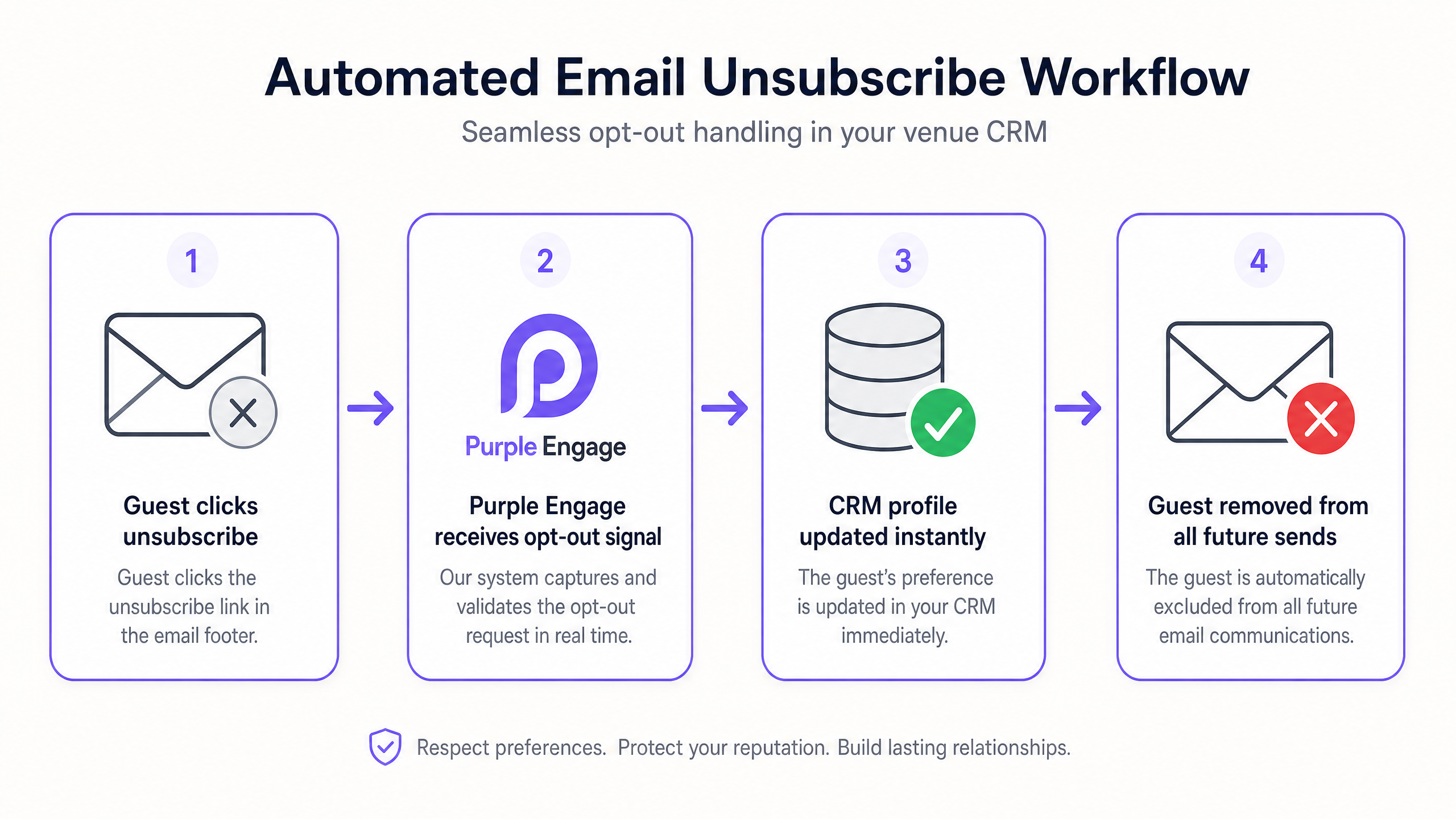
When a guest opts out - either by clicking the unsubscribe link in an email footer or by updating their preferences at a subsequent WiFi login - Purple updates their profile immediately. The opt-out is reflected across all connected platforms in real time. There is no batch process, no weekly sync, no gap between the guest's action and the list update.
How to do it with your guest WiFi
Deploying this process with Purple Engage follows four steps.
Step 1: Configure the captive portal. Set up your login page to include a clearly labeled marketing opt-in checkbox, separate from the terms of service. The opt-in language should be specific: tell the guest what they will receive, how often, and from which venue or brand. Vague language like "receive communications from us" is insufficient under GDPR. "Receive exclusive offers and event updates from [Venue Name] by email" is specific and compliant.
Step 2: Let Purple capture the data. As guests log in via Guest WiFi, Purple records their email address, consent status, and the full timestamp. It also captures their device identifier, which allows Purple to recognize returning guests on subsequent visits - building a visit history that feeds directly into your segmentation without requiring a new login each time.
Step 3: Automate the sync. Purple integrates directly with your email marketing platform. Every new opt-in flows into your list automatically. Every unsubscribe flows back out automatically. There is no manual CSV export, no Friday afternoon data entry, no risk of a stale list. The database is always current.
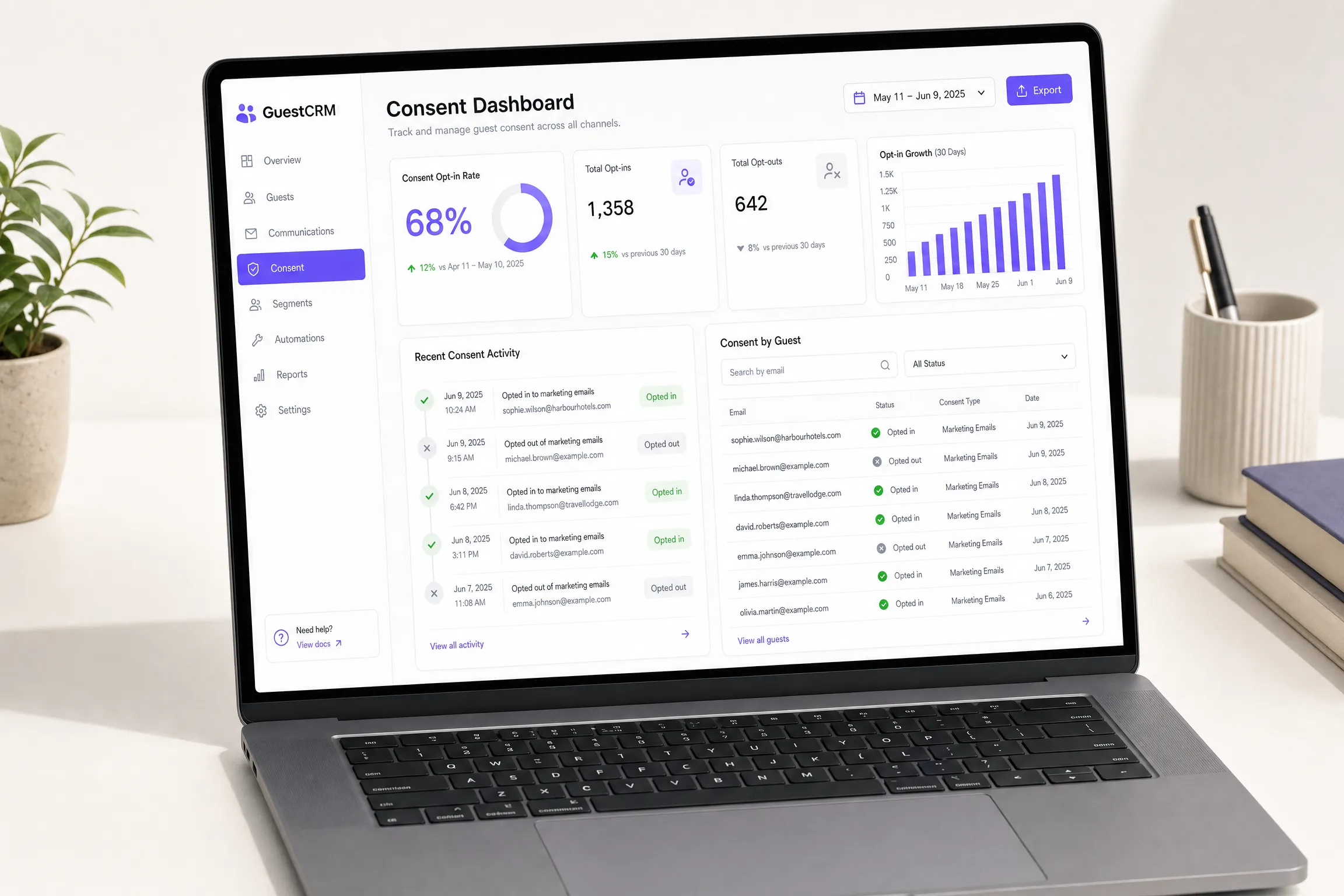
Step 4: Maintain the audit trail. Purple stores the full consent record for every contact. You can export this at any time to respond to a subject access request or demonstrate compliance to a regulator. The record includes the date, time, venue, portal version, and the exact opt-in language the guest saw when they consented.
What to send, and when
A verified, opted-in list of guests who have physically visited your venue is a high-value asset. The campaigns that perform best against this audience are those tied directly to visit behavior.
The welcome email is the single highest-performing automation in venue marketing. Send it within 24 hours of a guest's first visit. Thank them for coming, reference the venue specifically, and offer a reason to return - a discount on their next visit, a loyalty point, an invitation to an upcoming event. Guests who receive a well-timed, personalized welcome email return at a measurably higher rate than those who do not.
The win-back campaign targets guests who have not visited in 90 days. Because Purple tracks visit frequency via device recognition, you can identify exactly who has gone quiet. A targeted message - acknowledging the gap and offering an incentive - reactivates a meaningful proportion of lapsed guests at a fraction of the cost of acquiring new ones.
The VIP segment rewards your most frequent visitors. These are the guests who visit at least once a month, who spend above average, who are genuinely loyal. Treating them differently - with early access to events, personalized offers, a note from the venue manager - builds the kind of loyalty that competitors cannot easily replicate. For a detailed framework on building these segments using recency, frequency, and monetary value, see our guide on RFM segmentation for restaurants and hospitality.
The timing principle across all of these is the same: send when the visit is fresh. The 24-hour window after a first visit is the highest-engagement moment you will ever have with a new guest. Do not waste it with a generic newsletter.
Measuring what works
Open rates and click-through rates are useful hygiene metrics, but they are not the measure of success for a venue email program. The measure of success is return visits and revenue.
Because Purple Engage tracks physical presence via device recognition, you can close the loop between a campaign sent and a guest walking back through the door. This closed-loop reporting is the commercial proof point that justifies your email marketing investment. You can see, for a specific campaign, how many recipients returned to the venue within 30 days, what they spent, and how that compares to the control group who did not receive the email.
The secondary metrics worth tracking are list growth rate, consent opt-in rate at the portal, and unsubscribe rate per campaign. A rising unsubscribe rate on a specific campaign type is a signal that the content or frequency is misaligned with guest expectations - and it is far better to catch that signal early than to let it erode your sender reputation.
A consent opt-in rate below 30% at the portal is typically a sign that the opt-in language is unclear or the value proposition is weak. Test different portal copy to improve this rate. Every percentage point of improvement translates directly into a larger, higher-quality list.
Where to start
Here is a short, ordered checklist to get your consent management process in place.
- Audit your current captive portal. Confirm that the marketing opt-in is a separate, unchecked checkbox with specific, plain-language copy.
- Verify that your portal records a timestamp for every consent event and that this data is accessible for export.
- Enable the automated sync between Purple Engage and your email marketing platform so that opt-ins and unsubscribes flow in real time.
- Set up a welcome automation triggered within 24 hours of a guest's first visit.
- Build a win-back segment for guests with no visit in the past 90 days.
- Schedule a quarterly consent audit to review portal language, check unsubscribe rates, and confirm that opted-out contacts are correctly suppressed across all platforms.
If you are starting from a legacy list built before this process was in place, run a re-permission campaign before importing contacts into Purple Engage. Send a single email asking recipients to confirm they still want to hear from you. The list will shrink, but every contact who remains is verified and defensible.