
Purple Engage vs Mailchimp: what venue marketers need to know
This guide compares Purple Engage with Mailchimp for marketing directors and owner-operators at physical venues. It explains why a purpose-built venue CRM that captures first-party contacts from Guest WiFi logins outperforms a generic email tool that can only send campaigns.
Video overview
Listen to this guide
Read the transcript
Hello and welcome to the briefing. Today, we are looking at a specific challenge for physical venues: email marketing. Specifically, we are comparing Purple Engage with generic email tools like Mailchimp. If you are a marketing director at a restaurant group, a hotel chain, or a retail estate, this is for you. Let us start with the core problem. You have foot traffic. Hundreds, maybe thousands of people walk through your doors every day. But how many of them can you email tomorrow? For most venues, the honest answer is close to zero. You rely on booking forms, loyalty sign-ups at the till, or QR codes on tables. It is high friction, and it misses the vast majority of your actual customers. This is where the comparison between Purple Engage and Mailchimp begins. Mailchimp is an excellent tool for sending emails. It is a broadcast mechanism. You build a template, you select an audience, and you hit send. But Mailchimp assumes you already have the list. It cannot help you build that list from the people physically standing in your venue. Purple Engage is different. It is a venue CRM built on top of an Identity-Based Network. It solves the acquisition problem first. It turns your existing hardware - your Cisco Meraki, your Aruba, your Ubiquiti access points - into a first-party data capture engine. Here is how it works. A guest walks into your venue and wants to connect to the WiFi. They select your Guest WiFi network. A branded captive portal appears. To get online, they provide their email address and actively check a box to consent to marketing. In under 30 seconds, you have captured a verified email address, tied to a specific physical location, with GDPR-compliant consent. The list builds itself. You do not need staff asking for emails. You do not need paper forms. Now let us talk about the data quality. When you capture data through Purple, it is verified first-party data. It is clean. Purple uses email verification to reject invalid or disposable addresses in real time. Without this, you can expect roughly 17% of captured addresses to be invalid. With Purple's verification, database accuracy improves by 83%. And because the system logs the device identifier, you never have to ask that guest for their email again. When they return, the network authenticates them seamlessly and logs the repeat visit in your CRM. Over time, their profile gets richer. You know how often they visit, which venues they prefer, and how long they typically stay. This brings us to segmentation and automation. With a generic tool like Mailchimp, you segment based on digital behaviour. Who opened the last email? Who clicked the link? With Purple Engage, you segment based on physical behaviour. You can set up an automated welcome email that triggers exactly 30 minutes after a guest connects for the first time. You can set up a win-back campaign that automatically emails a guest if they have not connected to your network in 60 days. You can trigger messages based on which specific venue they are sitting in, or which zone within a large venue. This is visit-triggered automation, and it is highly effective. It is how businesses like Pizza Express captured 3.7 million users into their CRM in just two years. It is how Harrods drove over 4,400 sign-ups through Guest WiFi alone, achieving 57 times return on investment. Let us look at some practical examples of how this plays out in the real world. Imagine you run a 50-location restaurant group. You currently use Mailchimp, and you collect emails via your website booking form. You are capturing maybe 5% of your actual diners. You deploy Purple Engage across all 50 locations using your existing Cisco Meraki hardware. You configure a branded captive portal. You set up a welcome email offering a free dessert on the next visit. Within three months, you are capturing emails from 40 to 50% of your daily visitors. Your list grows by tens of thousands of verified contacts per month, at a cost of 28 pence per lead, compared to 6 to 12 pounds on paid social. Or consider a hotel group. Guests check in, connect to the WiFi, and consent to marketing. When they check out, their device disconnects from the network. Purple detects the departure and triggers an automated post-stay survey two hours later. The survey data feeds back into the CRM, enriching the guest profile. When they book again, the marketing team can personalise the pre-arrival email based on preferences captured from the previous stay. Now let us talk about measuring what works. This is where Purple Engage genuinely separates itself from generic email tools. Mailchimp tells you if someone opened an email. Purple Engage tells you if they walked back into your venue. Because Purple monitors the physical network, it closes the attribution loop. You send an offer on a Tuesday. On Thursday, that guest's device connects to your network. You know the campaign worked. You can measure actual footfall and revenue, not just open rates and click-through rates. This is how Avanti West Coast measured a 463% return on investment from their WiFi marketing programme. They tracked the path from WiFi connection to purchase, because the data existed at both ends of the journey. Now, a word on compliance. GDPR requires explicit, affirmative consent for marketing emails. The captive portal is actually one of the most GDPR-friendly consent mechanisms available, because the guest is fully attentive at the moment of sign-up. They are actively choosing to get online, and they see the consent checkbox clearly. Purple enforces conscious-choice opt-ins. The box is never pre-ticked. Pre-ticked boxes invalidate consent under GDPR. Purple also ships GDPR and CCPA-compliant flows out of the box, with consent statements configurable per region and per venue. Data residency is selectable at provision, covering EU, UK, and US. So, where do you start? Here is a practical checklist. First, audit your hardware. Purple is a cloud overlay, so it likely works with what you already have installed. It integrates with Cisco Meraki, HPE Aruba, Ruckus, Juniper Mist, Ubiquiti UniFi, Cambium, Extreme, and Fortinet. Second, design a simple, branded captive portal. Do not overcomplicate the form. Name, email, and a clear consent checkbox. The simpler the form, the higher the opt-in rate. Third, set up one automated welcome campaign. A single well-timed email after a first visit is more effective than a complex drip sequence you have not built yet. Fourth, monitor the capture rate. Track how many daily visitors convert into verified contacts. A well-configured portal typically achieves a 40 to 65% opt-in rate. Fifth, once the list is building automatically, expand the automations. Add a win-back campaign, a loyalty enrolment trigger, and a cross-venue campaign for multi-location estates. Let us close with a quick summary of the key points. Mailchimp sends campaigns. Purple Engage builds the list from physical footfall, and then sends the campaign. For physical venues, those are two very different problems. The data captured through Guest WiFi is verified, first-party, and GDPR-compliant. It is tied to a real person who physically chose to visit your venue. That is the highest quality marketing data available to a physical venue operator. The cost per lead through a captive portal is 28 pence on average across Purple's network of 80,000 venues. Paid social costs 6 to 12 pounds per lead. The economics are not close. Visit-triggered automation - sending emails based on physical presence and absence - outperforms time-based digital drips because it responds to real-world behaviour. And finally, Purple closes the attribution loop. You can measure return visits and revenue, not just opens and clicks. If you are currently using Mailchimp and wondering why your venue marketing is not driving repeat footfall, the answer is likely that you are solving the wrong problem. Mailchimp is a great tool for the second half of the job. Purple Engage handles the first half: building the list from the people already walking through your door. To learn more, visit purple dot ai and explore the Engage product. Thank you for listening.
Why this matters for your venue
Physical venues face a marketing challenge that online businesses do not. Foot traffic does not automatically translate into digital contacts. If 1,000 people visit your restaurant, hotel, or retail store today, how many can you email tomorrow? For most venues, the honest answer is close to zero.
Generic email tools like Mailchimp are built to send campaigns. They assume you already have a list. They do not help you build one from the guests physically standing in your venue right now. This forces venue marketers to rely on manual sign-ups, paper forms, or online booking integrations that capture only a fraction of actual visitors.
Purple Engage solves the list-building problem first. It turns your existing hardware into a first-party data capture engine. When a guest connects to your WiFi, they authenticate via a captive portal, providing a verified email address and GDPR-compliant consent. The list builds itself. You capture the contact, the location, the visit frequency, and the dwell time, then trigger automated campaigns based on that real-world behaviour.
The business outcome is measurable. Venues using Purple capture contacts at an average cost of £0.28 per lead, compared to £6-12 on paid social (Purple internal data, 80,000+ venues). More importantly, they build a database of verified, conscious-choice visitors who actually walked through the door.
The approach
The core difference between Purple Engage and Mailchimp is the source of the data.
Mailchimp is a broadcast mechanism. You upload a CSV, connect an ecommerce integration, build a template, and hit send. It is highly effective at delivering the message, but it knows nothing about the physical world. It cannot tell you if the recipient visited your venue three days after receiving the email, or if the campaign drove a single return visit.
Purple Engage is an Identity-Based Network. It links the physical visit to the digital identity. The approach runs in three steps.
Step 1 - Capture at the source. The captive portal captures the email address and GDPR-compliant consent before granting network access. The guest makes a deliberate, conscious choice to opt in.
Step 2 - Verify the identity. Purple verifies the email address in real time. Without verification, expect roughly 17% of captured addresses to be invalid. With Purple's Verify add-on, database accuracy improves by 83% (Purple internal data).
Step 3 - Trigger the action. The system sends automated, visit-based campaigns: a welcome email 30 minutes after a first login, a loyalty enrolment prompt after a third visit, or a win-back offer after 60 days of absence.
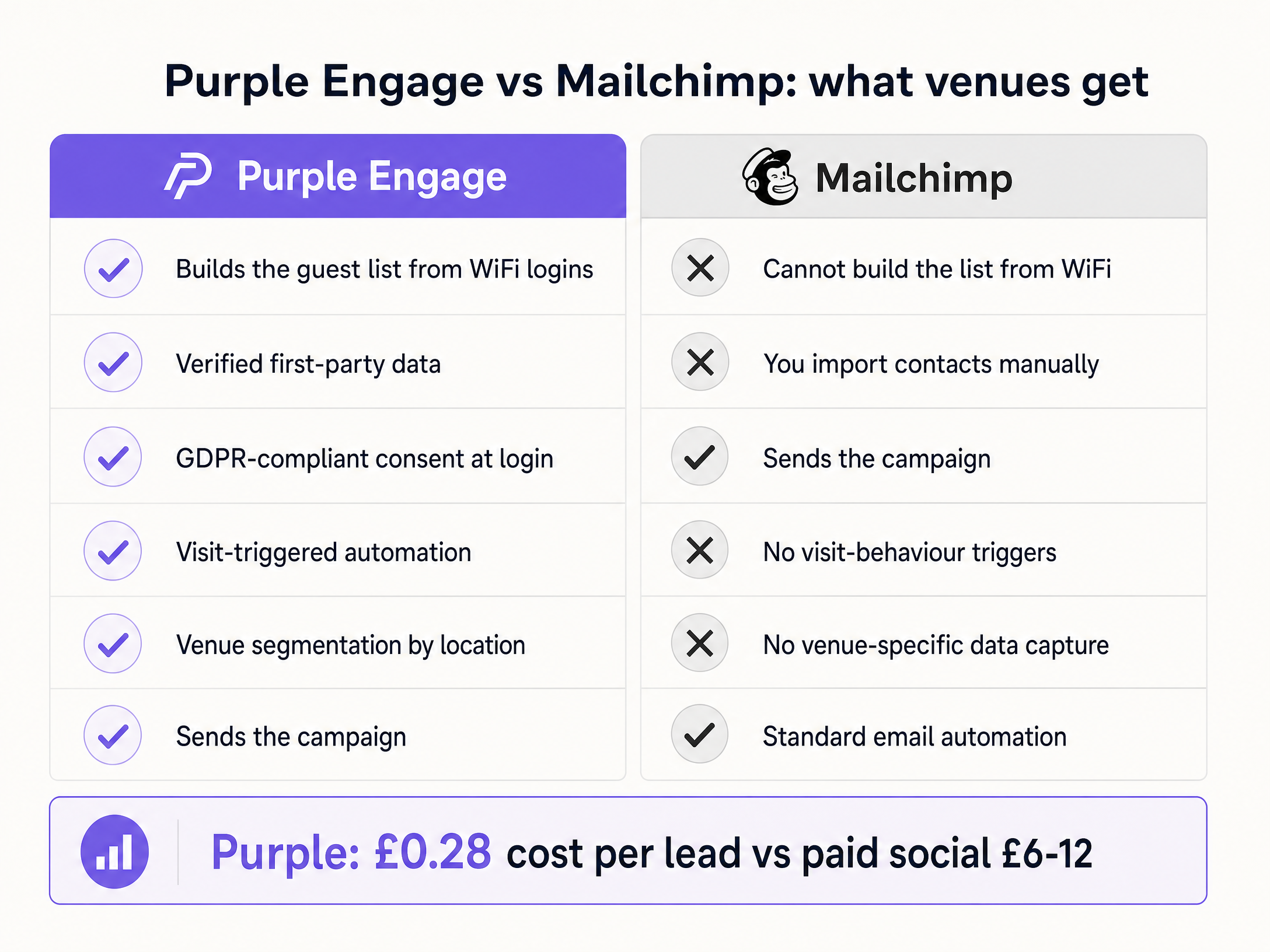
The table below summarises where each tool operates.
| Capability | Purple Engage | Mailchimp |
|---|---|---|
| Builds the guest list from WiFi logins | Yes | No |
| Verified first-party data | Yes | Depends on your import |
| GDPR-compliant consent at login | Yes, built in | Your responsibility |
| Visit-triggered automation | Yes | No |
| Venue segmentation by location | Yes | No |
| Sends the campaign | Yes | Yes |
| Standard email automation | Yes | Yes |
| CRM integration | Yes, 400+ connectors | Yes |
How to do it with your guest WiFi
To build the list from your WiFi, you do not need new hardware. Purple is a hardware-agnostic cloud overlay. It integrates with Cisco Meraki, HPE Aruba, Ruckus, Juniper Mist, Ubiquiti UniFi, Cambium, Extreme, and Fortinet.
When a guest selects your network, the captive portal appears. This is the value exchange: you offer secure, fast internet access; the guest provides their email address and actively checks the marketing consent box. The consent is recorded with a timestamp, IP address, and version of the consent statement - exactly what GDPR requires.
Because this happens at the network level, the data is clean. The device identifier ties to the email address. When that device returns to any venue in your estate, Purple recognises it automatically. You do not need to ask for their email again. The system logs the repeat visit and updates the customer profile.
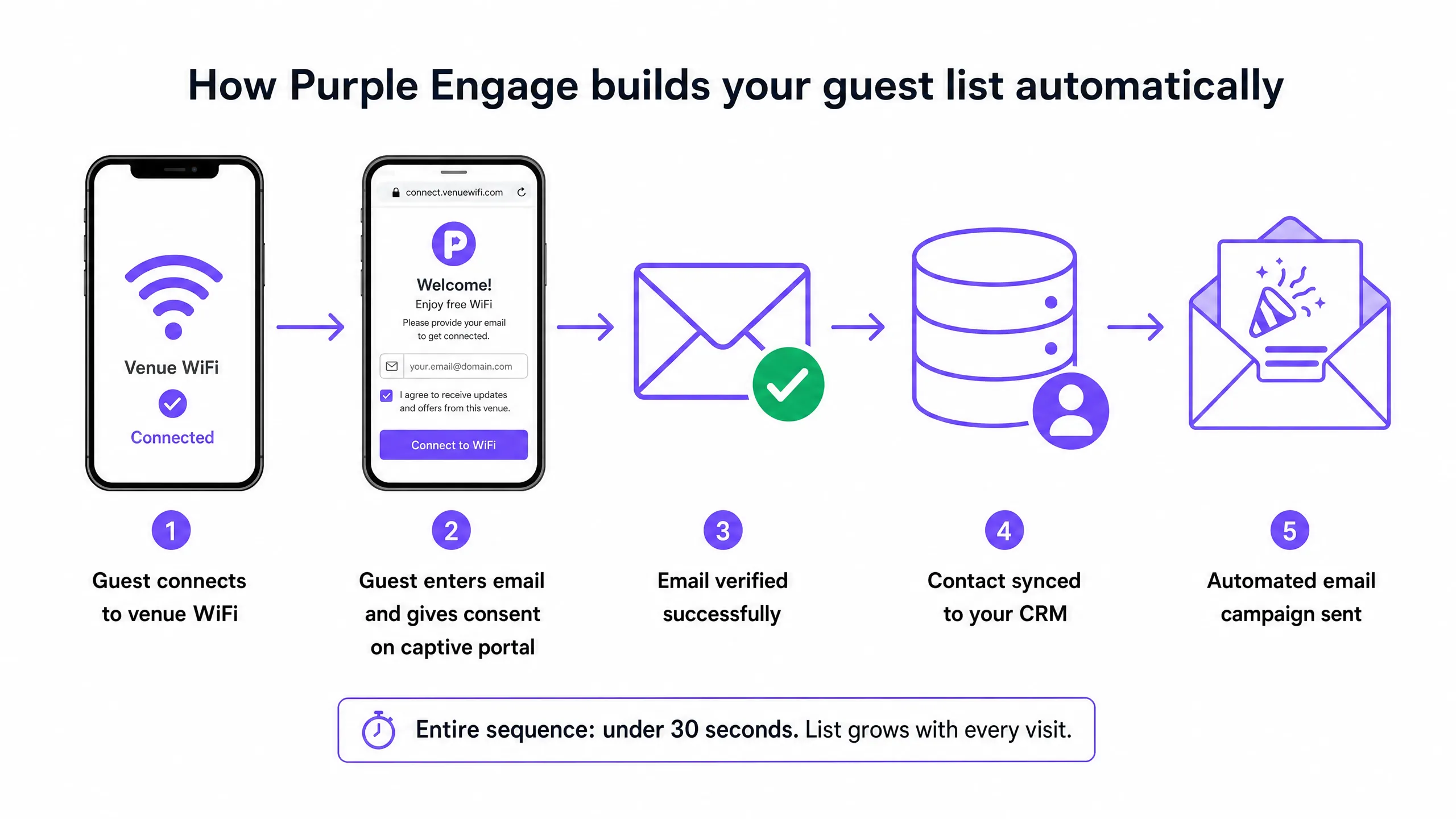
This is how Pizza Express captured 3.7 million guests into their CRM in two years. It is how Harrods drove over 4,400 sign-ups through Guest WiFi alone, achieving a 57x return on investment. The list does not require a campaign to grow. It grows with every visit.
For a deeper look at the mechanics, see our guide on how to build an email list from your WiFi (without buying one).
What to send, and when
With Mailchimp, you segment by open rates or click rates. With Purple Engage, you segment by physical behaviour. This enables highly specific, automated campaigns that respond to what guests actually do.
The welcome campaign. Trigger an email 30 minutes after a guest connects for the first time. Thank them for visiting. If they are in a hotel, include the digital compendium. If they are in a retail store, offer a 10% discount valid for the next 24 hours. If they are in a restaurant, invite them to join the loyalty programme.
The win-back campaign. Identify guests who visited three times in a month but have not returned in 60 days. Send an automated offer. Because Purple tracks physical presence, you know exactly when they return, allowing you to measure the precise ROI of the campaign.
The cross-venue campaign. If you operate multiple locations, identify guests who frequently visit one venue but have never visited another. When they connect at the new location for the first time, trigger a message acknowledging their loyalty across the estate.
The loyalty enrolment trigger. After a guest's third visit, send an automated email inviting them to join your loyalty programme. Guests who have visited three times are significantly more likely to enrol than first-time visitors.
For sector-specific campaign ideas, see our guide on email marketing for restaurants: a practical guide.
Measuring what works
Mailchimp measures success in opens and clicks. Purple Engage measures success in return visits and revenue.
When you send an email through Purple, the system tracks who received it. Because Purple also monitors the physical network, it knows if the recipient walked into your venue three days later. This closes the attribution loop. You are no longer estimating whether your email marketing works; you can see the foot traffic it generates.
Avanti West Coast used Purple to promote upsells throughout the WiFi journey, achieving 3,744 purchases and a 463% ROI. They tracked the exact path from WiFi connection to purchase because the data existed at both ends of the journey.
The metrics to track are:
| Metric | What it measures |
|---|---|
| Opt-in rate | Percentage of WiFi connections that become verified contacts |
| Cost per lead | Total platform cost divided by new contacts captured |
| Return visit rate | Percentage of contacts who physically return within 30 days of a campaign |
| Revenue per send | Total incremental revenue attributed to a campaign send |
| Lifetime value uplift | Difference in spend between guests in the CRM vs anonymous visitors |
Where to start
- Audit your hardware. Confirm your access points are on the compatible hardware list. Purple works with Cisco Meraki, HPE Aruba, Ruckus, Juniper Mist, Ubiquiti UniFi, Cambium, Extreme, and Fortinet.
- Design the portal. Create a branded captive portal. Keep the form simple: name, email, and a clear GDPR-compliant consent checkbox. Simpler forms achieve higher opt-in rates.
- Set the welcome trigger. Build one automated email that fires when a new guest connects. This single automation will outperform any batch newsletter sent to an unverified list.
- Monitor the capture rate. Track how many daily visitors convert into verified contacts. A well-configured portal typically achieves a 40-65% opt-in rate (Purple internal data, 80,000+ venues).
- Expand the automations. Once the list is building automatically, add win-back and loyalty campaigns.