
Birthday and anniversary email campaigns for venues
This guide details how venues can implement automated birthday and anniversary email campaigns to drive high-intent return visits.
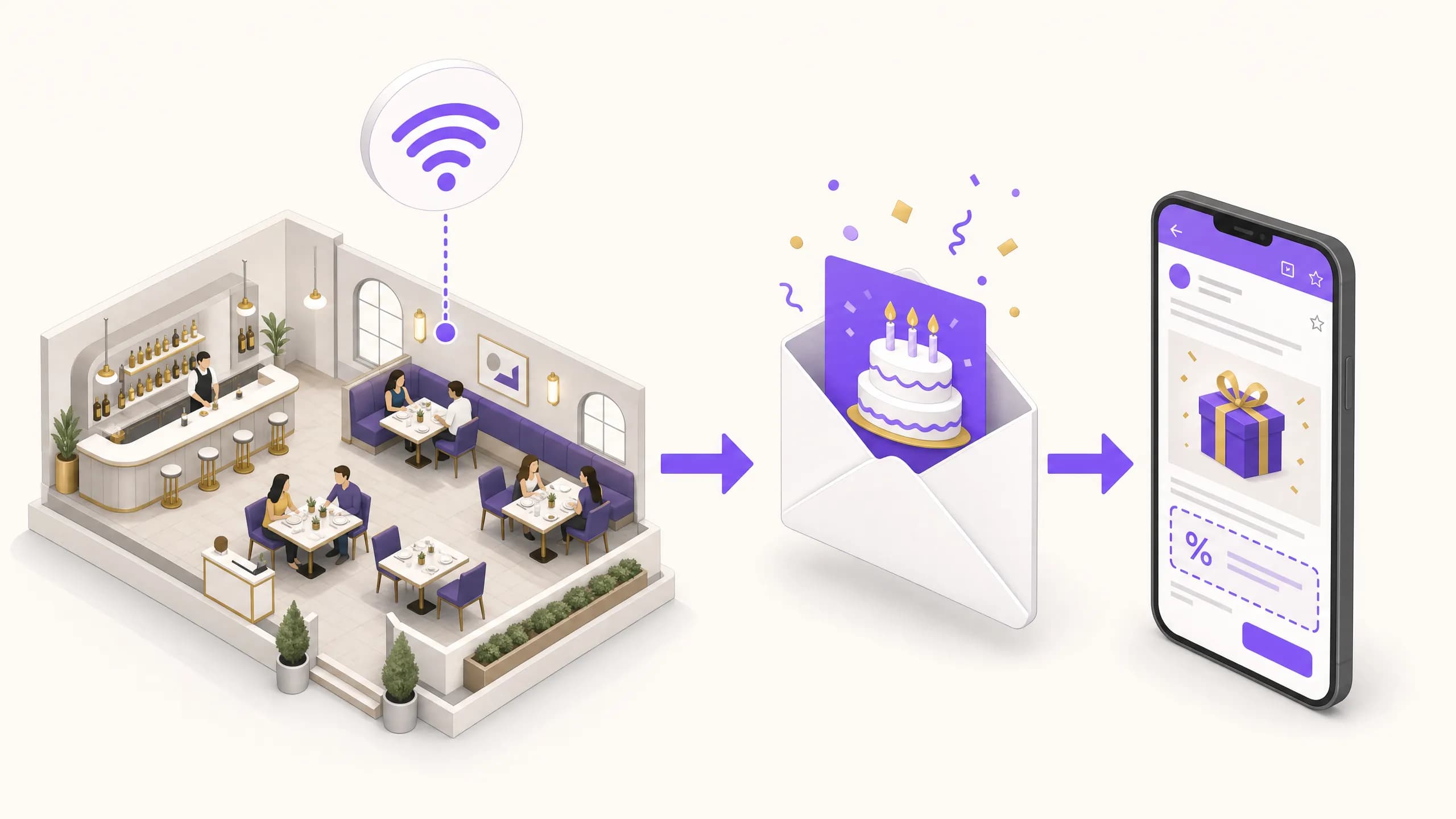
Video overview
Listen to this guide
Read the transcript
Birthday and anniversary email campaigns for venues A Purple Engage marketing guide - podcast episode [INTRO - approximately 1 minute] Welcome to the Purple Engage marketing guide series. I'm here to give you a practical briefing on one of the highest-return campaigns any venue can run: birthday and anniversary emails. If you run a restaurant, a bar, a hotel, or a retail space, you already have guests walking through your door. The question is whether they come back. A birthday email campaign is one of the simplest, most measurable ways to answer that question with a yes. This episode covers why it works, how to set it up, what to send, and how to measure whether it's actually driving revenue - not just opens. We'll also cover the one thing that separates a campaign that works from one that never gets off the ground: the data. Let's get into it. [WHY IT MATTERS - approximately 1 minute] Here is the business case in three numbers. Birthday emails achieve open rates of around 45 percent, compared to roughly 40 percent for standard restaurant emails. That gap matters because open rate is your first gate. If the email doesn't get opened, nothing else happens. The second number: birthday emails generate 342 percent more revenue per send than standard promotional emails. That figure comes from industry data across hospitality and retail. The reason is intent. A guest who receives a birthday offer is already thinking about where to celebrate. You are arriving at exactly the right moment. The third number: email marketing as a channel returns an average of 36 dollars for every dollar spent, according to Litmus research. Birthday campaigns sit at the top end of that range because they are triggered, personalised, and timed to a moment of high purchase intent. The cost of not running these campaigns is not zero. Every birthday that passes without an email from you is a booking that goes to a competitor who did send one. [THE APPROACH - approximately 5 minutes] The approach has three parts: building the list, setting up the automation, and writing the email. Part one: building the list. This is where most venues fall down. They sign up for Mailchimp or Klaviyo, build a beautiful template, and then realise they have no birthday data. Generic email tools are excellent at sending campaigns. They do not build the list for you. You have to supply the data. Purple Engage works differently. When a guest connects to your venue's WiFi, the login flow captures their email address and - critically - their date of birth. That data is stored directly in Purple Engage as verified, first-party data. The guest actively chose to provide it. That is a conscious-choice opt-in, which satisfies GDPR requirements for marketing consent. By the time you are ready to run your first birthday campaign, Purple Engage has already been building your list from every WiFi login at your venue. You do not need to run a separate data collection exercise. The list builds itself. Purple operates across 80,000 venues worldwide, and in 2024 alone recorded 440 million logins. That scale means the data model is well proven. For a busy restaurant or hotel, you can expect to accumulate a meaningful, marketable birthday list within the first few months of going live. Part two: setting up the automation. Purple Engage stores the date-of-birth data and fires the birthday email automatically. You set the trigger once - typically seven days before the guest's birthday - and the platform handles the rest. You do not need to check a spreadsheet, export a list, or manually schedule sends. The seven-day lead time is deliberate. It gives the guest enough time to make a booking or plan a visit. If you send on the birthday itself, you are too late for most dining or hotel decisions. If you send three weeks out, the offer feels premature and the urgency is gone. Seven days is the sweet spot that most hospitality operators settle on. For anniversary campaigns - whether that is a wedding anniversary, a first-visit anniversary, or a loyalty milestone - the same logic applies. Purple Engage records the date of a guest's first visit at your venue. You can trigger an anniversary email on that date each year, turning a single visit into an annual touchpoint. Part three: writing the email. Keep it short. The subject line should name the occasion and hint at the offer. Something like: "Happy birthday, Sarah - your gift is inside." Personalisation in the subject line increases open rates by around 22 percent, according to data from Business2Community. The body of the email needs three things: a warm acknowledgement of the occasion, a clear and specific offer, and a single call to action. Do not bury the offer in three paragraphs of brand copy. The guest opened the email because of the subject line. Reward that with immediate clarity. The offer itself should be meaningful but not margin-destroying. A free dessert, a complimentary drink, a percentage discount on a booking - these work well because they require the guest to visit in order to redeem. That is the point. You are not running a discount scheme. You are driving a physical return visit. For hotels, the anniversary email might offer a room upgrade or a preferential rate for a celebratory stay. For retail, it might be early access to a new collection or a gift with purchase. The mechanic is the same: a dated, personalised incentive that requires a physical visit to redeem. [PRACTICAL STEPS AND PITFALLS - approximately 2 minutes] A few practical points before we get to measurement. First, segment your sends. Not every guest on your list is equally valuable. Purple Engage lets you filter by visit frequency, last visit date, and spend tier. A guest who visited once two years ago and a guest who visits every month should not receive the same birthday offer. The frequent visitor might get a more generous offer or an earlier send. The lapsed guest might get a re-engagement message alongside the birthday hook. Second, do not over-complicate the offer. The most common mistake is building a birthday campaign with too many conditions. "20 percent off your next visit, valid Monday to Thursday, excluding bank holidays, minimum spend of 40 pounds, not valid with any other offer." By the time the guest has read the small print, the moment is gone. One clear offer, one clear redemption window. Third, test your send timing. Seven days before the birthday is a strong default, but your venue may have specific patterns. A restaurant that is busiest at weekends might find that sending on a Monday for a Saturday birthday performs better than a fixed seven-day window. Purple Engage gives you the attribution data to test and refine this. The main pitfall to avoid is treating birthday emails as a one-off campaign. The value compounds over time. A guest who redeems a birthday offer is more likely to return again. Purple Engage tracks that return visit and attributes it to the campaign, so you can see the full lifetime value impact, not just the redemption rate. [QUICK Q AND A - approximately 1 minute] A few questions that come up regularly. "Do guests actually provide their real date of birth?" Yes, at a higher rate than you might expect. When the data collection is part of a clear value exchange - free WiFi in return for your details - and the consent language is transparent, guests provide accurate information. Purple's data across 80,000 venues supports this. "What if we already use Mailchimp?" Purple Engage integrates with existing email platforms. You can use Purple to build and segment the list, and pass it to Mailchimp for the send if that is your existing workflow. The key point is that Purple is the data layer. Mailchimp is the delivery layer. You need both, but you cannot replace Purple's data capture with Mailchimp alone. "How do we handle GDPR?" The consent is captured at the WiFi login stage. Purple's login flow is designed to meet GDPR requirements, including a clear opt-in for marketing communications. The guest's date of birth is stored as part of their profile, and they can request deletion at any time. You do not need to build a separate consent mechanism. [SUMMARY AND NEXT STEPS - approximately 1 minute] To summarise. Birthday and anniversary email campaigns are the highest-intent, highest-return campaigns most venues are not running - because they do not have the data. Purple Engage solves the data problem at the point of WiFi login, capturing verified first-party data with GDPR-compliant consent. The automation fires the email at the right time, without manual intervention. The attribution tracks the return visit, so you know exactly what the campaign is worth. The place to start is simple. Connect Purple Engage to your venue WiFi. Let the list build. Set the birthday trigger. Write one clean email with one clear offer. Measure the return visits, not just the open rate. If you want to see how this works in practice, visit purple.ai and look at the Engage product. You can also read the full written guide in the Purple marketing guides library, which covers worked examples, timing frameworks, and offer benchmarks in more detail. Thanks for listening. We will see you in the next episode. [END]
Why this matters for your venue
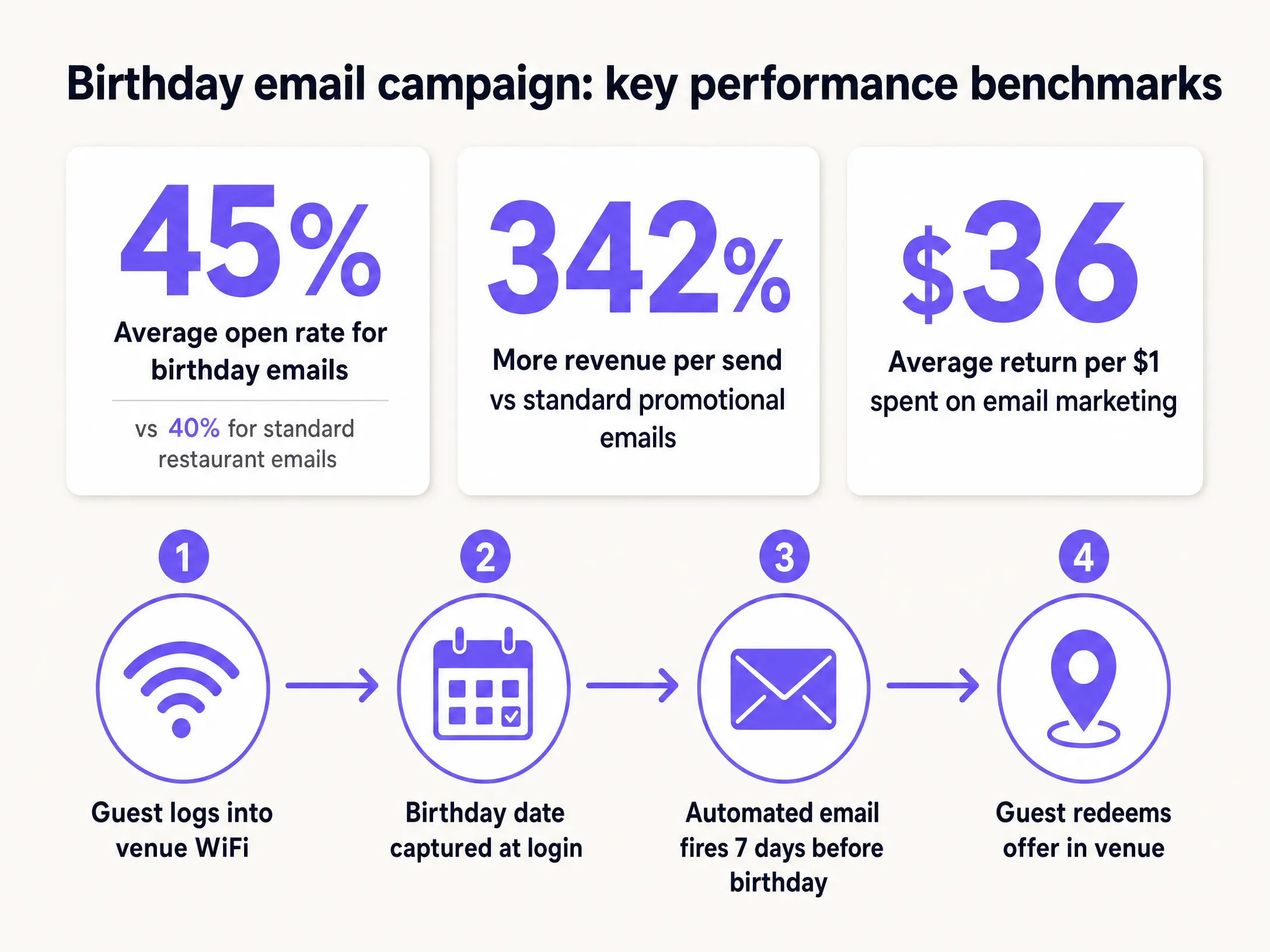
Birthday and anniversary email campaigns are one of the most effective, measurable ways to convert foot traffic into repeat visitors. While generic promotional emails achieve an average open rate of around 40%, birthday emails often exceed 45%. More importantly, they generate 342% more revenue per send than generic promotional emails [1]. This is because the intent is built into the occasion itself. A guest receiving a birthday offer is actively considering where to celebrate, and your email arrives at the perfect time.
The cost of not running these campaigns is clear: every birthday that passes without an email from your venue is a potential booking lost to a competitor. As a channel, email marketing delivers an average return of $36 for every $1 spent [2]. Birthday campaigns, being triggered, personalised, and timed to a high-intent event, sit at the very top of that performance spectrum.
The approach
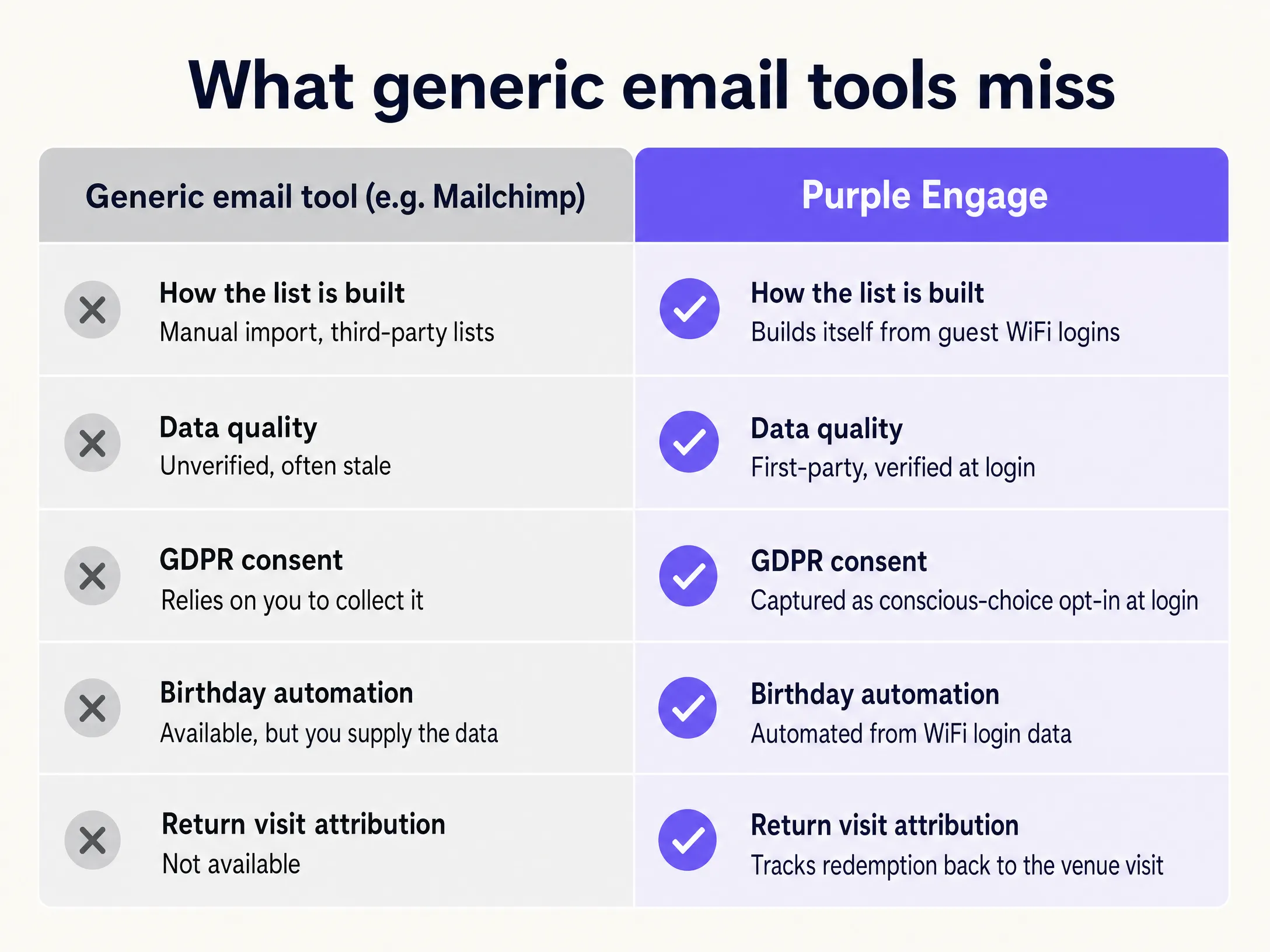
The fundamental challenge with birthday campaigns is not sending the emails, but acquiring the data. Generic email tools like Mailchimp or Klaviyo are excellent delivery mechanisms, but they rely on you to supply the list. If you do not have a reliable, automated way to collect guests' dates of birth, the campaign cannot run.
This is where the approach must shift from manual data collection to automated, passive capture. For physical venues, the most effective method is to link data collection to a clear value exchange: guest WiFi access. When a guest connects to the network, they provide their details in exchange for connectivity. This creates a continuous, automated pipeline of verified, first-party data.
How to do it with your guest WiFi
Purple Engage turns your existing network hardware into an automated list-building engine. This process requires no staff intervention and builds a database entirely from conscious-choice opt-ins.
- The Value Exchange: A guest enters your venue and selects the guest WiFi network. They are presented with a branded captive portal.
- The Data Capture: To gain access, the guest completes a short form. This form asks for their email address and date of birth. Because the guest is actively requesting access, the data provided is highly accurate.
- The Consent: The login flow includes clear, unambiguous opt-in checkboxes for marketing communications, meeting GDPR requirements for consent.
- The Storage: The data is securely stored as a verified customer profile within Purple Engage.
This method eliminates the need for manual data entry, paper forms, or unreliable third-party lists. The list builds itself. For venues debating different capture methods, our guide on QR codes vs WiFi login for collecting customer emails provides a detailed comparison.
What to send, and when
The timing of birthday emails is critical. Send it on the day, and you have missed the decision-making window. Send it a month in advance, and the urgency is lost.
The optimal trigger point is seven days before the birthday. This gives the guest enough time to coordinate with friends, make a reservation, or plan a visit, whilst maintaining the relevance of the occasion.
Offer structure
The offer must be compelling enough to drive a physical visit, but structured to protect your margins. It should act as an incentive, not just a discount.
- Restaurants and bars: A complimentary dessert, a free round of drinks for the table, or a set percentage off the total bill. These require the guest to dine in to redeem.
- Retail: A percentage discount on a purchase, or a small gift with purchase.
- Hotels: A complimentary room upgrade, a bottle of wine on arrival, or a preferential rate for a celebratory stay.
Keep the terms simple. Complex restrictions (e.g., "only valid on Tuesdays between 4pm and 6pm, excluding bank holidays") destroy the perceived value of the gift.
Measuring what works
Open rates and click-through rates are useful leading indicators, but they do not measure business impact. The true metric of a birthday campaign's success is the return visit rate and the associated revenue.
Purple Engage tracks the guest's return to the venue. When the guest logs back into the WiFi during their next visit, the platform attributes that visit to the birthday campaign. This allows you to measure the exact number of return visits generated, calculate the revenue impact, and determine the true lifetime value of the campaign.
Where to start
- Configure the captive portal: Ensure your Guest WiFi login flow includes a date of birth field and clear marketing consent checkboxes.
- Define the offer: Choose a single, clear incentive that drives physical visits without damaging margins.
- Set the trigger: Configure Purple Engage to automatically send the email seven days before the guest's birthday.
- Monitor return visits: Track campaign performance based on physical return visits rather than just email opens.
Listen to our briefing podcast for a complete overview of the strategy:
References
[1] Fun Fact: Birthday emails generate 342% more revenue than generic promotional emails. LinkedIn post by Rachel Mastandrea Turula. [2] The ROI of Email Marketing. Litmus Research.