
SMS and email: multi-channel campaigns for venues
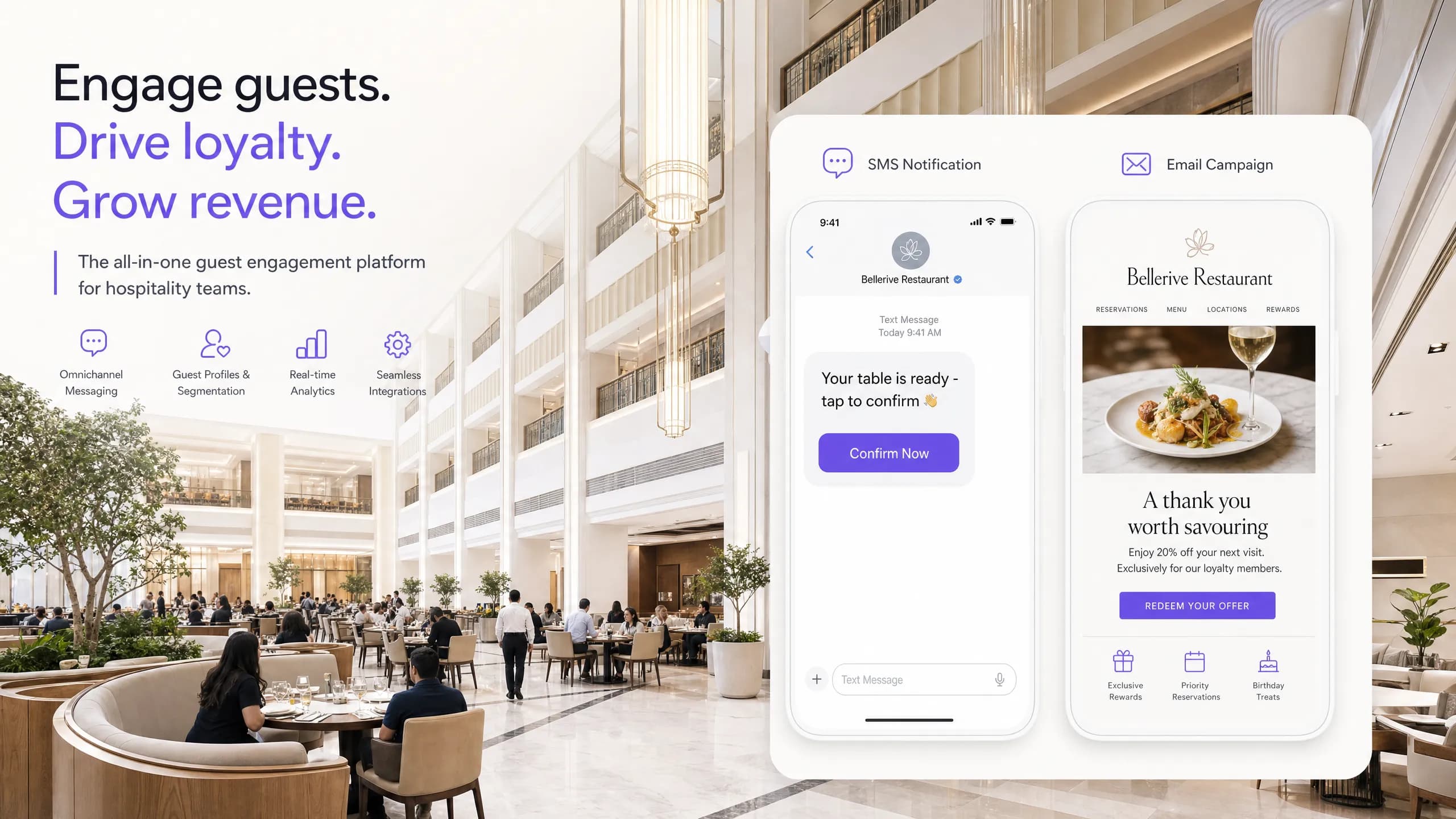
This guide explains how to orchestrate SMS and email into a single, automated campaign strategy for physical venues.
Video overview
Listen to this guide
Read the transcript
SMS and email: multi-channel campaigns for venues A Purple Engage marketing briefing. Approximately 10 minutes. --- SECTION 1: WHY IT MATTERS - approximately 1 minute Welcome. If you run marketing for a restaurant, hotel, bar, or retail venue, you already know the problem. Foot traffic walks through your door, spends money, and disappears. You have no way to reach them again unless they chose to give you their details. And most of the time, they did not. This briefing is about fixing that - and then doing something useful with it. Specifically, we are going to talk about SMS and email as a combined channel strategy, why they work differently, when to use each one, and how to run both from a single consented contact record. The business case is straightforward. A guest who visits twice spends roughly 67% more over their lifetime than a guest who visits once, according to research from Bain and Company. The difference between a one-time visitor and a loyal regular is almost always communication. You need a way to reach them, and you need their permission to do it. --- SECTION 2: THE APPROACH - approximately 5 minutes Let us start with the numbers, because they tell you everything you need to know about which channel to use and when. SMS has a 98% open rate. Email, for restaurants specifically, averages around 43%. That is still a strong number - well above the cross-industry average - but SMS is in a different category. Ninety percent of text messages are read within three minutes of delivery. Email is typically read within an hour, if it is read at all on that day. What does that mean in practice? SMS is for urgency. Email is for depth. If you have 40 covers to fill on a quiet Tuesday evening, an SMS sent at 4pm that says "Table for 2 tonight - 20% off if you book in the next hour" will drive bookings. An email with the same message sent at the same time will mostly be read tomorrow morning, when it is too late. On the other hand, if you want to tell your guests about a new seasonal menu, introduce a loyalty programme, or send a post-visit thank-you with a review request, email gives you the space to do it properly. You can include images, tell a story, and include multiple calls to action. SMS cannot do that. So the decision framework is simple. Ask yourself two questions. First: does this message need to drive action today, or even in the next few hours? If yes, use SMS. Second: does this message benefit from context, visuals, or a longer narrative? If yes, use email. There is a third consideration, which is cost. SMS costs more to send per message than email. That is not a reason to avoid it - the return on investment is well documented, with some benchmarks showing between 21 and 41 pounds returned for every pound spent on SMS. But it does mean you should be deliberate. Reserve SMS for high-value moments: same-day offers, event reminders sent two hours before, win-back messages to guests who have not visited in 60 days or more. Now, here is where the real opportunity sits. Most venues treat SMS and email as separate programmes. They have an email list built through a booking system or a loyalty card sign-up, and maybe a separate SMS list built through a different mechanism. The contacts overlap but they are not unified. The consent records are stored in different places. And when a campaign goes out, it goes out on one channel or the other, not both. The smarter approach is to build one contact record with consent recorded for both channels from the moment the guest first engages with you. That way, you can orchestrate. You can send an email on Monday to announce a new event, and then send an SMS reminder two hours before the event on Saturday. You can send a monthly newsletter by email, and reserve SMS for the moments that genuinely need immediate attention. Research from Omnisend found that brands integrating SMS into their multi-channel strategy see a 47.7% lift in customer engagement compared to single-channel approaches. And Attentive's data shows that subscribers who receive both SMS and email are 2.4 times more likely to make a purchase than those who receive SMS alone. The mechanism that makes this work at scale is Guest WiFi. When a guest connects to your WiFi, they go through a captive portal login. That login is a conscious-choice opt-in - the guest actively chooses to provide their details and agree to your marketing terms. Under GDPR, that is valid consent for both email and SMS, provided your consent language is clear and specific about both channels. This is the part that generic email tools like Mailchimp and Klaviyo cannot do for you. They are excellent at sending campaigns. They are not in the business of building your list. They receive contacts you push to them. Purple Engage builds the contact list directly from WiFi logins, records the consent, and makes those contacts available for both email and SMS campaigns - all from one opt-in moment. Across more than 80,000 live venues and 440 million logins in 2024, that is a significant volume of verified, first-party data being captured and activated every day. --- SECTION 3: PRACTICAL STEPS AND PITFALLS - approximately 2 minutes Let us get practical. Here are the steps to set this up, and the mistakes to avoid. Step one: configure your WiFi login portal to capture both email address and mobile number, with clear separate consent checkboxes for email marketing and SMS marketing. Do not bundle them into one checkbox - GDPR requires granular consent, and bundled consent is not valid consent. Step two: set up your welcome automation. The moment a guest logs in for the first time, trigger an automated welcome email. Keep it short. Thank them for visiting, tell them what to expect from your communications, and include one clear call to action - perhaps a link to your loyalty programme or a small incentive for their next visit. Step three: build your segmentation. At minimum, segment by visit frequency. Guests who have visited once in the last 90 days are candidates for a re-engagement campaign. Guests who visit regularly are your loyalty audience and should receive different messaging. Guests who have not visited in 60 days or more are your win-back segment. Step four: map your channel to your message type. Use the framework we discussed. Time-sensitive, high-urgency messages go by SMS. Newsletters, loyalty updates, seasonal campaigns, and post-visit follow-ups go by email. Step five: measure what matters. Open rate and click rate are useful indicators, but the metric that tells you whether your programme is working is return visit rate. How many guests who received a campaign came back within 30 days? What is the revenue per send across your SMS and email campaigns combined? Those are the numbers to track. Now, the pitfalls. The most common mistake is over-messaging by SMS. One or two SMS messages per month is the right cadence for most venues. More than that, and you will see unsubscribe rates climb. The CMO of Fabio Viviani Hospitality, a 35-location restaurant group in the US, found that dropping from weekly to fortnightly SMS sends caused unsubscribes to fall immediately, while revenue per send increased. The second pitfall is treating the two channels as identical. Do not send the same message by both SMS and email on the same day. Each channel should add something the other does not. If you send an email on Monday announcing a new menu, and then send an SMS on Thursday with a specific dish highlight and a booking link, that is a coordinated sequence. If you send the same message twice, that is spam. The third pitfall is neglecting consent hygiene. Your consent records need to be accurate and up to date. If a guest opts out of SMS, that preference must be honoured immediately and must not affect their email subscription. Purple Engage manages this at the contact level, so opt-outs on one channel do not accidentally suppress the other. --- SECTION 4: QUICK Q AND A - approximately 1 minute A few questions that come up regularly. "We already use Mailchimp. Do we need to replace it?" No. Purple Engage integrates with Mailchimp and other email platforms. We build the list and record consent. You can continue to send campaigns through whichever tool you prefer. The difference is that your list now grows automatically from every WiFi login, rather than relying on manual sign-up forms. "What if guests do not want to give their mobile number?" That is fine. The mobile number field can be optional. Guests who provide only an email address will receive email campaigns. Guests who provide both will be eligible for both channels. You capture what you can, and you work with what you have. "How quickly does the list grow?" At a typical restaurant doing 200 covers per week, with a 30% opt-in rate from WiFi logins, you would add roughly 60 new contacts per week. That is over 3,000 new contacts in a year, all verified, all consented, all first-party data. --- SECTION 5: SUMMARY AND NEXT STEPS - approximately 1 minute To summarise. SMS and email are not competing channels - they are complementary ones. SMS wins on urgency and immediacy. Email wins on depth and narrative. The key is running both from one unified contact record with consent recorded for both channels at the point of WiFi login. The differentiator is not the campaign tool. It is the list. A consented, verified, first-party contact list that builds itself from every guest who walks through your door is the asset that makes everything else work. If you want to see how this works in practice, visit purple dot ai forward slash guest dash wifi forward slash engage. You can see the Purple Engage platform, how the WiFi opt-in captures contacts, and how those contacts flow into your email and SMS campaigns. Three things to do this week. First, audit your current contact list - how many of those contacts have SMS consent recorded? Second, map your current campaigns to the SMS versus email decision framework we discussed. Third, if you are not yet capturing contacts from WiFi logins, that is the place to start. Thanks for listening. --- END OF SCRIPT
Why this matters for your venue
Foot traffic walks through your door, spends money, and disappears. You have no way to reach them again unless they chose to give you their details. The business case for capturing those details is straightforward. A guest who visits twice spends roughly 67% more over their lifetime than a guest who visits once. The difference between a one-time visitor and a loyal regular is almost always communication. You need a way to reach them, and you need their permission to do it.
Many venues attempt this by collecting email addresses through booking systems or SMS numbers through table waitlist apps. This creates fragmented lists. You end up with one audience for email and a different audience for SMS, with consent recorded in separate systems. When a campaign goes out, it goes out on one channel or the other, not both.
This guide covers how to fix that fragmentation. We will look at why SMS and email perform differently, when to use each channel, and how to run both from a single consented contact record built automatically from your guest WiFi.
The approach: matching the channel to the message
Let us start with the numbers, because they tell you everything you need to know about which channel to use and when.
SMS has a 98% open rate. Email, for restaurants specifically, averages around 43%. That is still a strong number, but SMS is in a different category entirely. Ninety percent of text messages are read within three minutes of delivery. Email is typically read within an hour, if it is read at all on that day.
What does that mean in practice? SMS is for urgency. Email is for depth.
If you have 40 covers to fill on a quiet Tuesday evening, an SMS sent at 4pm that says "Table for 2 tonight - 20% off if you book in the next hour" will drive bookings. An email with the same message sent at the same time will mostly be read tomorrow morning, when it is too late.
On the other hand, if you want to tell your guests about a new seasonal menu, introduce a loyalty programme, or send a post-visit thank-you with a review request, email gives you the space to do it properly. You can include images, tell a story, and include multiple calls to action. SMS cannot do that.
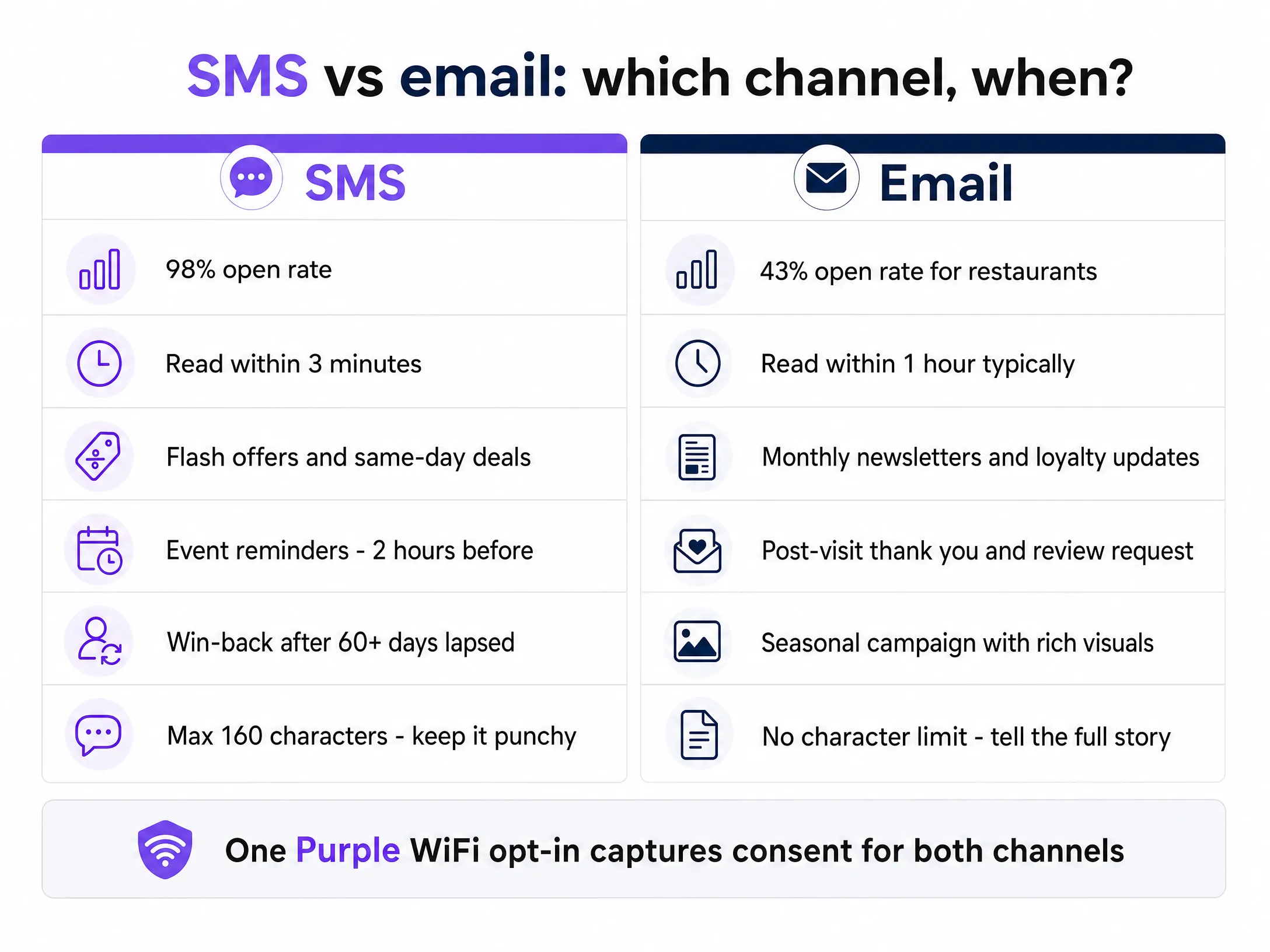
So the decision framework is simple. Ask yourself two questions. First: does this message need to drive action today, or even in the next few hours? If yes, use SMS. Second: does this message benefit from context, visuals, or a longer narrative? If yes, use email.
There is a third consideration, which is cost. SMS costs more to send per message than email. That is not a reason to avoid it - the return on investment is well documented, with some benchmarks showing between £21 and £41 returned for every £1 spent on SMS. But it does mean you should be deliberate. Reserve SMS for high-value moments: same-day offers, event reminders sent two hours before, win-back messages to guests who have not visited in 60 days or more.
How to do it with your guest WiFi
The smarter approach is to build one contact record with consent recorded for both channels from the moment the guest first engages with you. That way, you can orchestrate. You can send an email on Monday to announce a new event, and then send an SMS reminder two hours before the event on Saturday.
Research from Omnisend found that brands integrating SMS into their multi-channel strategy see a 47.7% lift in customer engagement compared to single-channel approaches. Attentive's data shows that subscribers who receive both SMS and email are 2.4 times more likely to make a purchase than those who receive SMS alone.
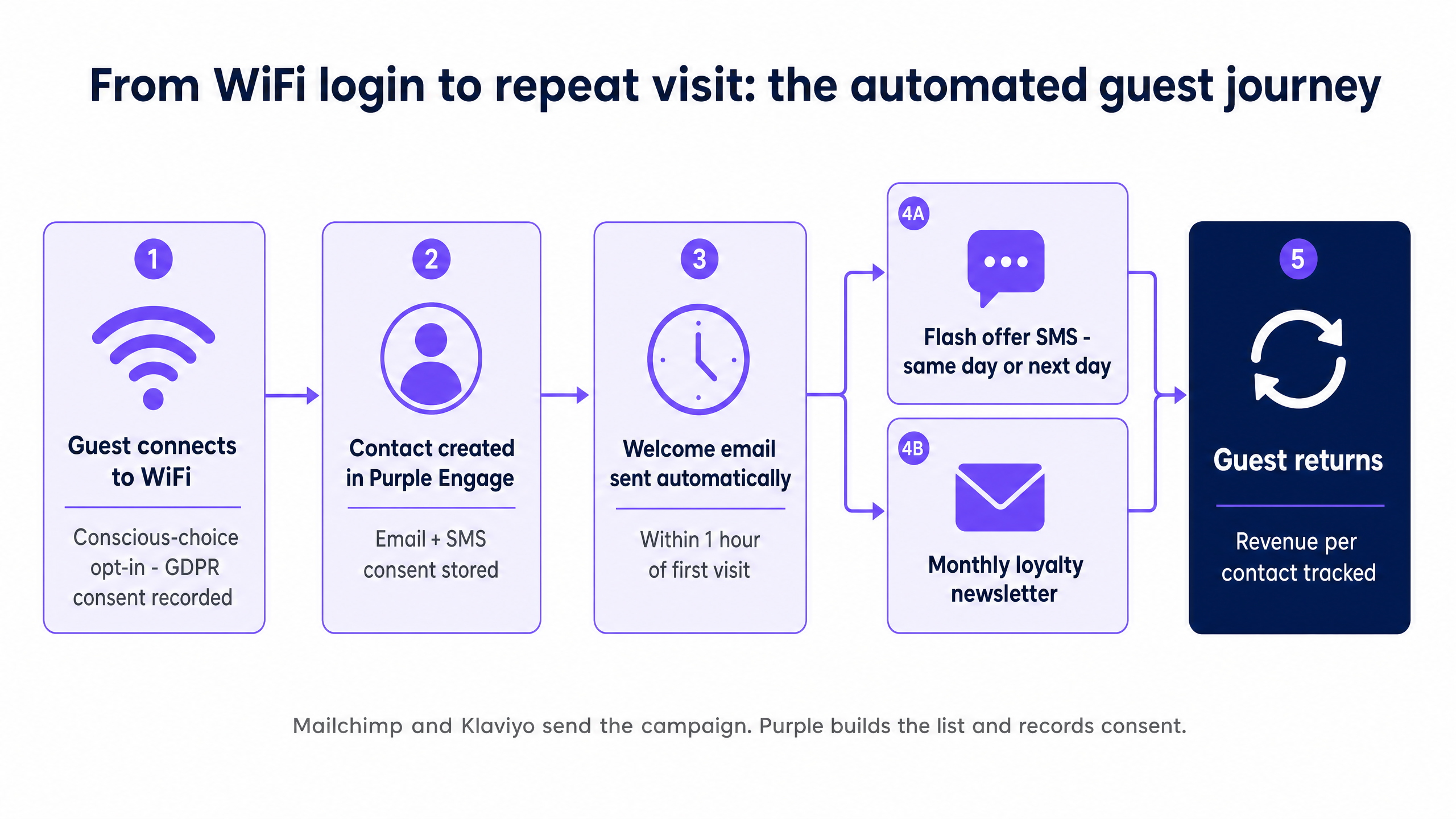
The mechanism that makes this work at scale is Guest WiFi. When a guest connects to your WiFi, they go through a captive portal login. That login is a conscious-choice opt-in - the guest actively chooses to provide their details and agree to your marketing terms. Under GDPR, that is valid consent for both email and SMS, provided your consent language is clear and specific about both channels.
This is the part that generic email tools cannot do for you. They are excellent at sending campaigns. They are not in the business of building your list. They receive contacts you push to them. For more context on these limitations, read our guide on Mailchimp for hotels: where it falls short for venues (also available in Spanish: Mailchimp para hoteles: en qué se queda corto para los establecimientos).
Purple Engage builds the contact list directly from WiFi logins, records the consent, and makes those contacts available for both email and SMS campaigns - all from one opt-in moment. Across more than 80,000 live venues and 440 million logins in 2024, that is a significant volume of verified, first-party data being captured and activated every day.
What to send, and when
Let us get practical. Here are the steps to set this up.
Step one: capture consent correctly. Configure your WiFi login portal to capture both email address and mobile number, with clear separate consent checkboxes for email marketing and SMS marketing. Do not bundle them into one checkbox - GDPR requires granular consent, and bundled consent is not valid consent.
Step two: set up your welcome automation. The moment a guest logs in for the first time, trigger an automated welcome email. Keep it short. Thank them for visiting, tell them what to expect from your communications, and include one clear call to action - perhaps a link to your loyalty programme or a small incentive for their next visit.
Step three: build your segmentation. At minimum, segment by visit frequency. Guests who have visited once in the last 90 days are candidates for a re-engagement campaign. Guests who visit regularly are your loyalty audience and should receive different messaging. Guests who have not visited in 60 days or more are your win-back segment.
Step four: map your channel to your message type. Use the framework we discussed. Time-sensitive, high-urgency messages go by SMS. Newsletters, loyalty updates, seasonal campaigns, and post-visit follow-ups go by email.
Measuring what works
Open rate and click rate are useful indicators, but the metric that tells you whether your programme is working is return visit rate. How many guests who received a campaign came back within 30 days? What is the revenue per send across your SMS and email campaigns combined? Those are the numbers to track.
Avoid the common pitfall of over-messaging by SMS. One or two SMS messages per month is the right cadence for most venues. More than that, and you will see unsubscribe rates climb. Fabio Viviani Hospitality, a 35-location restaurant group, found that dropping from weekly to fortnightly SMS sends caused unsubscribes to fall immediately, while revenue per send increased to $440,000 over six months.
Do not send the same message by both SMS and email on the same day. Each channel should add something the other does not. If you send an email on Monday announcing a new menu, and then send an SMS on Thursday with a specific dish highlight and a booking link, that is a coordinated sequence. If you send the same message twice, that is spam.
Finally, maintain consent hygiene. Your consent records need to be accurate and up to date. If a guest opts out of SMS, that preference must be honoured immediately and must not affect their email subscription. Purple Engage manages this at the contact level, so opt-outs on one channel do not accidentally suppress the other.
Where to start
- Audit your current contact list - how many of those contacts have SMS consent recorded?
- Map your current campaigns to the SMS versus email decision framework.
- Configure your guest WiFi captive portal to capture both email and mobile numbers with explicit consent.
- Set up a welcome automation email for first-time logins.
- Plan your first coordinated campaign: an email announcement followed by a targeted SMS reminder a few days later.