
First-time vs. regular guests: tailoring email by customer type
This guide explains why first-time guests and returning regulars require fundamentally different email messaging to drive repeat visits.

Video overview
Listen to this guide
Read the transcript
Welcome to the Purple Engage Marketing Series. I'm your host, and today we're covering one of the most practical segmentation moves you can make this quarter: treating first-time guests and regular guests as completely different audiences in your email marketing. Because they are. Let's get into it. PART ONE: WHY THIS MATTERS Here's the problem most venue operators have. They build an email list, they send the same newsletter to everyone on it, and they wonder why the numbers are flat. Open rates hover around 20%. Click-throughs are thin. And the revenue per send never seems to move. The reason is straightforward. A guest who walked through your door for the first time last Tuesday has completely different needs from someone who has visited you 12 times in the past six months. One needs to understand who you are and why they should come back. The other already knows - they just need a reason to return sooner, or to feel recognised for their loyalty. Sending the same message to both is not neutral. It actively damages one of those relationships. The first-timer gets a loyalty reward they haven't earned yet, which feels odd. The regular gets a welcome email that treats them like a stranger. Neither converts well. The fix is loyalty segmentation - splitting your list by visit history and sending messages that match where each person actually is in their relationship with your venue. This is not a new idea. What is new is that most venues now have the data to do it automatically, without manual tagging or complicated CRM workflows. That data comes from Guest WiFi logins. PART TWO: THE APPROACH When a guest connects to your WiFi, they give you something genuinely valuable: a verified email address, a timestamp, and explicit GDPR consent to market to them. That is first-party data - collected directly, not bought, not scraped, not inferred from third-party cookies. Purple Engage builds your contact list from those WiFi logins. Every time someone connects, the platform records the visit. It knows whether this is their first time or their fifth. It knows how long ago they last visited. And it uses that data to place each guest into the right segment automatically. So the split you need - new versus returning - happens without you lifting a finger. You do not need to import a spreadsheet. You do not need to manually tag contacts. The segmentation is live and continuous. Now, let's talk about what you actually send to each group. For first-time guests, the goal is a second visit. That's it. Not a loyalty programme sign-up, not a five-email nurture sequence, not a survey. One clear objective: get them back. The message should do three things. First, acknowledge the visit warmly - not with generic copy, but with something specific to your venue. Second, tell them one thing that makes you worth returning to. Third, give them a single, low-friction offer. A discount on their next visit. A complimentary item. Something with a clear expiry date so it creates urgency without pressure. Subject lines for first-timers should feel personal. "Thanks for visiting us on Tuesday" outperforms "Welcome to our loyalty programme" every time. The former feels like a human wrote it. The latter feels like a database generated it. For returning guests - people who have visited two or more times - the goal shifts. They already like you. The question is how to deepen that relationship and increase visit frequency. These guests respond to recognition. They want to feel seen, not marketed to. The message for a regular should reference their history. "You've been with us five times this year" is a powerful opening line. Follow it with something exclusive - early access to a new menu, a members-only event, a reward that is not available to the general public. The exclusivity is the point. It signals that their loyalty has been noticed and valued. Timing matters too. For first-timers, send within 24 hours of the visit. The experience is fresh. They are most likely to engage. For returning guests, the timing depends on their visit cadence. If someone typically visits every two weeks and they haven't been in for three, that's your trigger. Purple Engage can automate that trigger based on the gap between their last recorded visit and today. PART THREE: PRACTICAL STEPS AND PITFALLS Let me walk you through the practical setup, and flag the mistakes I see operators make. Step one: make sure your WiFi login page is collecting consent correctly. Under GDPR, you need explicit, informed consent to send marketing emails. The consent checkbox must be unticked by default, and the wording must be clear about what the guest is signing up for. Purple's captive portal handles this out of the box, but check your wording is specific to your venue and your marketing activity. Step two: define your segments. In Purple Engage, you set the rule for what counts as a first-time guest - typically anyone with a single recorded visit - and what counts as a returning guest - anyone with two or more visits, or visits within a defined time window. You can also create a third segment for lapsed guests: people who visited regularly but haven't been in for 60 or 90 days. That segment needs a win-back message, which is different again from both the first-timer and the active regular. Step three: build your automations. For first-timers, set a trigger: one visit recorded, send email within 24 hours. For returning guests, set a visit-frequency trigger: guest reaches their third visit, send a loyalty recognition email. For lapsed guests, set a time-based trigger: no visit in 60 days, send a re-engagement offer. Step four: write the emails. Keep them short. A first-timer email should be readable in under 90 seconds. A returning guest email should feel like a note from someone who knows them, not a broadcast. One call to action per email. No exceptions. Now, the pitfalls. The most common mistake is over-segmenting too early. Venues with small lists sometimes try to create six or seven segments before they have enough data to make them meaningful. Start with two: first-timers and returning guests. Add lapsed guests when your list is large enough to make that segment worth targeting separately. The second mistake is treating the first-timer email as a sales pitch. It is not. It is a relationship opener. If the first email a new guest receives from you is a hard sell, you will lose them. Lead with warmth and one clear benefit. Save the upsell for the second or third interaction. The third mistake is ignoring the data after you send. Open rate tells you whether your subject line worked. Click-through rate tells you whether your offer was relevant. But the metric that actually matters is return visits. Did the guests who received the email come back? Purple Engage tracks this because it records every subsequent WiFi login. You can close the loop between email sent and visit recorded. That is the number you should be optimising. PART FOUR: QUICK Q AND A Let me answer three questions I hear regularly from operators. Question one: We already use Mailchimp. Why do we need Purple Engage? Mailchimp sends the campaign. It does not build the list. It does not know which contacts are first-timers and which are regulars. It does not record return visits. You would need to manually export visit data from your point-of-sale or booking system, import it into Mailchimp, and tag contacts yourself. That is a weekly manual task that most teams do not have time for. Purple Engage automates the entire loop: list building, segmentation, send, and visit tracking. Question two: What if a guest visits multiple locations? Purple Engage handles multi-site operators. A guest who visits your Manchester site and your Leeds site is recognised as the same contact. You can choose to segment by venue, by region, or across your entire estate. The visit history is tied to the individual, not the location. Question three: How quickly can we get this running? For most venues, the WiFi login page is already collecting data. If you are on Purple's Engage plan, you can set up your first two automations - first-timer welcome and returning guest loyalty - in an afternoon. The templates are there. The segments populate automatically. You are not starting from zero. PART FIVE: SUMMARY AND NEXT STEPS Let me bring this together. First-time guests and returning guests need opposite messages. First-timers need warmth, context, and one clear reason to come back. Returning guests need recognition, exclusivity, and a reward that reflects their loyalty. Sending the same email to both is the single most common and most fixable mistake in venue email marketing. The segmentation is automatic when your list is built from Guest WiFi logins. Purple Engage records every visit, identifies whether each guest is new or returning, and routes them into the right automation without manual intervention. The data is first-party, GDPR-compliant, and verified - because the guest chose to connect. Your next steps are these. First, check that your WiFi login page is collecting consent correctly. Second, define your two core segments in Purple Engage: first-timers and returning guests. Third, write one email for each segment - keep both under 200 words. Fourth, set the automations live and measure return visits, not just open rates. If you want to go deeper on what to put in that first-timer email specifically, we have a companion guide on the Purple website: What to email guests after their first visit. It covers subject lines, offer types, and timing in detail. Thanks for listening. We'll be back next week with another practical guide from the Purple Engage Marketing Series.
Why this matters for your venue
Sending the same email to every guest on your list actively damages relationships and suppresses revenue. A guest who visited your venue for the first time last Tuesday has entirely different needs from a regular who has visited 12 times in the past six months. The first-timer needs to understand your brand and requires a compelling reason to return. The regular already knows your value; they need recognition and a reason to return sooner.
When you send a generic "welcome" message to a regular, you treat them like a stranger. When you send an unearned loyalty reward to a first-timer, it feels disconnected. Neither approach converts well. Loyalty segmentation solves this by splitting your list based on actual visit history and sending messages that match each guest's relationship with your venue. While this concept is established, the mechanism has changed. Venues now have the data to automate this split without manual tagging or complex CRM workflows, using the verified first-party data captured through guest WiFi logins.
The approach
The foundation of effective segmentation is accurate data. When a guest connects to your WiFi, they provide a verified email address, a timestamp, and explicit GDPR consent for marketing. This is conscious-choice, first-party data. It is collected directly from the guest, not purchased from brokers or inferred from third-party cookies.
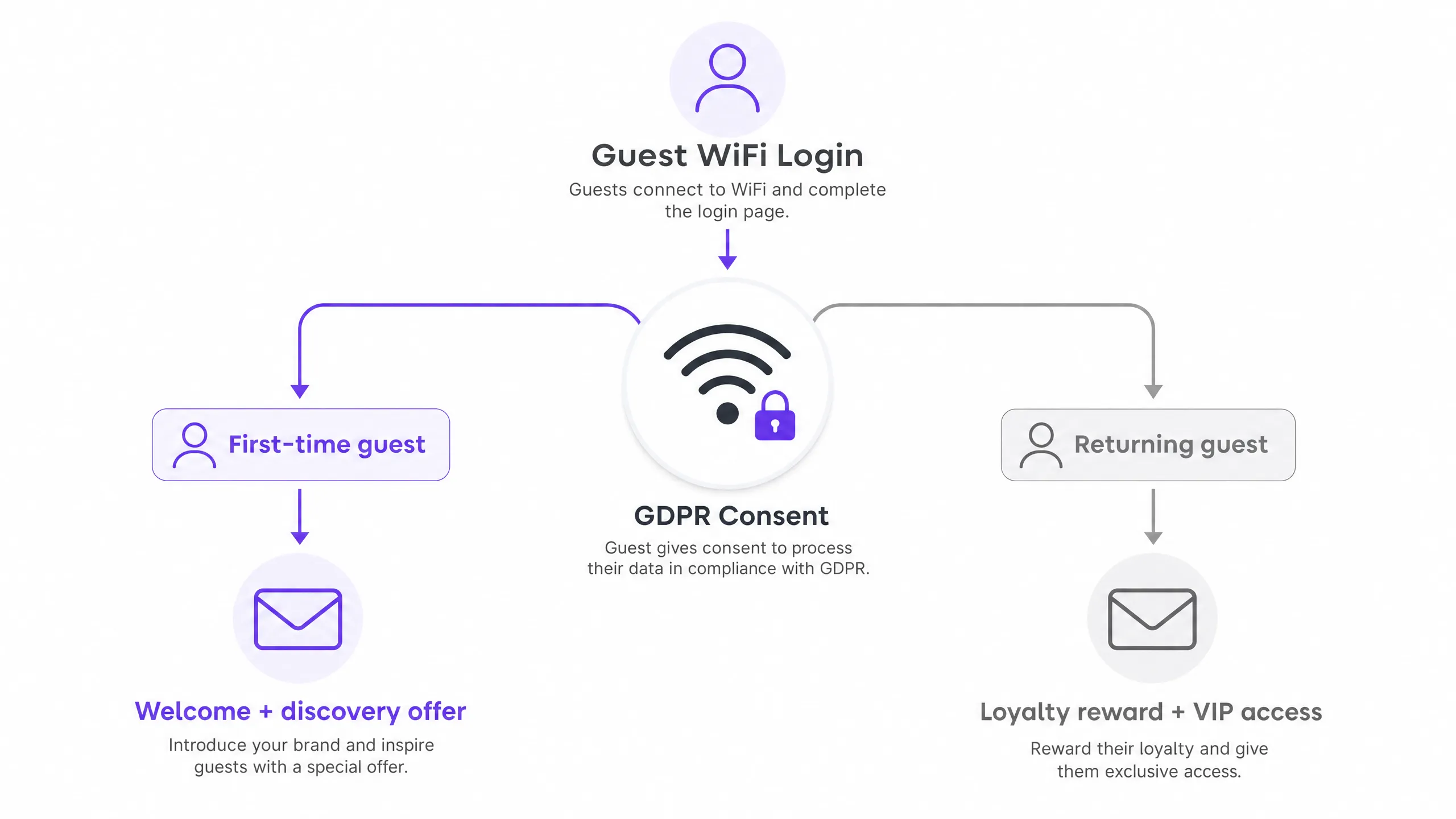
Purple Engage builds your contact list directly from these WiFi logins. Every time a guest connects, the platform records the visit. It knows definitively whether this is their first visit or their fifth. It tracks the exact duration since their last visit. The platform uses this data to place each guest into the correct segment automatically. The split between new and returning guests happens without any manual intervention. You do not need to import spreadsheets from your point-of-sale system or manually tag contacts. The segmentation is live, continuous, and always accurate.
How to do it with your guest WiFi
The implementation relies on clear rules defined within Purple Engage. You set the parameter for a first-time guest, which is typically anyone with a single recorded WiFi login. You define a returning guest as anyone with two or more recorded logins. The platform then routes guests into the appropriate automated email flow based on these rules.
To ensure compliance, your WiFi login page must collect consent correctly. Under GDPR, you need explicit, informed consent to send marketing emails. The consent checkbox on the captive portal must be unchecked by default, and the wording must clearly state what the guest is signing up for. Purple handles this compliance out of the box, allowing you to focus on the messaging rather than the legal mechanics.
What to send, and when
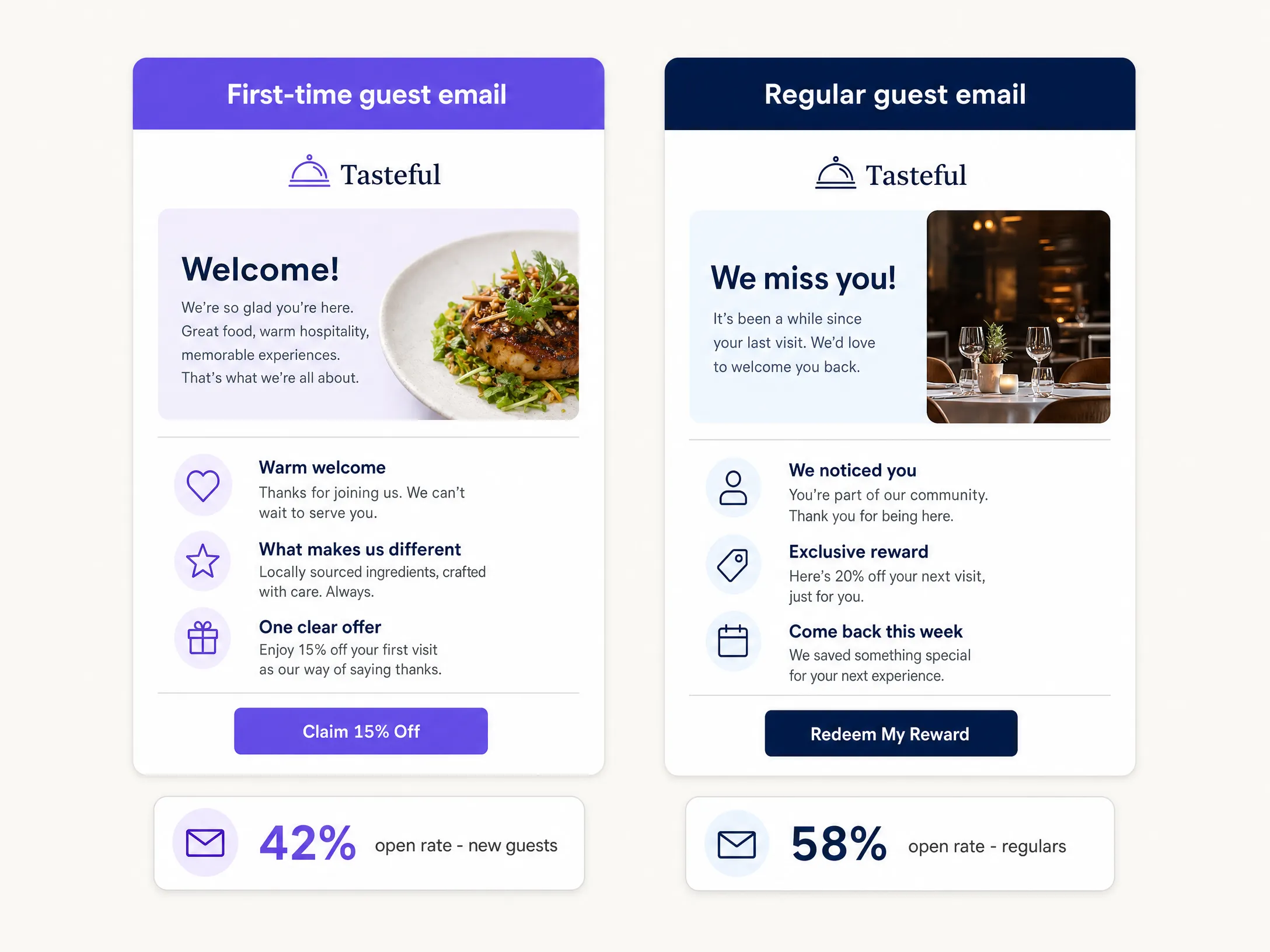
For first-time guests, the sole objective is securing a second visit. The message should acknowledge the visit warmly, highlight one specific aspect that makes your venue unique, and provide a single, low-friction offer. A 15% discount on their next visit or a complimentary item works well. This offer must have a clear expiration date to create urgency. Send this email within 24 hours of their visit while the experience is fresh. Subject lines should feel personal, such as "Thanks for visiting us on Tuesday," rather than a generic "Welcome to our list."
For returning guests, the goal is increasing visit frequency and deepening the relationship. These guests respond to recognition. The message should reference their history, perhaps noting they have visited five times this year. Follow this with an exclusive reward, such as early access to a new menu or a members-only event. The exclusivity signals that their loyalty is valued. Timing for regulars depends on their typical visit cadence. If a guest usually visits every two weeks and has not returned in three, that gap triggers the email. Purple Engage automates this based on the time elapsed since their last recorded visit.
Measuring what works
The most common mistake operators make is judging success solely on open rates. Open rate indicates whether your subject line was effective. Click-through rate shows if your offer was appealing. However, the only metric that truly matters is return visits.
Did the guests who received the email actually come back to your venue? Purple Engage tracks this automatically because it records every subsequent WiFi login. You can definitively close the loop between the email sent and the visit recorded. This closed-loop attribution allows you to measure the actual revenue generated by each segment and optimize your campaigns based on footfall rather than digital engagement metrics.
Where to start
- Verify your WiFi login page is collecting explicit GDPR consent for marketing.
- Define your two core segments in Purple Engage: first-time guests (one visit) and returning guests (two or more visits).
- Write one short, focused email for each segment, keeping the copy under 200 words.
- Set the automations live to trigger based on visit counts and time delays.
- Monitor return visits in the Purple Engage dashboard to measure actual business impact.
For more detail on crafting the perfect initial message, read our guide on What to email guests after their first visit.