
Customer lifetime value for restaurants and hotels
A practical guide for hospitality marketers on calculating and increasing customer lifetime value (CLV) using verified visit data. Learn how to move from estimated segment averages to individual-level tracking by capturing first-party data through guest WiFi.
Video overview
Listen to this guide
Read the transcript
Customer Lifetime Value for Restaurants and Hotels A Purple Engage Marketing Briefing Runtime: approximately 10 minutes --- INTRO Welcome to the Purple Engage marketing briefing. I'm your host, and today we're talking about customer lifetime value - what it actually means for restaurants and hotels, how to calculate it properly, and most importantly, how to grow it. If you're a marketing director or CRM manager at a hospitality venue, this one is for you. --- SECTION 1: WHY IT MATTERS - 1 MINUTE Let's start with the uncomfortable truth. Most hospitality venues spend the majority of their marketing budget acquiring new guests, and almost nothing retaining the ones they already have. That's backwards. Here's why. Research from Bain and Company shows that increasing guest retention by just five percent can increase profits by between 25 and 95 percent. And Harvard Business School puts the cost of acquiring a new customer at five to seven times more than keeping an existing one. Customer lifetime value - or CLV - is the single number that makes this argument concrete. It tells you exactly how much a guest is worth to your venue over the entire time they keep coming back. Not just tonight's cover. Not just this weekend's room booking. The whole relationship. When you know that number, every marketing decision changes. You stop treating every guest the same. You start investing more in the ones who are worth more. And you build campaigns that bring people back, not just through the door once. --- SECTION 2: THE APPROACH - 5 MINUTES So how do you actually calculate CLV for a hospitality venue? The formula is straightforward. CLV equals average visit value, multiplied by visit frequency, multiplied by guest lifespan. Let me break each of those down. Average visit value is the average amount a guest spends each time they visit. For a restaurant, that's the average cover value including drinks. For a hotel, it's the average revenue per stay, including food and beverage, spa, and ancillary spend. Visit frequency is how many times a guest visits per year. This is where most venues have a blind spot. They know their total covers or occupancy rate, but they have no idea how many of those are repeat guests versus new ones. Guest lifespan is how long a guest keeps coming back before they lapse. For a neighbourhood restaurant, that might be three to five years for a loyal regular. For a destination hotel, it might be measured differently - how many times a guest books over a decade. Now let me give you some numbers to make this real. Take a casual dining restaurant. A one-time guest spends forty-five pounds, visits once, and never returns. CLV: forty-five pounds. An occasional guest spends fifty-two pounds per visit, comes in eight times a year, and stays active for three years. CLV: one thousand two hundred and forty-eight pounds. A loyal regular spends sixty-eight pounds per visit, comes in twice a month, and stays active for five years. CLV: eight thousand one hundred and sixty pounds. That loyal regular is worth one hundred and eighty times more than the one-time guest. One hundred and eighty times. And yet most venues market to both of them identically. The same logic applies in hotels. A guest who books once for a leisure trip has a very different value profile from a business traveller who stays twelve nights a year. Premier Inn, for example, has built significant competitive advantage by understanding and acting on exactly this distinction. Now here's where it gets interesting - and where most venues hit a wall. To calculate CLV properly, you need to link individual guests to their visit history and spend data. That sounds obvious, but it's genuinely hard. Point-of-sale systems record transactions, not people. Reservation systems record bookings, but not walk-ins. Hotel PMS systems capture stay data, but only for guests who book direct. The result is that most venues are estimating CLV at a segment level, not an individual level. They know their average, but they cannot identify which specific guests sit above or below it. And that means they cannot act on it. This is the problem that guest WiFi solves - when it is set up correctly. When a guest connects to your WiFi, they complete a login page. That login captures their name, email address, and - critically - their consent to receive marketing communications under GDPR. Purple's approach is what we call conscious-choice opt-ins. The guest actively chooses to receive communications. That is not a pre-ticked box. It is a verified, deliberate decision. That matters both legally and commercially, because opted-in guests engage at significantly higher rates than contacts acquired through other means. But here is the key point. Every time that same guest returns and reconnects to your WiFi, Purple links that new visit to their existing profile. You now have a verified record of how many times that specific person has visited, on which dates, and at which times. That is visit frequency data, automatically captured, at the individual guest level. Combined with your POS or PMS data, you can calculate a real CLV for real people - not an average for a fictional segment. Tools like Mailchimp or Klaviyo are excellent at sending campaigns to a list you already have. But they do not build the list. They do not capture visit data. They do not know whether the person who opened your email last Tuesday actually came in last Wednesday. Purple does. --- SECTION 3: PRACTICAL STEPS AND PITFALLS - 2 MINUTES Right, let's get practical. Here are the steps to implement CLV tracking at your venue. Step one: get your WiFi login capturing first-party data. If you are running an open network with no login, you are leaving the most valuable part of the guest interaction on the table. Deploy a GDPR-compliant splash page that captures name and email at minimum. Step two: integrate your WiFi data with your CRM. Purple Engage connects the captured contact to a profile that tracks every subsequent visit. You do not need to do this manually. It is automated. Step three: connect your spend data. If your POS or PMS can export transaction data, map it to your guest profiles. Even a rough average spend per visit, segmented by visit frequency band, is enormously more useful than a single overall average. Step four: build your segments. At minimum, you want four: new guests who have visited once, occasionals who have visited two to five times, regulars who visit six or more times per year, and lapsed guests who have not visited in ninety days or more. Step five: set up automated campaigns for each segment. A welcome email for new guests. A re-engagement offer for lapsed guests. An exclusive reward for your top twenty percent by CLV. These do not need to be complex. They need to be timely and relevant. Now the pitfalls. The most common mistake is treating CLV as a one-time calculation rather than a live metric. Your guest mix changes. Spending patterns shift. You need to recalculate CLV at least quarterly, and ideally have it updating automatically in your CRM. The second pitfall is ignoring lapsed guests. A guest who visited six times and then stopped is worth far more to recover than a new guest you have never met. Their CLV history tells you they liked your venue. Something changed. A well-timed re-engagement campaign - perhaps triggered at sixty days of inactivity - can recover a meaningful percentage of that cohort. The third pitfall is optimising for average CLV when you should be optimising for the top cohort. Your top twenty percent of guests by CLV typically generate around sixty percent of your revenue. Know who they are. Treat them accordingly. --- SECTION 4: QUICK Q AND A - 1 MINUTE Question: we do not have a loyalty programme. Can we still calculate CLV? Yes. You do not need a loyalty programme to track visit frequency. Guest WiFi login data gives you visit timestamps linked to individual profiles. That is sufficient to calculate visit frequency and estimate CLV without any loyalty card infrastructure. Question: what if guests do not connect to WiFi every visit? That is a fair point. WiFi-based visit tracking captures a subset of visits, not necessarily all of them. The key is consistency. If a guest connects on most visits, the relative frequency data is still valid for segmentation purposes. Over time, as WiFi adoption increases - and it is now above eighty percent in most casual dining environments - the data becomes more complete. Question: how does this compare to just using our booking data? Booking data captures guests who reserve in advance. Walk-ins, bar visits, and spontaneous visits are invisible. WiFi data captures all of them, regardless of whether they booked. For restaurants especially, where a significant proportion of covers are walk-ins, this is a material difference. --- SECTION 5: SUMMARY AND NEXT STEPS - 1 MINUTE To wrap up. Customer lifetime value is the most important metric most hospitality venues are not measuring properly. The formula is simple: average visit value, times visit frequency, times guest lifespan. The hard part is getting the individual-level data to make it real. Guest WiFi, set up with a GDPR-compliant login and connected to your CRM, solves that data problem. It builds your contact list automatically, tracks return visits, and gives you the foundation to calculate and act on CLV at the individual guest level. The venues that do this well - and Premier Inn, Pizza Express, and Whitbread are examples of operators who take this seriously - generate significantly more revenue per guest than those who treat every visit as a transaction. Your next step: audit your current WiFi setup. Is it capturing guest data? Is that data flowing into your CRM? Is your CRM segmenting by visit frequency? If the answer to any of those is no, that is where to start. For more on this, visit purple.ai and explore the Engage platform. There is also a companion guide on using dwell time and visit data for segmentation, which goes deeper on the analytics side. Thanks for listening. We'll be back with another briefing shortly. --- END OF SCRIPT
Why it matters for your venue
Most hospitality venues spend the lion's share of their marketing budget on acquiring new guests, and spend almost nothing on retaining those they already have. This approach is expensive and inefficient. Research consistently shows that increasing guest retention by just 5% can increase profits by 25% to 95%.
For a restaurant or hotel, customer lifetime value (CLV) is the single metric that makes this argument real. It tells you exactly how much a guest is worth to you overall, for as long as they keep returning to your venue. When you know this number, every marketing decision changes. You stop treating every guest the same. You start investing more in those who are worth more.
How it works
To calculate customer lifetime value, you need three numbers: average visit value, visit frequency, and guest lifespan.
CLV = average visit value × visit frequency × guest lifespan
Average visit value is the average amount of money a guest spends each time they visit. Visit frequency is how many times a guest visits per year. Guest lifespan is how long a guest keeps returning before they stop coming.
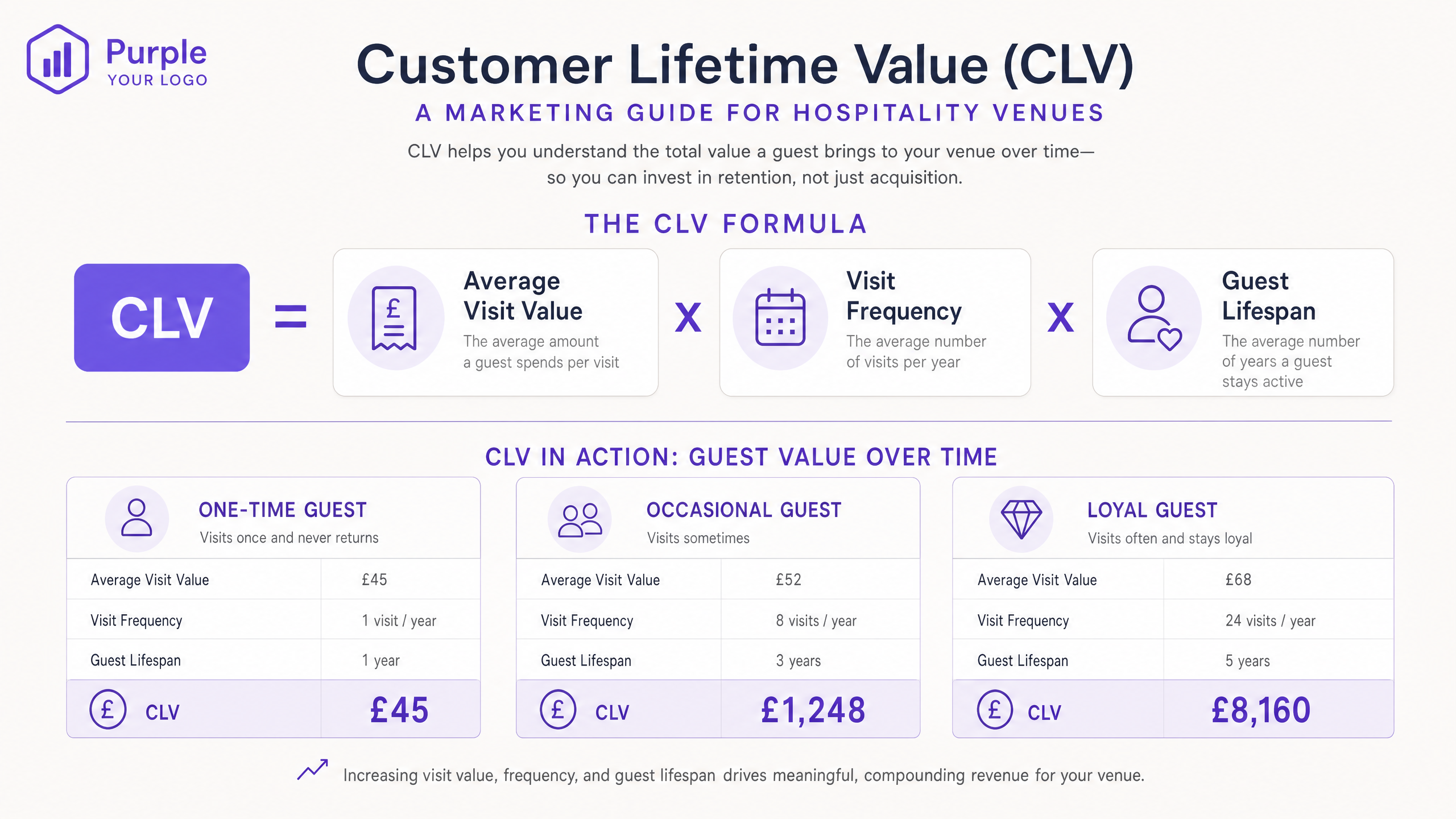
Take a casual dining restaurant, for example. A one-off guest spends £45, visits once, and never returns. Their CLV is £45. A loyal regular guest spends £68 per visit, comes twice a month, and remains active for 5 years. Their CLV is £8,160. That loyal regular guest is worth 180 times more than the one-off guest. Yet most venues market to both in exactly the same way.
The challenge is that most venues estimate CLV at a segment level because they cannot link individual guests to their visit history. POS systems record transactions, not people. Reservation systems record bookings, but miss walk-ins. To calculate CLV accurately, you need verified, individual-level visit data.
How to do this with your guest WiFi
This is exactly where guest WiFi becomes a strategic marketing tool. When a guest connects to your WiFi, they complete a login page. That login captures their name, email address, and consent to receive marketing communications under GDPR.
Purple uses active-choice opt-ins. The guest actively chooses to receive communications. This is a verified, deliberate decision, which means these opted-in guests engage at a significantly higher rate compared to contacts acquired through other means.
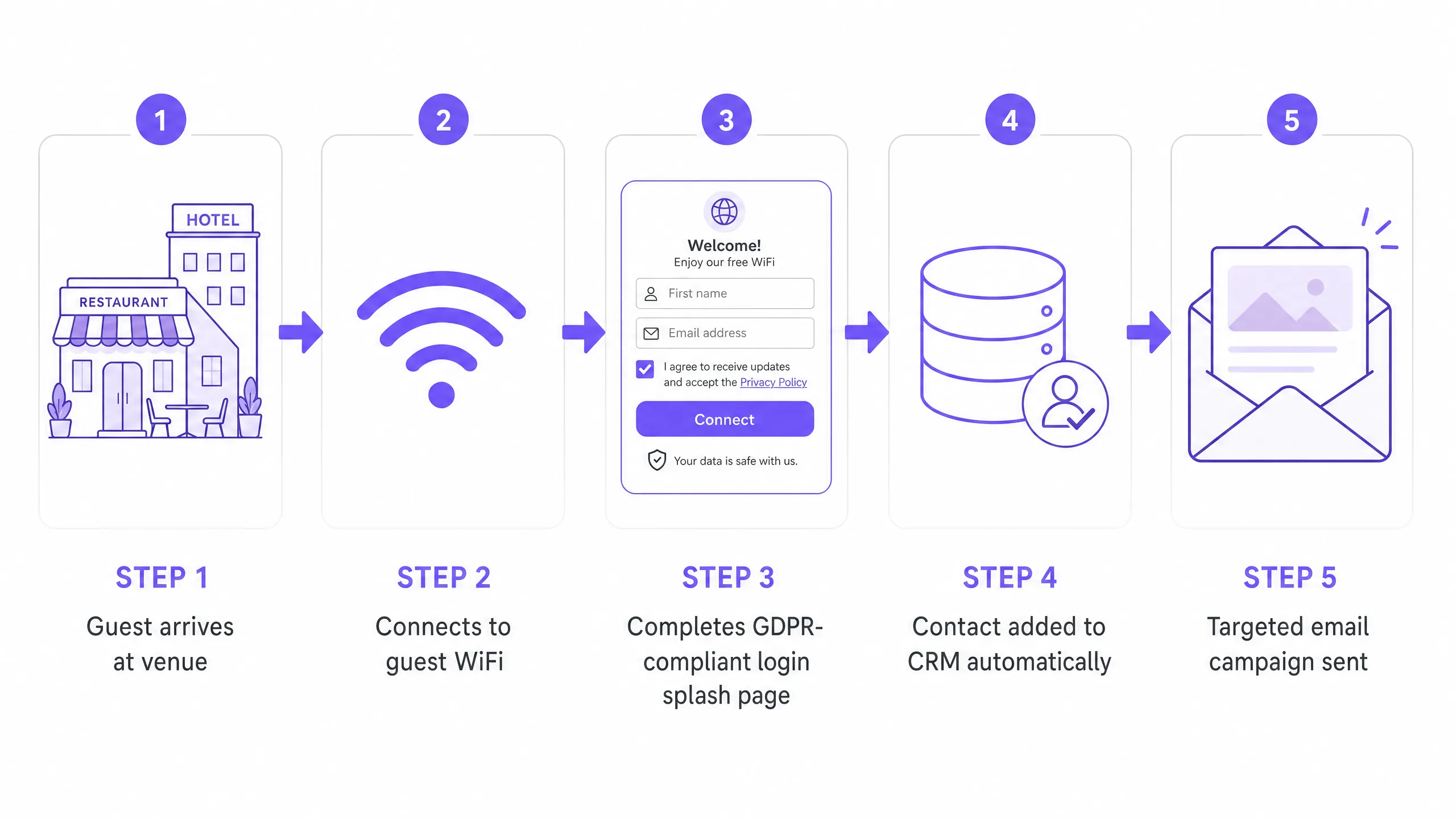
Most importantly, every time that same guest returns and reconnects to your WiFi, Purple links that new visit to their existing profile. You now have a verified record of how many times, on which dates, and at what times that specific individual has visited. This is visit frequency data, captured automatically at the individual guest level.
By pairing this with your POS or PMS data, you can calculate a real CLV for real people. Generic email tools like Mailchimp send campaigns, but they do not build lists or capture visit data. Purple Engage captures first-party data and links it directly to repeat visits.
To learn more about segmentation, read our guide on Using dwell time and visit data to segment venue guests.
What to send and when to send it
Once you have individual-level visit data, you can create segments based on actual behaviour rather than guesswork.
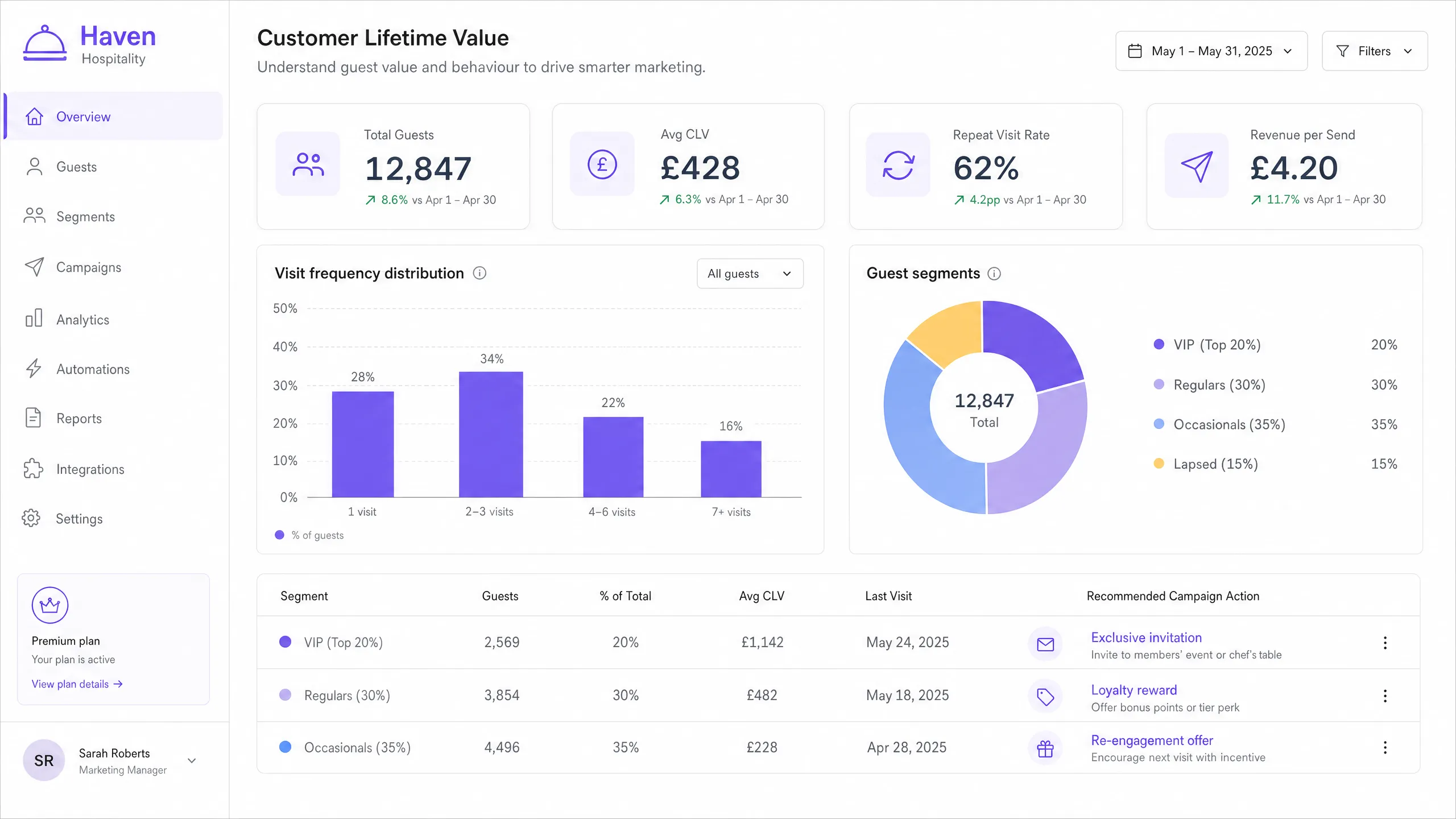
At a minimum, you should create four core segments:
- New guests: Visited once. Send a welcome email 24 hours after their visit.
- Occasional guests: Visited 2-5 times. Send targeted offers to increase their visit frequency.
- Regular guests: Visited 6+ times. Give exclusive rewards or early access to events. Do not offer discounts; they already love your venue.
- Lapsed guests: No visits in 90 days. Send a strong re-engagement offer. Winning back a guest who stopped coming after six visits is far more valuable than acquiring a new guest you have never seen before.
Measuring what works
Do not measure the success of your campaigns by open rates or click-through rates. Measure them by return visits and revenue generated per send.
Because Purple Engage tracks physical visits via WiFi login, you can see exactly how many people received an email on Tuesday and actually walked through your door on Friday. This attribution closes the loop, helping you see which campaigns actually drive footfall and increase CLV.
Where to start
- Audit your WiFi: Ensure you have a captive portal that captures first-party data with GDPR-compliant consent.
- Connect your CRM: Ensure captured data flows automatically into your CRM or marketing platform. See the Purple Engage product overview to learn how this works seamlessly.
- Segment your audience: Group your guests by visit frequency.
- Automate the basics: Set up a welcome campaign for new guests and a re-engagement campaign for lapsed guests.
- Track physical returns: Measure success by actual venue visits, not just email open rates.