
Measuring email ROI for physical venues: beyond open rates
Most venue marketers track opens and clicks, but these metrics fail to show whether an email campaign actually drove footfall.
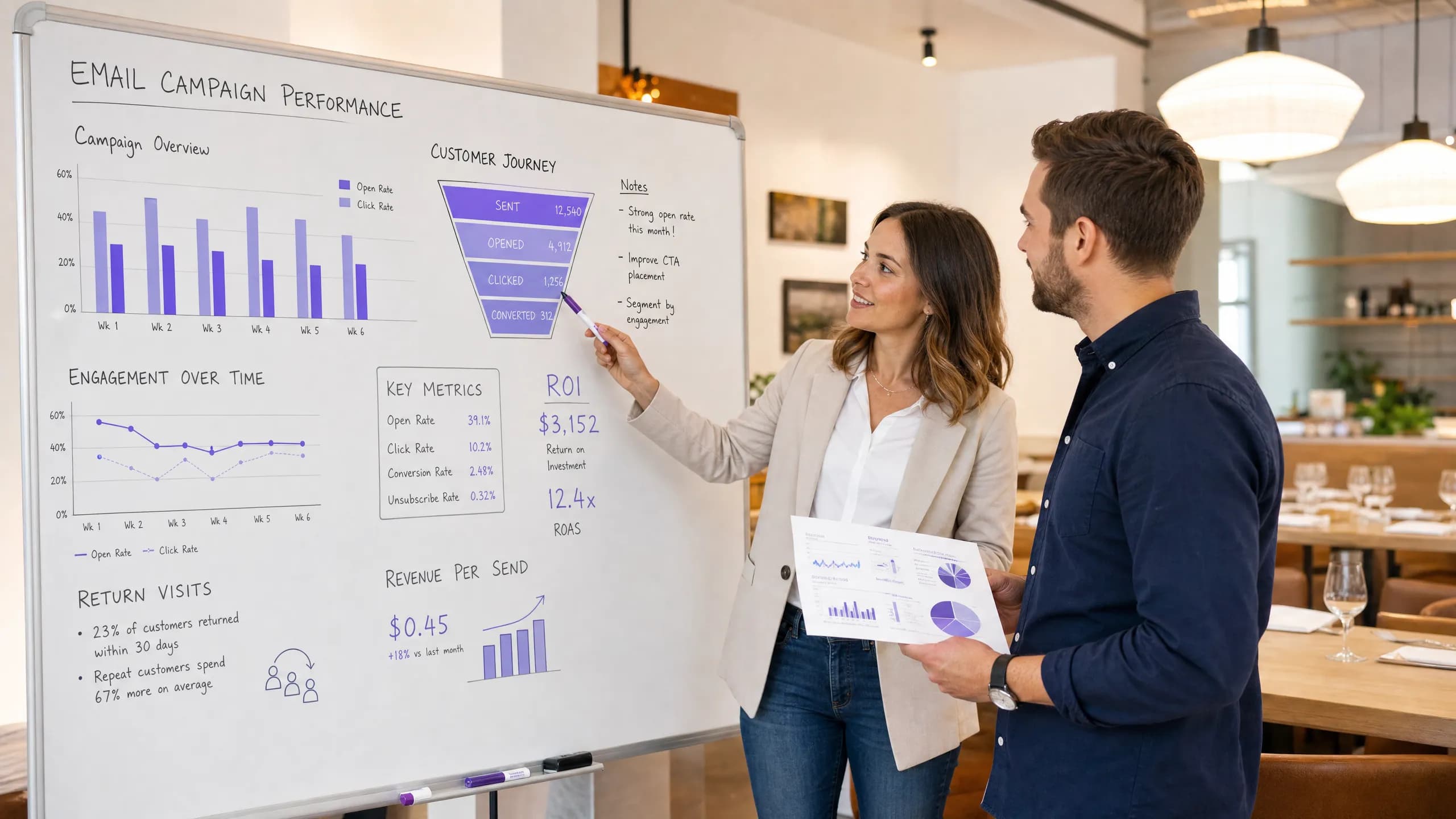
Video overview
Listen to this guide
Read the transcript
Welcome to the Purple marketing briefing. I'm your host, and today we are tackling a problem that every marketer in hospitality, retail, and physical venues faces: proving the ROI of your email campaigns. If you run marketing for a restaurant group, a hotel chain, or a shopping centre, you know the frustration. You spend hours crafting the perfect email. You hit send. You watch the open rate climb to 35, maybe 40 percent. You report that number to your leadership team. And they ask the inevitable question: 'That's great, but how many people actually walked through the door and bought something?' And if you are using standard email tools like Mailchimp or Klaviyo, you probably have to guess. You can track the click, but you cannot track the footfall. Today, we are going to fix that. We are going to look at how to measure what actually matters: return visits, revenue per send, and customer lifetime value. And we are going to do it by connecting your email marketing to your physical venue through your Guest WiFi. Let's start with the fundamental problem. Most venue marketers are measuring the wrong things. An open rate tells you if your subject line was good. A click rate tells you if your call to action was compelling. But neither of those metrics tells you if someone walked into your restaurant, bought a round of drinks, or booked a room. This is the measurement gap. Ecommerce brands don't have this problem. When someone clicks a link in a Shopify email, the purchase is tracked automatically. But when you send an email promoting a Saturday brunch, there is no equivalent moment of digital conversion. The conversion happens in the physical world, and standard email tools have no way to see it. So how do you close that gap? You use the one piece of infrastructure that every modern venue already has: the WiFi network. Here is how it works. When a guest connects to your WiFi, they go through a captive portal. They enter their email address, they accept your terms, and they tick the box to receive marketing from you. That is a conscious choice. That is GDPR-compliant consent. And that is the moment your marketing list starts building itself. Purple captures that data and stores it in a centralised CRM. Every guest who connects is added to your database with their email, their visit date, their dwell time, and their preferred location. You are not buying a list. You are not guessing who your customers are. You know exactly who visited, when, and for how long. Now, here is where the attribution magic happens. Because you are using Purple Engage, which sits on top of your existing hardware - whether that's Cisco Meraki, HPE Aruba, or Ubiquiti UniFi - you can send campaigns based on actual behaviour. And when those guests return to your venue, the network recognises their device. Purple logs a return visit and attributes it to the specific campaign you sent. No QR codes. No vouchers. No asking the guest to do anything other than walk through the door. The network does the work. So what should you actually be sending? The short answer is: stop sending batch-and-blast newsletters. They yield low returns because they are not relevant to the individual. You need automated, behaviour-triggered emails. Set up a Welcome email two hours after a first-time guest leaves. Set up a 'We miss you' offer when a regular guest hasn't visited in 60 days. Set up a birthday promotion two weeks before their birth date. If you operate multiple venues, segment your list by location. Don't send a London promotion to a Manchester guest. These automations run in the background. Once you set them up, they work continuously, sending the right message to the right person at the right time. Now let's talk about measurement. Once your campaigns are running, you need to track three numbers. Number one: Return Visit Rate. What percentage of the people who received the email actually walked back into the venue within 14 or 30 days? This is your new primary metric. A campaign with a 22% return visit rate drove more value than one with a 45% open rate and no measurable footfall. Number two: Revenue per Send. Take your return visits, multiply them by your average transaction value, and divide by the total number of emails sent. If you send 10,000 emails, get 500 return visits, and your average spend is twenty pounds, your campaign generated ten thousand pounds. Your revenue per send is one pound. That is a number you can take to the board. Number three: Customer Lifetime Value. Track how email engagement affects long-term spend. Guests who are in your WiFi database and engage with your campaigns visit more frequently and spend more over their lifetime than anonymous foot traffic. Measuring this by cohort - opted-in guests versus walk-in guests - quantifies the long-term value of your data capture programme. Let me give you a quick practical example to make this concrete. A 40-site restaurant group is using Mailchimp. They have a 35 percent open rate on their monthly newsletter, but they cannot prove it drives diners into the restaurants. The marketing director is under pressure to justify the budget. They deploy Purple Engage. They start collecting data via the captive portal on their Cisco Meraki network. They set up two automated campaigns: a Birthday Month offer with a complimentary dessert, and a Lapsed Diner campaign targeting guests who haven't visited in 60 days. When recipients return to any of the 40 sites, the network logs the visit and attributes it to the campaign. The marketing director can now report exact footfall numbers. Not estimated. Not assumed. Exact. They have replaced vanity metrics with definitive proof. Now, a quick note on pitfalls. The most common mistake is setting your attribution window too long. If you use a 90-day window for a restaurant, you will over-attribute visits that would have happened anyway. Start with 14 days and adjust based on your venue's natural visit frequency. The second pitfall is sending too early. A 'We miss you' email sent after 90 days of absence often arrives too late. The guest's habit has already broken. Test sending at 30 days and 45 days and measure the return visit rate for each. The data will tell you the optimal trigger point. The third pitfall is not segmenting by location. If you operate multiple venues, a guest who visits your Manchester location is not interested in a promotion for your London site. Segment by primary venue and your relevance - and your return visit rate - will improve significantly. Let me take a couple of quick questions that come up frequently. First question: we already use Mailchimp and we are happy with it. Do we need to switch? Not necessarily. Purple Engage can work alongside your existing tools, or you can consolidate everything within Engage. The key is connecting your WiFi data to your email platform so you can close the attribution loop. The tool you use to send the email matters less than the data you use to measure the result. Second question: what about privacy? GDPR compliance is built into the process. Guests opt in at the captive portal. They make a conscious choice. You are not tracking them without consent. You are measuring the behaviour of people who asked to hear from you. That is exactly what GDPR is designed to enable. So, where should you start? Here is a short, ordered checklist. First, review your current email metrics and acknowledge the gap between digital engagement and physical outcomes. Second, audit your Guest WiFi setup. Ensure you are capturing first-party data and securing GDPR-compliant opt-ins at the captive portal. Third, consolidate your data within Purple Engage, or connect your WiFi data to your existing email platform. Fourth, build your first automated trigger. Start simple - a 'We miss you' campaign for 30-day lapsed guests is the easiest place to start and typically delivers the clearest ROI signal. And fifth, establish your baseline. Measure the return visit rate of that first campaign. That number becomes your benchmark for everything that follows. The shift from vanity metrics to outcome metrics is not complicated. It does not require a new team or a large budget. It requires connecting the tools you already have - your WiFi network and your email platform - so that the physical world and the digital world can finally talk to each other. Stop measuring opens. Start measuring outcomes. Thanks for listening, and we'll see you next time.
Why this matters for your venue
If you run marketing for a physical venue, you face a measurement gap that e-commerce brands do not. When an online retailer sends an email, they track the click straight through to the checkout. When you send an email to promote a new menu, a seasonal sale, or a weekend event, you see the open rate and the click rate. You do not see if that person actually walked through your doors on Saturday.
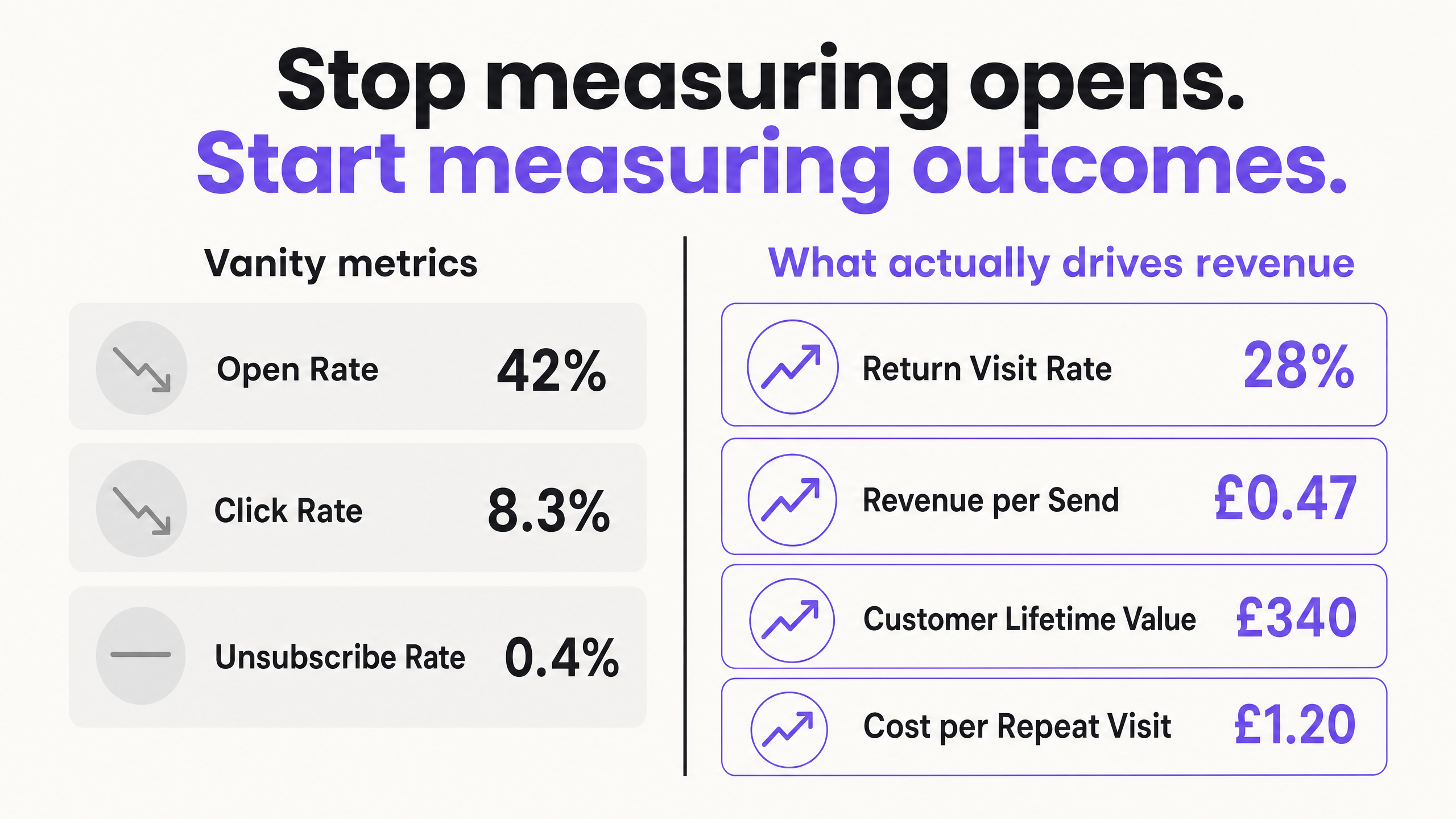
This measurement gap forces venue marketers to rely on vanity metrics. You report a 42% open rate to your leadership team. They ask how many people visited the venue and how much revenue the campaign generated. Without closed-loop attribution, you cannot answer them.
This is where standard email tools fall short for physical spaces. Platforms like Mailchimp or Klaviyo send the campaign, but they cannot verify whether the recipient visited your location. To prove the ROI of your email marketing, you need to connect your digital communications to physical footfall - and you do that by tying your email list to your venue's Guest WiFi network.
The approach
To measure true ROI, you must shift your focus from engagement metrics to outcome metrics. You need to track three specific numbers: Return Visit Rate, Revenue per Send, and Customer Lifetime Value.
First, you need a verified, conscious-choice list of first-party data. You build this list when guests log into your Guest WiFi. They authenticate, accept your terms, and opt into marketing in compliance with GDPR. This creates a clean, verified database of people who have definitively visited your venue - not a rented list, not a scraped list. People who were physically present and made a conscious choice to hear from you.
Second, you send targeted campaigns to this list based on their actual behavior. You know when they last visited, which location they prefer, and how long they stayed.
Third, you measure the result when they return. Because their device is associated with their profile, your network recognizes them the moment they walk back in. You do not need them to click a link, scan a QR code, or redeem a voucher. The network logs the return visit automatically. This is closed-loop attribution.
How to do it with your guest WiFi
Purple Engage makes this process automatic. We sit as a cloud overlay on top of your existing hardware. Whether you use Cisco Meraki, HPE Aruba, Ruckus, Juniper Mist, Ubiquiti UniFi, Cambium, Extreme, or Fortinet, the process is the same.
When a guest connects to your WiFi, they hit a captive portal. They log in using their email address or a social profile. Purple captures this data and stores it in a centralized CRM. This is your first-party data asset - built automatically, every day, by every guest who connects.
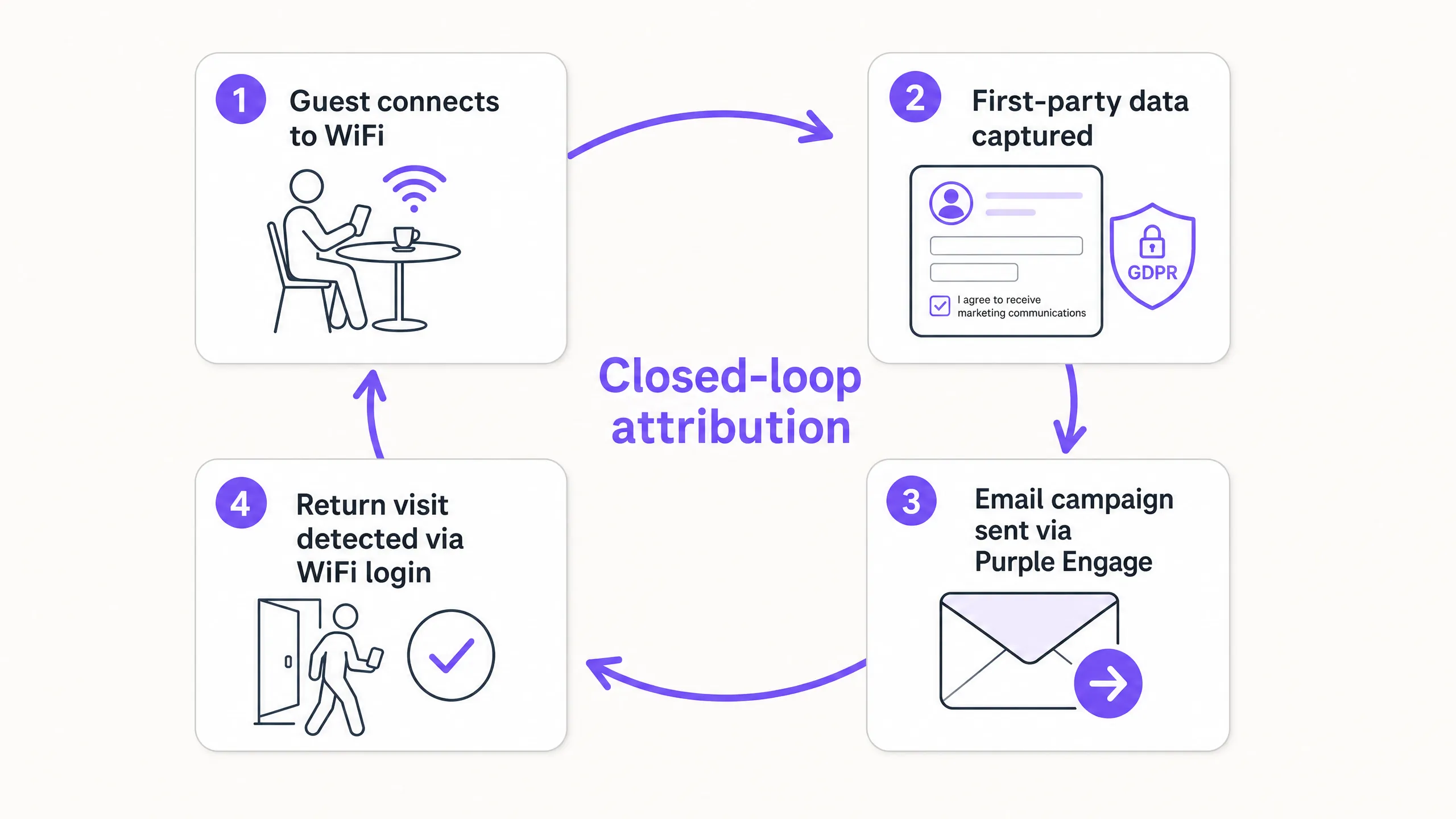
You build your email campaigns directly within Purple Engage. You segment your audience based on demographics, visit frequency, or dwell time. For example, you can isolate guests who visited three times last month but have not returned in 30 days. You send them a targeted offer. When they return, the network logs it. Purple attributes that physical visit back to the specific campaign you sent.
This is what separates Purple from generic email tools. Mailchimp sends the email. Purple sends the email and then tells you who walked back through the door.
What to send, and when
To drive return visits, you must send relevant content at the right time. Batch-and-blast newsletters yield low returns. Automated, behavior-triggered emails drive measurable footfall.
Set up automated campaigns based on the visitor lifecycle. Send a 'Welcome' email two hours after a first-time guest leaves your venue. Send a 'We miss you' offer when a regular guest has not visited in 60 days. Send a birthday promotion two weeks before their birth date.
For ad-hoc campaigns, segment your list by location. If you operate 50 pubs, do not send a promotion for a London event to your Manchester guests. Filter your list by the guests' primary venue and send highly targeted, location-specific offers. For a deeper look at how to build these segments, read our Email segmentation for venues: a practical guide.
| Trigger | Audience | Timing | Goal |
|---|---|---|---|
| First visit | New guests | 2 hours after leaving | Drive second visit |
| Lapsed guest | No visit in 60 days | Day 60 | Re-engage |
| Birthday | Guests with DOB on file | 14 days before birthday | Drive celebration visit |
| Post-event | Attendees at a specific event | 24 hours after event | Capture feedback and repeat booking |
| Seasonal | Full list, segmented by location | 2 weeks before key dates | Drive seasonal footfall |
Measuring what works
Once your campaigns are running, you must measure the outcomes that impact the bottom line.
Return Visit Rate is the percentage of email recipients who physically return to your venue within a specific attribution window - typically 14 or 30 days. This is your new primary metric. A campaign with a 22% return visit rate drove more value than one with a 45% open rate and no measurable footfall.
Revenue per Send is calculated by multiplying your return visits by your average transaction value, then dividing by the total number of emails sent. If you send 10,000 emails, generate 500 return visits, and your average spend is $20, your campaign generated $10,000. Your revenue per send is $1.00. That is a number you can take to the board.
Customer Lifetime Value (CLV) tracks how email engagement affects long-term spend. Guests who engage with your WiFi and email campaigns visit more frequently and spend more over their lifetime than anonymous foot traffic. Measuring CLV by cohort - WiFi-opted-in guests versus walk-in guests - quantifies the long-term value of your data capture program.
| Metric | What it measures | How to calculate |
|---|---|---|
| Return Visit Rate | Footfall driven by email | (Return visits / Emails sent) x 100 |
| Revenue per Send | Financial return per email | (Return visits x Avg transaction) / Emails sent |
| Cost per Return Visit | Efficiency of spend | Campaign cost / Return visits |
| Customer Lifetime Value | Long-term guest value | Avg visit frequency x Avg spend x Avg tenure |
Where to start
- Review your current email metrics. Identify the gap between digital engagement (opens) and physical outcomes (visits).
- Audit your Guest WiFi setup. Ensure you capture first-party data and secure GDPR-compliant marketing opt-ins.
- Integrate your data. Connect your Guest WiFi data to your email marketing platform, or consolidate both within Purple Engage.
- Build your first automated trigger. Start with a 'We miss you' campaign targeting guests who have not visited in 30 days.
- Establish your baseline. Measure the return visit rate of that first campaign to set a benchmark for future performance.