
Segmenting guests by visit frequency: how to reward your best customers
This guide explains how to segment physical venue guests based on visit frequency using WiFi login data. It covers the strategy, implementation, and measurement of automated campaigns for first-timers, regulars, and lapsed guests to drive repeat visits and revenue.
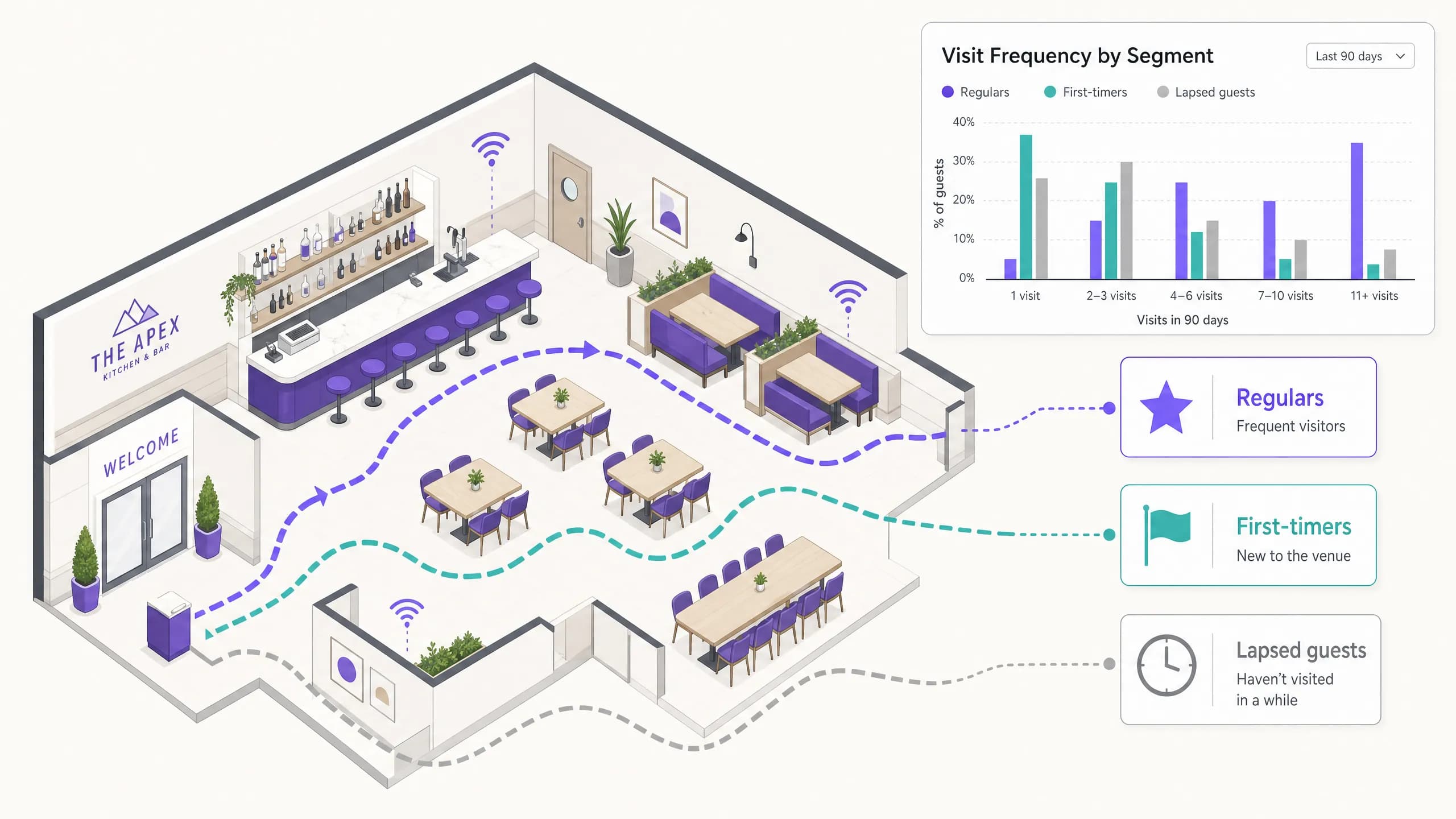
Video overview
Listen to this guide
Read the transcript
Welcome to the Purple Engage marketing series. I'm your host, and today we're talking about one of the most practical things you can do with your guest WiFi data: segmenting your guests by visit frequency, and then actually doing something useful with those segments. This episode runs about ten minutes. By the end, you'll have a clear picture of how to identify your best customers, what to send each group, and how to measure whether it's working. Let's start with why this matters. Section one: Why visit frequency is the number you should care about. Most venues collect email addresses. Very few do anything meaningful with them. The typical approach is to blast the same newsletter to everyone on the list, once a month, and then wonder why open rates are sitting at twelve percent. Here's the problem. A guest who visited your restaurant last Tuesday is not the same as a guest who came once in March and hasn't been back since. Sending them the same message is a waste of your budget and, frankly, a bit tone-deaf. Visit frequency tells you something that demographic data can't. It tells you about behaviour. A guest who visits five times in ninety days has already decided they like you. Your job is to reward that, deepen it, and make them feel seen. A guest who visited once and disappeared is a different conversation entirely. You need to give them a reason to come back before they forget you exist. Research from Bain and Company suggests that increasing customer retention by just five percent can increase profits by between 25% and 95%. The guests who visit most often are not just your most loyal. They're your most profitable. They spend more per visit, they're more likely to bring friends, and they cost far less to retain than a new guest costs to acquire. The challenge has always been: how do you actually know who visits how often? If you're relying on a loyalty card scheme or a booking system, you're only capturing a fraction of your footfall. Most guests don't book. Most don't carry a loyalty card. They just walk in, sit down, and leave. That's where guest WiFi changes everything. Section two: The approach - how WiFi login data builds your segments automatically. When a guest connects to your WiFi, they log in through a captive portal. They enter their name and email address, they accept your terms and conditions, and they get online. That's a conscious choice. That's GDPR-compliant, first-party consent. Not a scraped list. Not a purchased database. A real person who chose to share their details with you. Purple Engage captures that login and ties it to a guest profile. Every subsequent visit, when that same guest logs back in, the system records it. Over time, you build a picture: how many times they've visited, how recently, how long they typically stay. From that data, you can define three core segments. First-timers. These are guests who have logged in exactly once. They came, they connected, they left. You have their email. You have a window of roughly fourteen days before the memory of their visit fades. The goal is simple: get them back for a second visit. Research consistently shows that a guest who visits twice is significantly more likely to become a regular than one who visits once. That second visit is the conversion moment. Regulars. These are guests who have visited five or more times in the past ninety days. They're your advocates. They're the people who recommend you to friends. The goal here is not to convert them - they're already converted. The goal is to reward them, make them feel like insiders, and increase their spend per visit. Lapsed guests. These are guests who visited at least once but haven't been back in sixty days or more. They haven't unsubscribed. They haven't told you they dislike you. They've just drifted. The goal is reactivation. A well-timed, personalised win-back campaign can recover a meaningful percentage of this group. The key thing to understand is that these segments update automatically. You don't need to manually export a spreadsheet and sort it every week. Purple Engage does that work for you, based on live WiFi login data. Section three: What to send, and when. Let's get specific about each segment. For first-timers, timing is everything. Send a welcome email within twenty-four hours of their first login. Keep it warm but not gushing. Acknowledge the visit, tell them something they might not know about you - an upcoming event, a dish they might have missed, a reason to come back. Include a specific offer with a clear expiry. Not a vague "come back soon." Something like: "Enjoy a complimentary dessert on your next visit before the end of the month." The expiry creates urgency. The specificity makes it feel like a real offer, not a mass mailout. If they don't return within fourteen days, send a second email. Keep it short. A single line of copy and a clear call to action is often more effective than a designed newsletter. "We haven't seen you since your visit on the fifth. Here's something to bring you back." That level of personalisation - referencing the actual visit date - is only possible because the data came from a WiFi login, not a generic sign-up form. For regulars, the approach is different. They don't need to be convinced to visit. They need to feel valued. A loyalty reward email - triggered when a guest hits a visit milestone, say their tenth visit - lands very differently from a generic newsletter. "You've visited us ten times. That means a lot to us. Here's something to say thank you." That email has a purpose. It acknowledges a behaviour. It rewards it. You can also use dwell time data here. If a regular typically stays for ninety minutes, you know they're a sit-down guest, not a grab-and-go. You can tailor your messaging accordingly. Invite them to a tasting evening. Offer them a reserved table on a quiet night. The data makes the personalisation possible. For lapsed guests, the win-back campaign is a two-email sequence. The first email goes out at day sixty of no visits. It should acknowledge the gap without being passive-aggressive about it. "It's been a while. We've missed you." Then a clear, time-limited incentive. The second email goes out at day seventy-five if they still haven't returned. This is your last shot. Make the offer compelling. If they don't respond to this, move them to a low-frequency general list rather than continuing to chase them. Section four: Practical steps and pitfalls. Let's talk about how to actually set this up, and where people go wrong. Step one: Define your segment thresholds. The numbers I've used - one visit for first-timers, five visits in ninety days for regulars, sixty days of absence for lapsed - are starting points. Your venue's visit cadence might be different. A hotel has a very different visit frequency to a coffee shop. Adjust the thresholds to reflect realistic behaviour at your venue. Step two: Write the emails before you build the automations. This sounds obvious, but many teams build the automation first and then rush the copy. The copy is the thing that drives the result. Spend time on the subject line. Personalise with the guest's first name and, where possible, a reference to their actual visit behaviour. Step three: Set up the automations in Purple Engage. Each segment has a trigger: first login for first-timers, visit count milestone for regulars, days-since-last-login for lapsed. The platform handles the segmentation and the trigger logic. You set the rules once and the campaigns run automatically. Step four: Don't ignore dwell time. Visit count and recency are the primary signals, but dwell time adds nuance. A guest who spends three hours every Friday evening is a very different guest from one who pops in for fifteen minutes. Use dwell time to refine your messaging within the regular segment. Now, the pitfalls. The most common mistake is treating the lapsed segment as a dumping ground. Some venues send their most aggressive promotional emails to lapsed guests on the basis that they have nothing to lose. That's wrong. Aggressive discounting to lapsed guests trains them to wait for offers. It also damages your brand perception. Win-back campaigns should feel like a genuine invitation, not a clearance sale. The second mistake is neglecting the regulars. Most venues focus their marketing energy on acquisition and reactivation. The regulars get the same newsletter as everyone else. That's a missed opportunity. Your regulars are your most cost-effective marketing channel. They recommend you. They bring people. A small investment in making them feel special pays back disproportionately. The third mistake is not measuring the right thing. Open rate tells you whether your subject line worked. Click rate tells you whether your offer was compelling. Neither tells you whether the guest actually came back. The metric that matters is return visit rate by segment. Purple Engage tracks this because the same WiFi login data that built the segment also records the return visit. Close the loop. Quick question and answer. Question: We already use Mailchimp. Why can't we just do this there? Answer: You can send segmented emails from Mailchimp. The problem is the data. Mailchimp doesn't know who visited your venue and when. It can only segment on data you manually import or collect through forms. The visit frequency data that makes these segments meaningful comes from WiFi logins. Without that data source, you're segmenting on guesswork. Purple Engage builds the list and the segments from verified, real-world visit behaviour. That's the difference. Question: What about guests who don't use WiFi? Answer: Fair point. WiFi login data captures a subset of your total footfall. In most hospitality venues, that's typically between 30% and 60% of guests, depending on the venue type and the quality of the WiFi experience. It's not a complete picture, but it's a far larger and more verified dataset than any other opt-in mechanism most venues have access to. And unlike a loyalty card, it requires no extra step from the guest beyond connecting to WiFi. Summary and next steps. Here's what to take away from this episode. Visit frequency is the most actionable signal you have. It tells you who your best guests are, who's at risk of lapsing, and who you have a short window to convert. Three segments cover most of what you need: first-timers, regulars, and lapsed guests. Each needs a different message, a different offer, and a different timing. The data that makes this possible comes from guest WiFi logins. That's first-party, GDPR-compliant, and it builds itself every time a guest connects. The campaigns run automatically once you've set the triggers. You write the emails once. The platform does the rest. Measure return visits, not just opens. That's the number that connects your email marketing to your revenue. If you want to see how this works in practice, visit purple.ai and take a look at Purple Engage. The platform covers everything from WiFi login capture through to segmented email automation, all in one place. Thanks for listening. We'll see you in the next episode.
Why this matters for your venue
Most physical venues collect email addresses, but very few do anything meaningful with them. The typical approach is to blast the same newsletter to everyone on the list, once a month, and then wonder why open rates are sitting at 12%.
Here is the problem. A guest who visited your restaurant last Tuesday is not the same as a guest who came once in March and has not been back since. Sending them the same message is a waste of your budget and, frankly, a bit tone-deaf.
Visit frequency tells you something that demographic data cannot. It tells you about behavior. A guest who visits five times in 90 days has already decided they like you. Your job is to reward that, deepen it, and make them feel seen. A guest who visited once and disappeared is a different conversation entirely. You need to give them a reason to come back before they forget you exist.
Research from Bain & Company suggests that increasing customer retention by just 5% can increase profits by between 25% and 95%. The guests who visit most often are not just your most loyal. They are your most profitable. They spend more per visit, they are more likely to bring friends, and they cost far less to retain than a new guest costs to acquire.
The challenge has always been knowing who visits how often. If you rely on a loyalty card program or a booking system, you only capture a fraction of your foot traffic. Most guests do not book. Most do not carry a loyalty card. They just walk in, sit down, and leave.
That is where guest WiFi changes everything.
The approach
When a guest connects to your WiFi, they log in through a captive portal. They enter their name and email address, they accept your terms and conditions, and they get online. That is a conscious choice. That is GDPR-compliant, first-party consent. Not a scraped list. Not a purchased database. A real person who chose to share their details with you.
Purple Engage captures that login and ties it to a guest profile. Every subsequent visit, when that same guest logs back in, the system records it. Over time, you build a picture: how many times they have visited, how recently, how long they typically stay.
From that data, you can define three core segments.
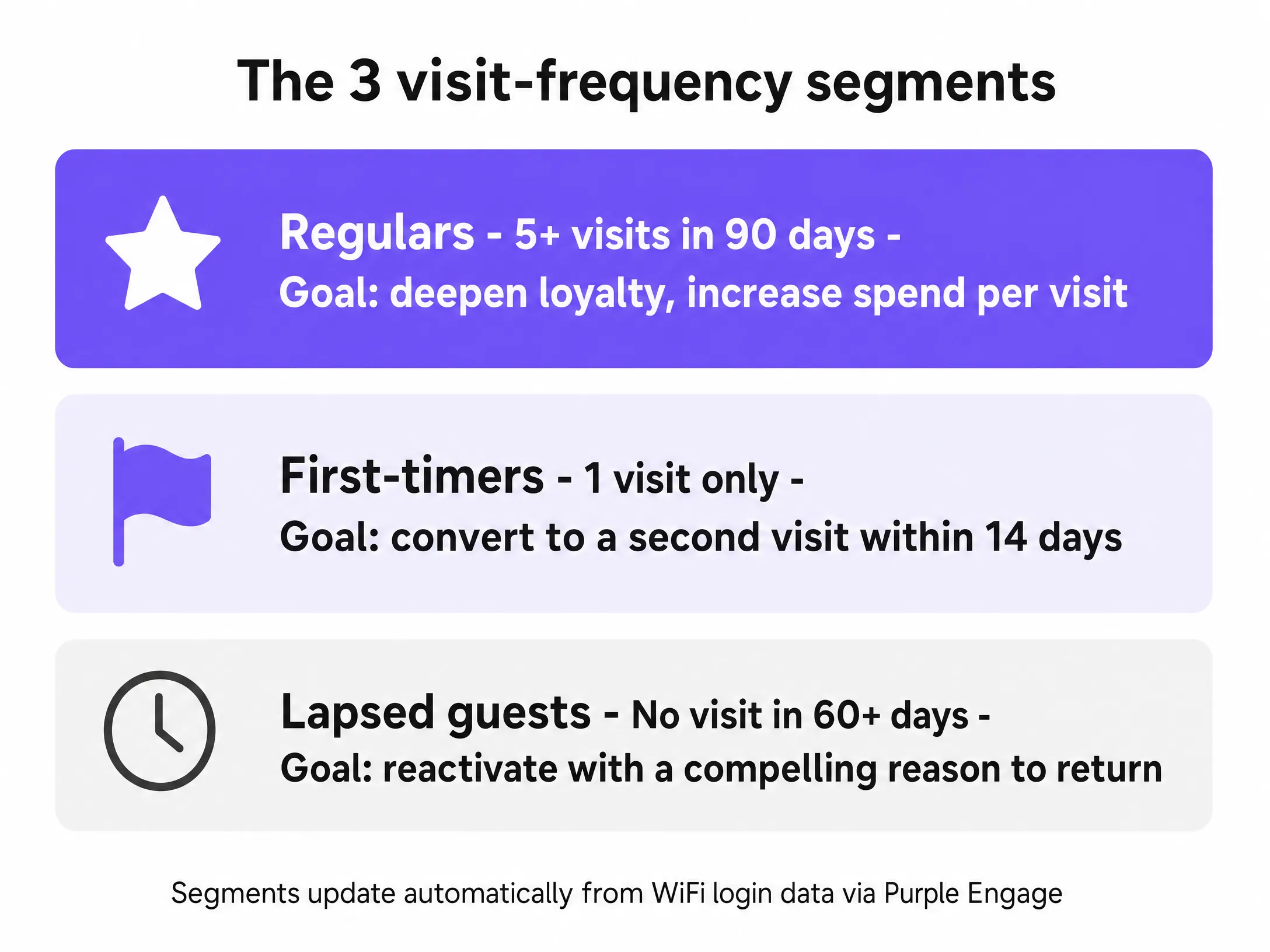
First-timers. These are guests who have logged in exactly once. They came, they connected, they left. You have their email. You have a window of roughly 14 days before the memory of their visit fades. The goal is simple: get them back for a second visit. Research consistently shows that a guest who visits twice is significantly more likely to become a regular than one who visits once. That second visit is the conversion moment.
Regulars. These are guests who have visited five or more times in the past 90 days. They are your advocates. They are the people who recommend you to friends. The goal here is not to convert them - they are already converted. The goal is to reward them, make them feel like insiders, and increase their spend per visit.
Lapsed guests. These are guests who visited at least once but have not been back in 60 days or more. They have not unsubscribed. They have not told you they dislike you. They have just drifted. The goal is reactivation. A well-timed, personalized win-back campaign can recover a meaningful percentage of this group.
The key thing to understand is that these segments update automatically. You do not need to manually export a spreadsheet and sort it every week. Purple Engage does that work for you, based on live WiFi login data.
How to do it with your guest WiFi
The technical implementation relies on the network infrastructure you already have. Purple integrates with Cisco Meraki, HPE Aruba, Ruckus, Juniper Mist, Ubiquiti UniFi, Cambium, Extreme, and Fortinet. The hardware provides the connection; Purple provides the intelligence.
When a guest connects, the hardware sends the MAC address to the Purple cloud overlay via RADIUS. If the MAC address is unknown, Purple presents the captive portal. The guest completes the login, granting GDPR-compliant consent. If the MAC address is known, Purple authenticates the device seamlessly and logs the visit.
This data flows directly into Purple Engage. The platform evaluates the guest's visit history against the segment rules you have defined. If a guest hits their fifth visit in 90 days, the system moves them into the 'Regulars' segment and triggers the associated automation.
This eliminates the manual data handling that plagues traditional CRM deployments. The customer list builds itself from guest WiFi logins, as verified, conscious-choice, first-party data. Generic email tools like Mailchimp send the campaign but do not build the list.
What to send, and when
Let's get specific about each segment.
First-timers
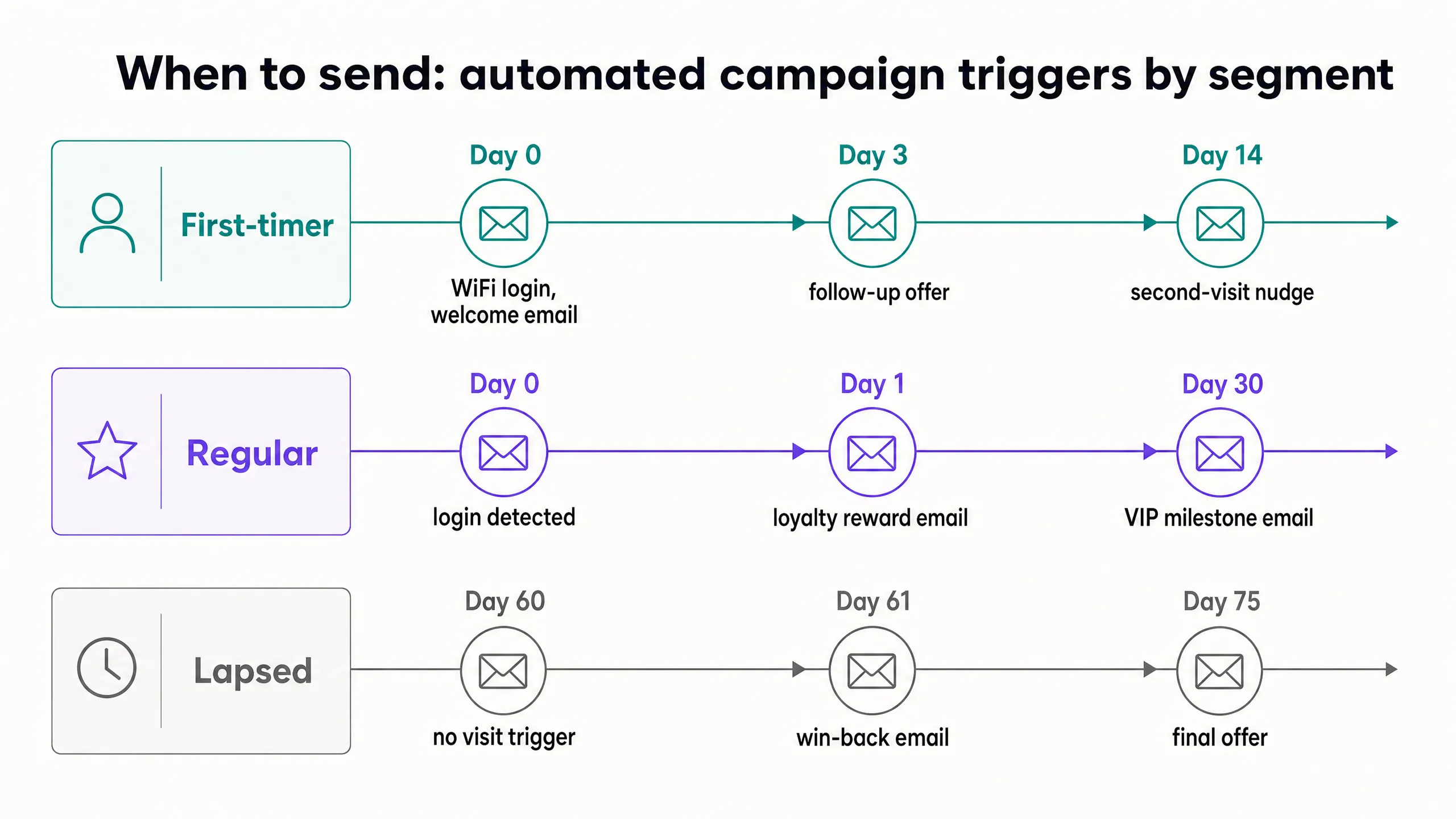
For first-timers, timing is everything. Send a welcome email within 24 hours of their first login. Keep it warm but not gushing. Acknowledge the visit, tell them something they might not know about you - an upcoming event, a dish they might have missed, a reason to come back. Include a specific offer with a clear expiry. Not a vague "come back soon." Something like: "Enjoy a complimentary dessert on your next visit before the end of the month." The expiry creates urgency. The specificity makes it feel like a real offer, not a mass mailout.
If they do not return within 14 days, send a second email. Keep it short. A single line of copy and a clear call to action is often more effective than a designed newsletter. "We have not seen you since your visit on the 5th. Here is something to bring you back." That level of personalization - referencing the actual visit date - is only possible because the data came from a WiFi login, not a generic sign-up form.
Regulars
For regulars, the approach is different. They do not need to be convinced to visit. They need to feel valued. A loyalty reward email - triggered when a guest hits a visit milestone, say their 10th visit - lands very differently from a generic newsletter. "You have visited us 10 times. That means a lot to us. Here is something to say thank you." That email has a purpose. It acknowledges a behavior. It rewards it.
You can also use dwell time data here. If a regular typically stays for 90 minutes, you know they are a sit-down guest, not a grab-and-go. You can tailor your messaging accordingly. Invite them to a tasting evening. Offer them a reserved table on a quiet night. The data makes the personalization possible.
Lapsed guests
For lapsed guests, the win-back campaign is a two-email sequence. The first email goes out at day 60 of no visits. It should acknowledge the gap without being passive-aggressive about it. "It has been a while. We have missed you." Then a clear, time-limited incentive. The second email goes out at day 75 if they still have not returned. This is your last shot. Make the offer compelling. If they do not respond to this, move them to a low-frequency general list rather than continuing to chase them.
Measuring what works
Open rate tells you whether your subject line worked. Click rate tells you whether your offer was compelling. Neither tells you whether the guest actually came back.
The metric that matters is return visit rate by segment. Purple Engage tracks this because the same WiFi login data that built the segment also records the return visit. Close the loop.
When a guest receives a win-back email and subsequently logs onto the WiFi at the venue, Purple attributes that visit to the campaign. You can measure the exact revenue generated by the email, based on your average spend per head. This shifts the conversation from marketing vanity metrics to tangible business outcomes.
Where to start
- Define your thresholds. The numbers used here (one visit for first-timers, five in 90 days for regulars, 60 days absent for lapsed) are starting points. Adjust them based on your venue type.
- Write the copy. Focus on clear, direct messaging with specific, time-bound offers.
- Configure the triggers. Set up the automations in Purple Engage based on visit count and recency.
- Monitor and refine. Track the return visit rate and adjust the timing or the offer if a segment underperforms.
Listen to the Podcast
To dive deeper into the strategy, read our guide on WiFi-triggered email campaigns: what to send and when. For an overview of the platform, visit the Guest WiFi page or the Product overview.