
Win-back campaigns for venues: how to bring lapsed guests back
This guide shows venue operators and marketing managers how to build automated win-back email campaigns that target guests who have not visited in 30, 60, or 90 days.
Video overview
Listen to this guide
Read the transcript
Win-back campaigns for venues: how to bring lapsed guests back. A Purple Engage strategy briefing. Why it matters. Let's start with a number that should get your attention. According to Olo, 60 percent of restaurant revenue is driven by repeat guests. Not new guests. Not one-time visitors. Repeat guests. The people who already know you, already like you, and have already chosen to spend money with you. Now here is the problem. Most venues have no idea when a guest stops coming back. They have no automated mechanism to detect absence. They have no system to intervene. They just accept the loss and spend more money trying to acquire new guests instead. Research shows that acquiring a new guest costs five to 25 times more than retaining an existing one. And the average email list loses 22 to 30 percent of its subscribers every single year through natural decay. That is a significant, compounding revenue problem that most venues are ignoring. The good news is that 45 percent of inactive guests can be reactivated with the right message at the right time. A win-back campaign is how you do it. The approach. Before we get into the mechanics, let's address the core problem with how most venues approach this. Traditional email marketing tools like Mailchimp or Klaviyo are excellent at sending campaigns. But they have a fundamental blind spot: they do not know when a guest physically visits your venue. They only know if someone opened an email or clicked a link. This creates a broken feedback loop. You might send a we miss you email to someone who visited last Tuesday but paid with cash. You might exclude someone who has genuinely lapsed because their email address changed. You are flying blind. The modern approach uses your existing network infrastructure to solve this. When a guest connects to your venue WiFi, they interact with the captive portal. They provide their email address and give explicit, conscious-choice consent to receive marketing communications. This is first-party data - verified, consented, and tied to a real physical visit. From that moment, the network knows that device. Every subsequent visit is logged automatically. No manual check-ins. No loyalty app required. No POS integration needed. The WiFi itself is the visit-tracking mechanism. Purple Engage uses this data to automate the entire win-back process. When a guest's device has not appeared on your network for a defined period - say, 60 days - Purple Engage automatically moves them into the lapsed segment and triggers the win-back sequence. The list builds itself. The detection is automatic. The campaign fires without any manual intervention. This is the key differentiator from generic email tools. Mailchimp can send the campaign. But it cannot build the list from verified visit data, and it cannot detect physical absence from your venue. Purple Engage does both. The three-stage sequence. Effective win-back campaigns use a staged approach. Think of it as three conversations, each with a different tone and a different offer. Stage one: the nudge. This fires at around 30 to 60 days of absence. At this stage, you are not yet acknowledging that the guest has been away. You are reminding them of the value of your venue. Show them what is new. A seasonal menu update. An upcoming event. A new product line. The goal is to re-establish relevance without being heavy-handed. A good subject line for this stage might be: Something new is waiting for you at your venue name. Keep it light. No discount yet. You want to see if a gentle reminder is enough to bring them back. Stage two: the direct win-back. This fires at 60 to 90 days. Now you acknowledge the absence. We miss you is a cliche, but it works because it is honest. The key at this stage is the offer. For restaurants and bars, a free appetiser or a complimentary drink often outperforms a percentage discount. Here is why: a percentage off requires the guest to spend money to get value. A free item feels like a genuine gift. It lowers the barrier to return. For retail, a no minimum spend free delivery offer or a 20 percent discount with a short expiry window works well. The expiry is important. An offer with no deadline creates no urgency. Seven to 14 days is the right window. For hotels, avoid discounting the room rate. Instead, offer a value-add package: complimentary late check-out, a welcome drink, or a room upgrade subject to availability. This protects your Average Daily Rate while still giving the guest a compelling reason to book. A strong subject line for stage two: It's been a while, and then the guest's first name, followed by here's something to say we've missed you. Stage three: the final chance. This fires at 90 to 120 days. This is your best offer. Make it count. And be transparent: let the guest know that if they do not engage, you will stop sending them emails. This serves two purposes. First, it creates genuine urgency. Second, it protects your sender reputation by cleaning the list of disengaged contacts. A subject line that works here: Last chance - we're about to give up on you, and then the guest's first name. After stage three, if the guest has not returned, apply a sunset policy. Remove them from the active list. This is not a failure. It is good list hygiene. Sending emails to unengaged addresses damages your deliverability for everyone else. Practical steps and pitfalls. Let me walk you through the practical implementation steps, and flag the pitfalls that catch most venues out. Step one: configure your captive portal correctly. The portal needs to capture the email address and an explicit marketing consent checkbox. That checkbox must not be pre-ticked. Under GDPR, consent must be a deliberate, affirmative action. A pre-ticked box is non-compliant and invalidates the consent. Purple Engage ships GDPR-compliant flows out of the box, with consent statements configurable per region. Step two: enable email verification. Purple Verify checks the email address in real time before granting network access. This eliminates invalid and disposable addresses before they enter your database. Without verification, you can expect around 17 percent of your captured addresses to be invalid. With verification, database accuracy improves by 83 percent. A clean list is the foundation of good deliverability. Step three: set your lapsed threshold. This varies by venue type. For a coffee shop or fast-casual restaurant, 30 days is appropriate - these are high-frequency venues where absence is quickly meaningful. For a destination restaurant or bar, 60 days. For a hotel, 90 to 180 days, depending on your typical booking cycle. Step four: draft the three-stage sequence. Write the emails before you activate the automation. Test the subject lines. Keep the copy short. One clear call to action per email. Research shows that emails with a single call to action generate 42 percent more clicks than those with multiple links. Step five: activate and monitor. Once the automation is live, monitor it weekly for the first month. Check the return visit rate in the Purple Engage dashboard, not just the email open rate. Now, the pitfalls. The biggest pitfall is measuring success by email open rates. Apple's Mail Privacy Protection has made open rates unreliable. An email can register as opened when it was never actually read. The only metric that matters for a venue win-back campaign is whether the guest physically came back. Purple Engage tracks this via the network - when the guest's device reconnects to your WiFi after receiving the email, you have closed-loop attribution. That is the number you report to your board. The second pitfall is discounting too early. If you offer a discount in the first email, you train your guests to wait for discounts before returning. Start with value-add content, then escalate to financial incentives only if the nudge does not work. The third pitfall is sending to everyone. Win-back campaigns should only go to genuinely lapsed guests. If you send them to your whole database, you dilute the message and annoy guests who are already loyal. Purple Engage handles this segmentation automatically. Quick questions and answers. I want to address a few questions that come up regularly. We already use Mailchimp. Do we need to replace it? No. Purple Engage integrates with Mailchimp, Klaviyo, HubSpot, and most major email platforms. Purple handles the data capture, the lapsed detection, and the segment management. Your existing email tool handles the send. You get the best of both. What hardware do we need? Purple works with Cisco Meraki, HPE Aruba, Ruckus, Juniper Mist, Ubiquiti UniFi, Cambium, Extreme, and Fortinet. If you already have any of these in your venue, you can activate Purple Engage as a cloud overlay without replacing any hardware. How long does it take to see results? The first win-back emails will fire automatically once your lapsed threshold period has elapsed. For a 60-day threshold, you will see the first results within two months of going live. Most venues see measurable return visit uplift within the first campaign cycle. Summary and next steps. Let me summarise the key points. Sixty percent of venue revenue comes from repeat guests. Losing them silently is the most expensive mistake a venue can make. Traditional email tools send campaigns but cannot detect physical absence. Purple Engage uses WiFi visit data to identify lapsed guests automatically and trigger win-back sequences without any manual list management. Use a three-stage sequence: a value-led nudge at 30 to 60 days, a direct win-back offer at 60 to 90 days, and a final-chance email at 90 to 120 days. Apply a sunset policy after that. Measure success by physical return visits, not email opens. Purple Engage provides closed-loop attribution by matching email sends to subsequent network connections. Your next steps are straightforward. First, check that your captive portal is capturing email with explicit GDPR consent. Second, enable email verification. Third, set your lapsed threshold in Purple Engage. Fourth, draft your three-stage sequence. Fifth, activate the automation. For more detail on how to segment your guest list beyond win-back campaigns, read our guide on email segmentation for venues, available on the Purple website. Thank you for listening. This has been a Purple Engage strategy briefing.
Why this matters for your venue
Guest retention is the single largest lever for venue profitability. According to Olo data from over 100 million guest records, 60% of restaurant revenue is driven by repeat guests.[^1] Not new guests. Repeat guests - people who already know you, already like you, and have already chosen to spend money with you.
When a guest stops visiting, most venues have no mechanism to notice, let alone intervene. They accept the loss and spend more money on acquisition instead. This is expensive. Research consistently shows that acquiring a new guest costs five to 25 times more than retaining an existing one.[^2] Meanwhile, the average email list loses 22% to 30% of its subscribers annually through natural decay.[^3]
The cost of inaction compounds. Every lapsed guest who drifts away without a win-back attempt represents lost lifetime value that is difficult to recover through acquisition spend alone. The good news: research indicates that 45% of inactive subscribers can be reactivated with targeted messaging.[^4] A systematic win-back campaign turns this lost revenue into a predictable recovery stream.
This guide covers the practical mechanics of building that campaign - from the data source that makes it possible, to the three-stage sequence, to the metrics that prove it worked.
The approach
The core problem with how most venues approach win-back campaigns is the data source. Traditional email marketing tools like Mailchimp, Klaviyo, and HubSpot are excellent at sending campaigns. But they have a fundamental blind spot for physical venues: they do not know when a guest actually visits your building. They only know if someone opened an email or clicked a link.
This creates a broken feedback loop. You might send a "we miss you" email to a guest who visited last Tuesday but paid with cash. You might miss a genuinely lapsed guest because their email address changed. You are working from a static, manually maintained list that is always out of date.
The modern approach uses your existing network infrastructure. When a guest connects to your Guest WiFi, they interact with the captive portal. They provide their email address and give explicit, conscious-choice consent to receive marketing communications. This is first-party data - verified, consented, and tied to a real physical visit at a specific date and time.
From that moment, the network knows that device. Every subsequent visit is logged automatically. No manual check-ins. No loyalty app required. No POS integration needed. The WiFi itself is the visit-tracking mechanism.
Purple Engage uses this data to automate the entire win-back process. When a guest's device has not appeared on your network for a defined period - say, 60 days - Purple Engage automatically moves that profile into the lapsed segment and triggers the win-back sequence. The list builds itself. The detection is automatic. The campaign fires without any manual intervention.
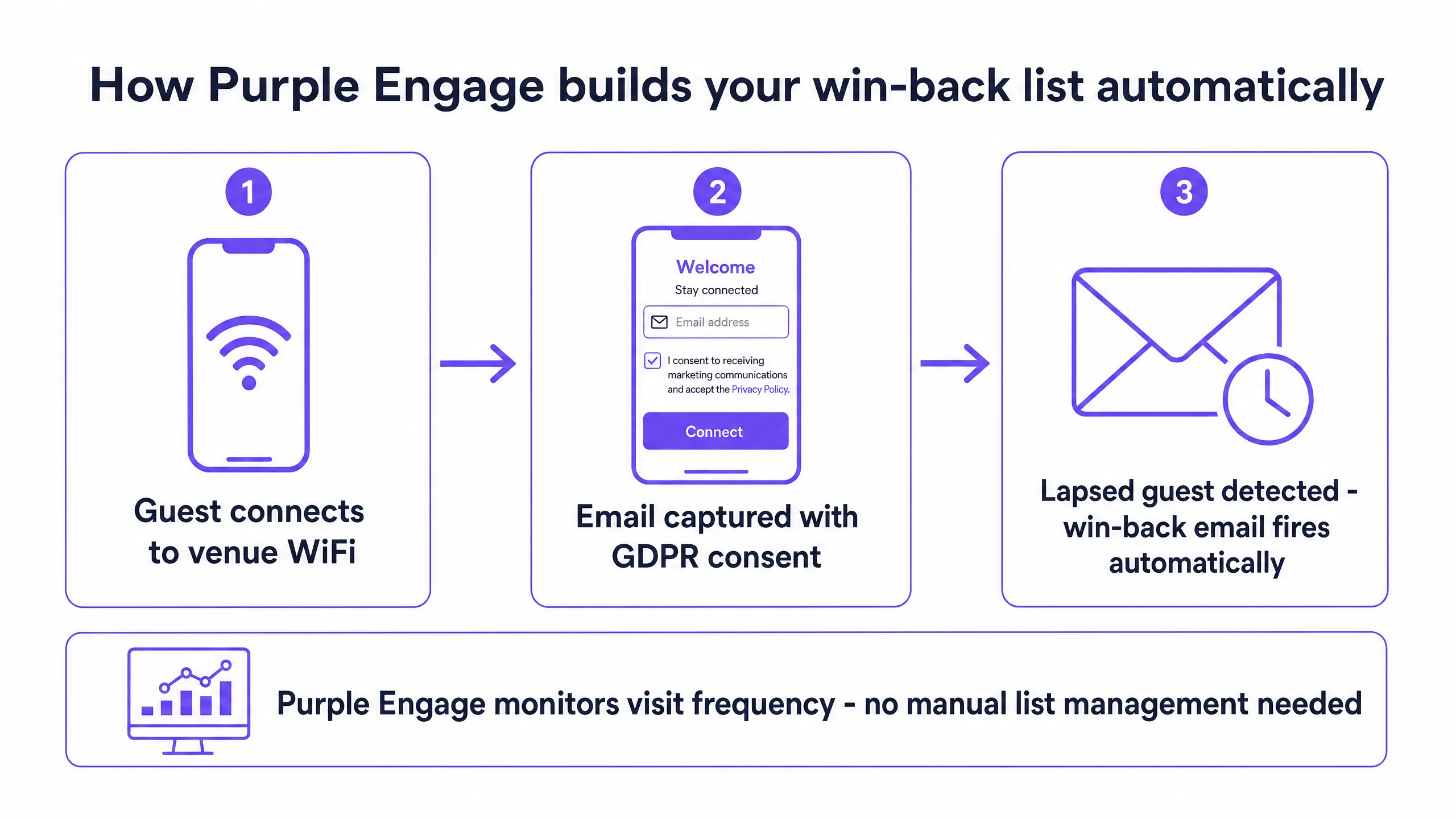
How Purple Engage builds your win-back list automatically, from WiFi connection to triggered campaign.
How to do it with your guest WiFi
Purple Engage connects to your existing hardware - Cisco Meraki, HPE Aruba, Ruckus, Juniper Mist, Ubiquiti UniFi, Cambium, Extreme, or Fortinet - as a cloud overlay. No hardware replacement is required.
The setup has four steps.
Step 1: Configure the captive portal. The portal captures the guest's email address and an explicit GDPR-compliant marketing consent checkbox. That checkbox must not be pre-ticked. Under GDPR, consent must be a deliberate, affirmative action. Purple Engage ships compliant consent flows out of the box, configurable per region and per venue.
Step 2: Enable email verification. Purple Verify checks the email address in real time before granting network access. Without verification, expect around 17% of captured addresses to be invalid. With Verify, database accuracy improves by 83% (Purple internal data). A clean list is the foundation of good deliverability and sender reputation.
Step 3: Set your lapsed threshold. This varies by venue type. For a coffee shop or fast-casual restaurant, 30 days is appropriate - these are high-frequency venues where absence is quickly meaningful. For a destination restaurant or bar, 60 days. For a hotel, 90 to 180 days, depending on your typical booking cycle.
Step 4: Connect to your email platform. Purple Engage syncs the lapsed segment to your existing email tool - Mailchimp, Klaviyo, HubSpot, Braze, Iterable, or any platform with webhook support. Your existing tool handles the send. Purple handles the data, the segmentation, and the trigger. For more on how to structure those segments, read our guide on Email segmentation for venues: a practical guide.
What to send, and when
Effective win-back campaigns use a staged approach. Each stage has a different tone, a different offer, and a different goal.
| Stage | Timing | Tone | Offer | Goal |
|---|---|---|---|---|
| 1: The nudge | 30-60 days | Informative | No discount - new content | Re-establish relevance |
| 2: The direct win-back | 60-90 days | Personal | Meaningful incentive | Drive a return visit |
| 3: The final chance | 90-120 days | Urgent | Best offer you can sustain | Last attempt before sunset |
Stage 1: The nudge (30-60 days)
At this stage, do not acknowledge the absence. Remind the guest of the value of your venue. Show them what is new - a seasonal menu, an upcoming event, a new product line. The goal is to re-establish relevance without being heavy-handed. A good subject line: "Something new is waiting for you at [Venue Name]."
Stage 2: The direct win-back (60-90 days)
Now acknowledge the absence. Use a clear, honest subject line. The offer matters here. For restaurants and bars, a free appetiser or complimentary drink often outperforms a percentage discount - a free item feels like a genuine gift and lowers the barrier to return. For retail, a no-minimum-spend free delivery offer or a 20% discount with a seven to 14-day expiry works well. For hotels, offer a value-add package (complimentary late check-out, a welcome drink, a room upgrade subject to availability) rather than a rate cut, to protect your Average Daily Rate. A subject line that works: "It's been a while, [First Name] - here's something to say we've missed you."
Stage 3: The final chance (90-120 days)
This is your best offer. Make it count. Be transparent: let the guest know that if they do not engage, you will stop sending them emails. This creates genuine urgency and protects your sender reputation by prompting a clean-up of disengaged contacts. Subject line: "Last chance, [First Name] - we're about to give up on you."
After stage 3, apply a sunset policy. Remove non-responders from the active list. This is not a failure - it is good list hygiene. Sending emails to unengaged addresses damages deliverability for every campaign you send.
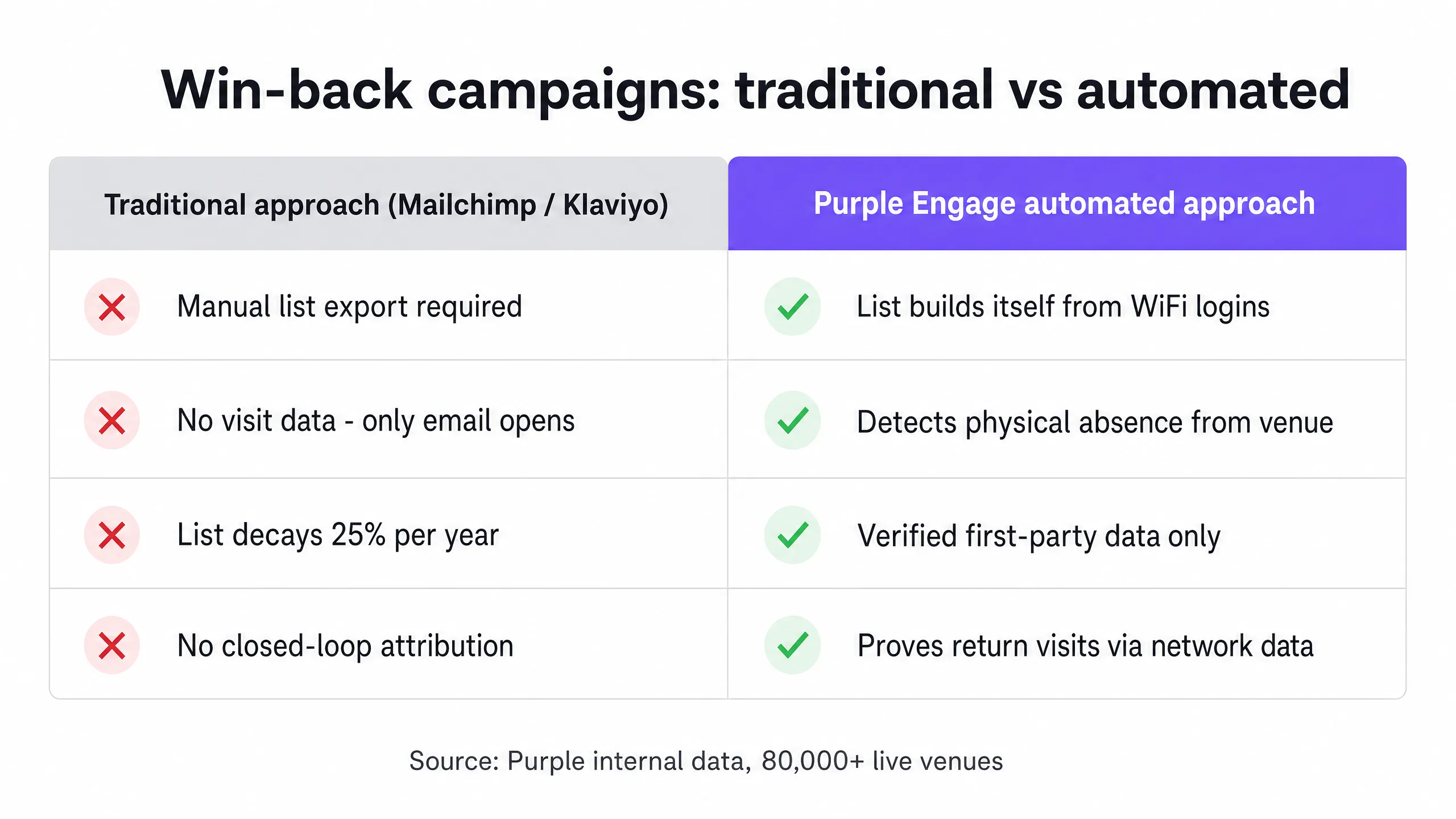
Traditional win-back approaches rely on manual list management and email-only signals. Purple Engage automates both the list and the detection using verified WiFi visit data.
Measuring what works
Do not measure success by email open rates. Apple's Mail Privacy Protection has made open rates unreliable - an email can register as "opened" when it was never actually read. Klaviyo's own 2026 benchmarks note this distortion.[^5]
The metric that matters for a venue win-back campaign is the physical return visit. Because Purple Engage tracks presence via the WiFi network, you can measure exact attribution: you know when the email was sent, and you know exactly when the guest walked back through the doors and connected to the network. This closed-loop attribution proves the revenue generated per send.
The metrics to track are:
- Return visit rate: the percentage of lapsed guests who physically returned within 30 days of receiving the win-back email.
- Revenue per send: total incremental revenue from returning guests divided by the number of emails sent.
- Reactivation rate: the percentage of lapsed guests who complete at least one transaction after the campaign.
- List health: the reduction in bounce rate and unsubscribe rate as a result of the sunset policy.
Industry benchmarks suggest that well-executed win-back campaigns recover 8% to 15% of inactive contacts.[^6] For a venue with 10,000 lapsed guests and an average transaction value of £25, recovering 10% of that list at one visit each generates £25,000 in incremental revenue from a single campaign cycle.
Where to start
Here is the ordered checklist to get your first win-back campaign live.
- Confirm your hardware is on the supported list (Cisco Meraki, HPE Aruba, Ruckus, Juniper Mist, Ubiquiti UniFi, Cambium, Extreme, or Fortinet).
- Activate the captive portal and configure it to capture email with explicit GDPR consent. No pre-ticked boxes.
- Enable Purple Verify to ensure database accuracy from day one.
- Set your lapsed threshold in Purple Engage (30 days for high-frequency venues, 60 to 90 days for destination venues).
- Draft the three-stage email sequence with escalating offers and a clear sunset message at stage 3.
- Connect Purple Engage to your email platform via native connector or webhook.
- Activate the automation and monitor physical return visits in the Purple dashboard weekly for the first month.
[^1]: Olo, "60% of Restaurant Sales Are From Repeat Guests," November 2024, based on 100 million+ guest records. [^2]: Invesp, "Customer Acquisition vs Retention Costs," 2026. [^3]: Emercury, "8 Strategies for Re-Engaging Inactive Subscribers," 2026. [^4]: GrowthWay Advertising, "The Best Re-Engagement Email Templates," 2025. [^5]: Klaviyo, "Email Marketing Benchmarks 2026," February 2026. [^6]: Chase Dimond, "Re-Engagement Email Examples," 2025, based on $200M+ in managed ecommerce email campaigns.